The post Driving customer-centric growth: Meet Sharon Biggar, our VP of Marketing appeared first on PriceLabs .
]]>At PriceLabs, our commitment to empowering our customers with the world’s best dynamic pricing solutions just got stronger. We’re thrilled to announce Sharon Biggar has joined us as our new VP of Marketing. Sharon is a dynamic and visionary leader with a wealth of global experience, and her arrival marks a new and exciting chapter in our journey. Her passion for data-driven strategy, deep understanding of product-led growth, and commitment to building world-class teams make her the perfect person to steer our marketing efforts into the future.
Sharon’s path to PriceLabs has been a truly global one. Her journey began in New Zealand with a degree in Music, a testament to her creative foundation. This was followed by a Master’s degree in Economics in Japan and a prestigious MBA from MIT in Boston. This unique blend of creative arts, analytical economics, and strategic business administration gives Sharon a distinctive and holistic perspective that she brings to her leadership role. Her career is just as diverse, spanning strategy consulting, entrepreneurship—where she founded her own data analytics company—and senior leadership roles in marketing, analytics, and sales. Her leadership of four successful product-led growth (PLG) companies demonstrates a deep understanding of how to translate data insights into actionable strategies that drive customer success.
When Sharon was looking for her next long-term “home,” she had a clear vision. She sought a company with an inspiring team, a great product that solves a real customer problem, an open culture that values experimentation, and a team with ambitious goals. We are incredibly proud and humbled that she found all of those things here at PriceLabs. Her decision to join us is a powerful endorsement of the product we’ve built, the culture we’ve nurtured, and the bright future we are all working towards.
What does Sharon’s arrival mean for our customers?
In her first couple of months, Sharon plans to dive deep into our product and immerse herself in the world of our customers. She will be engaging directly with our users to understand their evolving needs and challenges, truly. Her initial focus will be on leveraging these insights to optimize the customer journey and ensure our customer education and marketing are continually aligned with delivering maximum value and ROI for your rental business. You can expect to see her influence in how we communicate the value of Revenue Management, engage with the community, expand our educational resources, and gather feedback to refine our offerings further. Please join us in giving Sharon a very warm welcome. Her arrival energizes us, and we look forward to seeing the impact of her leadership as we continue on our mission to empower our customers with the world’s best dynamic pricing solutions.
Want to join the conversation and help her learn? Feel free to book a meeting directly with her via her Calendly link here.
Welcome aboard, Sharon!
The post Driving customer-centric growth: Meet Sharon Biggar, our VP of Marketing appeared first on PriceLabs .
]]>The post How PriceLabs Harnesses Generative AI to Simplify Your Revenue Management appeared first on PriceLabs .
]]>Understanding Generative AI
Generative AI, particularly in the form of Large Language Models (LLMs) is at the forefront of technological advancements in data interpretation. These AI systems learn from vast amounts of textual data to generate new content that mimics human-like understanding.
In the context of AI Insights, Generative AI processes existing data from our platform to produce concise summaries and insights that are easy to understand. This technology does not alter the data itself; instead, it helps highlight the most relevant information through clear, natural language.
Crafting AI Insights—The Role of Our Data Science Team
PriceLabs has introduced AI Insights to directly tackle the challenges that property managers and hosts face with complex data interpretation. This new tool transforms detailed, hard-to-digest data charts into clear and simple sentences, making it easier to understand key trends and market dynamics. This simplification helps users quickly see how their properties are performing and make informed decisions to optimize pricing and capitalize on market opportunities.
AI Insights is part of PriceLabs’ commitment to making sophisticated revenue management tools more accessible, supporting users in enhancing their operational efficiency and strategic planning. By offering straightforward summaries of complex data, AI Insights enables users to save time and focus more on implementing effective strategies rather than trying to interpret dense information.
The journey of AI Insights began with our skilled data science team, who combined their deep industry knowledge with advanced AI technologies. Their goal was to develop a tool that not only collects and analyzes vast amounts of data but also presents it in an easily understandable format.
By integrating Generative AI, our team enabled the platform to interpret and communicate data findings as if you were consulting with an expert analyst.
How AI Insights Works—A Closer Look
Why we could not use standard Generative AI models as they are
Off-the-shelf Generative AI models available today are capable of ingesting large amounts of data and presenting a text summary from that data. However, our team found that there were two problems with this approach:
- Generative AI models hallucinate. This means they sometimes present outputs that may not accurately reflect the data.
- Generative AI models lack domain knowledge. They frequently present a summary of data that is not insightful or actionable.
Our team realized that we’d have to add proprietary layers that incorporate industry understanding and revenue management domain knowledge.
For that reason, the integration of AI Insights begins with our powerful, proprietary analytics platform, which forms the backbone of our data analysis capabilities. The data is processed in real-time before being input into the Generative AI system.
The preprocessing step involves selecting competitive set data according to user selections on the dashboard. This data is then fed to our proprietary insights engine, which is trained to create/extract key features from this data.
Step 1: Integration with Proprietary Analytics
The integration of AI Insights begins with our powerful, proprietary analytics platform, which forms the backbone of our data analysis capabilities. The data is processed in real-time before being input into the Generative AI system. The preprocessing step involves selecting competitive set data according to user selections on the dashboard. This data is then fed to our proprietary insights engine, which is trained to create/extract key features from this data.
Step 2: Mechanics of the Generative AI
Generative AI within AI Insights uses a heuristic approach to prioritize data points based on their relevance, built on top of the domain knowledge of Revenue Managers and Data Scientists.
Step 3: Development of the Interpretation Layer
The interpretation layer, a crucial interface between the raw data processed by our analytics and the output delivered to users, employs Natural Language Processing using Large Language Models to convert analytical data into comprehensible text.
Step 4: Outputting Textual Data Insights
Outputs are generated in the form of simple sentences and summaries, providing insights such as, “Expect a 20% increase in bookings next month.” Extensive fine-tuning is done to obtain accurate insights/outputs in the various locales we support. To continuously improve this feature, we have added a feedback section. This will be utilized to further fine-tune the output based on how users perceive these insights. In the beta launch, about 90% of users have already found it valuable.
User Interface and Interaction
At first, users will discover AI Insights through the Neighborhood Data tab. On the Future Prices and the Occupancy charts, they can click a button and immediately get a summary of the key market trends and competitive ranking for each of their listings.
Conclusion
AI Insights represents a significant advancement in revenue management technology, crafted specifically with your needs in mind. By turning complex data into simple explanations, PriceLabs aims to free up your time and increase your operational efficiency. Experience the benefits of AI Insights and see how it can transform your approach to managing properties effectively.
Embrace the future of hosting and property management with AI Insights. Learn more about how our Generative AI can help you achieve your revenue targets. Start your free 30-day trial and experience the benefits firsthand.
The post How PriceLabs Harnesses Generative AI to Simplify Your Revenue Management appeared first on PriceLabs .
]]>The post Overview of PriceLabs’ Dynamic Pricing Algorithm (Part 2) appeared first on PriceLabs .
]]>In Part 1 of our Dynamic Pricing Algorithm Overview, we reveal how we calculate optimal prices for any future date by forecasting its occupancy, estimating the probability of booking, and finding the price that maximizes the expected revenue.
The first part goes into why prices should be different by season, day of the week, how the market is pacing, and if there is a demand spike due to a holiday or event. If you have not read Part 1 yet, we recommend reading it before diving deeper into this article.
We now come to the last part of our algorithm: Rate Evolution, or how prices for a future date change over time. There are two main reasons why our price recommendations change over time.
Evolving forecast: Our forecast for a future date can change every day as we get new information. The chart below shows how our forecast for April 14, 2023 in the Phoenix market evolved in the preceding months. We see a sudden jump in the forecast after November 2022. Taylor Swift announced her Eras Tour dates for Phoenix, AZ. During August – October 2022, our market forecast had been reducing because the area were pacing behind previous year trends, picking up on the early signs of the slowing economy. But soon after the Eras Tour announcement, the pacing trend reversed, and our forecast jumped up by roughly 25%.
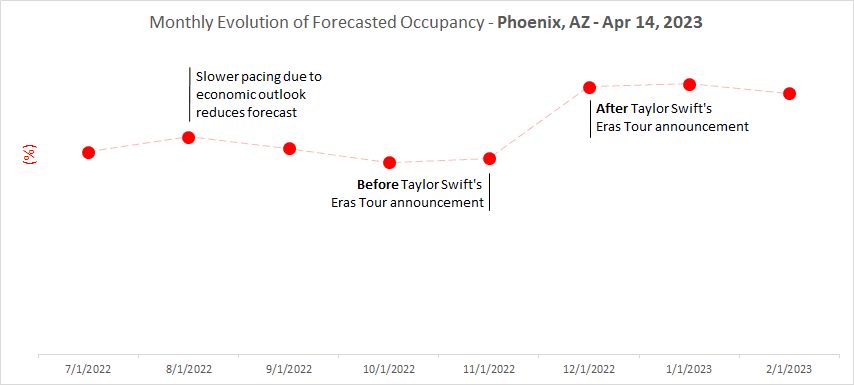
Note: The chart showing the monthly evolution of the forecast is for illustrative purposes only. The forecasting engine that powers wer dynamic pricing runs daily.
Remaining booking opportunity: In the example above, it is clear to anyone looking that as the forecast jumped up after the Eras tour dates were announced, the optimal prices should also jump up. But it is less clear how rates should evolve if our demand forecast for a date doesn’t change.
The upcoming sections help build the intuition around why and how the rates should evolve as we get closer to the stay date.
Why should prices change with lead time?
Our customers often ask us why our price recommendations are usually high for a far out date and reduced over time. We learned in the previous article that the probability of booking for a future date is tied to the forecasted occupancy.
For example, if the forecasted occupancy is 90%, and no bookings have happened. We expect 90 properties out of 100 similar properties to get booked. At that moment, we can pick a high price, given that most properties in the market are expected to be booked.
Let’s fast forward to 3 months out and say 80 properties are now booked. The market is pacing as expected, and we’re still forecasting 90% occupancy. This means that out of the remaining 20 properties, only 10 are expected to get booked – a 50% probability of booking.
While the overall market outlook hasn’t changed (we’re still expecting 90% occupancy), if wer property hasn’t been booked yet, the chances of it getting booked now while holding the same price have dropped. So, we might want to lower rates to increase expected revenue.
Unlock 7: Rate Evolution
Thus, we need to introduce “lead time” to the calculation of the probability of booking at different price points.
Let’s use another example to understand this better. Consider a scenario where:
- We can change prices 3 times at the following booking windows – 360, 240, and 120 days.
- Prices can be either 200, 400, 600, 800 or 1000.
- No one books more than 360 days in advance.
- The probabilities of booking at each booking window are in the table below.
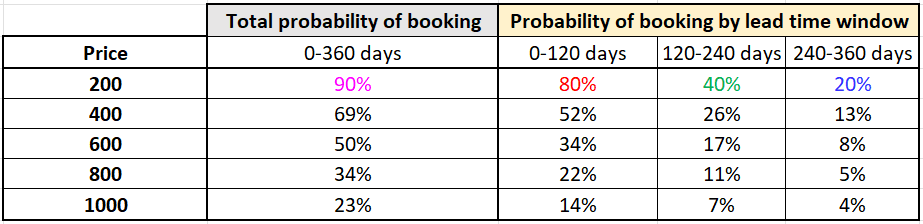
As we’ll notice – we now have access to what the probability of booking is in different booking windows. The total probability of booking at a price can be derived from the individual booking window probabilities.
For example, for a price of 200 -> the total probability of booking can be calculated using the formula below

Scenario 1: we can only set prices once
Let’s now calculate the maximum expected revenue in the two scenarios below.
In this case, the revenue maximizing price would be the one where the multiplication of the first two columns (price and the probability of booking at the price) is the highest. The price point of $600 provides the highest expected revenue of $300 ($600*50%). If we were only allowed to set a price once, $600 is what we’d go with!
Scenario 2: we can change the prices 3 times
Finding the optimal set of prices can be computationally challenging given the sequence of decisions with multiple possibilities and conditional probability. There are 5 possible prices for each of the three booking windows. That makes the total number of possibilities to explore 5*5*5 = 125 possibilities.
Now imagine if we had the same 5 and prices for the future date that is 360 days away. But now we can change the price daily. The number of possibilities now is 5^360. A very large number that’s difficult even for the fastest computers to solve!
The easiest decision to explain is the price 120 day booking window. At 120 days, the revenue-maximizing price can be calculated by multiplying the prices by the probability of getting booked 120 days out. In this case, 400 is the revenue-maximizing price for this window.
For 240 days booking window, we not only have to consider maximizing the revenue that can be made by selling in that window, but also the possibility of not selling and selling in the 0-120 day window. We don’t want to sell for too cheap now when we can possibly sell for $400 in the future. Optimizing this can be an involved exercise, but thankfully, this is a well-studied area of mathematical optimization. We solve this computation problem using the Bellman Equation.
We are providing an optimal solution to show that the expected revenue is more than what we’d find in Scenario 1.
The optimal set of prices below gives an expected revenue of $303:
- 360 days out: set to $800
- 240 days out: set to $600
- 120 days out: set to $400
Scenario 2 gives an expected revenue of $303 vs scenario 1 with an expected revenue of $300. Thus, scenario 2 performs 1% better.
While the above example showed a fairly modest 1% revenue gain from changing prices, our experiments with real data show the gains from correctly using last-minute discounts to be around 9%. The difference comes from the fact that our algorithms aren’t just changing prices 3 times a year, but doing it every day.
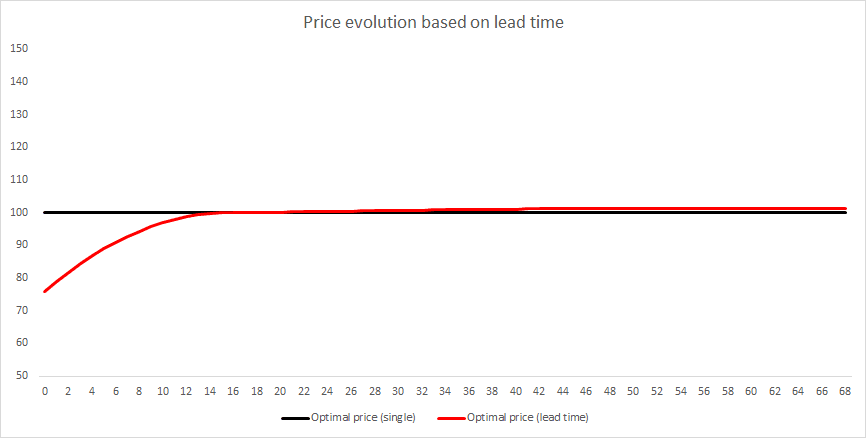
Note: we’ll notice that the price for the 0-120 day window has a discount on the optimal price from scenario 1, while the price for the 240-360 day window has a premium on the optimal price from scenario 1. Our algorithm automatically calculates these as lead time changes.
Increase prices at the last minute?
Yes! The above example assumes that our demand forecast is known at the beginning and doesn’t change. In reality, as we saw with the Taylor Swift Era’s concert, or economies slow down, a lot can happen as a date gets closer.
Prices can increase as a date gets closer if the market is booking up faster than our forecast. It can also happen when there is a significant difference in the price sensitivity of last-minute and early-bird bookings.
Why do Airlines do it differently?
While both Airlines and Vacation Rentals are a part of the travel industry, the market dynamics are very different.
Vacation rentals are close to “perfect competition” – for a potential guest, many options are available. In addition, the ownership of these options tends to be fairly fragmented – even in markets where a large manager manages most of the inventory, the revenue from a booking on one home isn’t shared with another homeowner.
Airlines are an oligopolistic market. There are only a few viable options on most routes from one city to another. Additionally, when we factor in last-minute business travel, three additional factors weigh in – loyalty programs that mean travelers are more likely to choose their preferred airline; enterprise sales contracts that mean large businesses exclusively book their employees on tends to their preferred airlines; and the generally lower price sensitivity of business travelers. All these mean that the revenue-maximizing decision for Airlines is frequently to keep prices higher at the last minute, even if that means a few empty seats. Unlike homes, the total revenue of the plane is what matters, not that each seat maximizes its revenue.
Far out premiums in vacation rentals serve another important function: when a date is very far out and the booking volume is low, there is an inherent margin for error in the forecast. We can do our best based on the data available, but lot of events can impact demand for a future date. Far out premiums serve as a hedge against such events, especially when the dates are far enough that not much of the demand was booking anyways.
Final note:
Setting prices to be dynamic for each future date is not a one-time exercise. Our data science team has found that even when the forecast is stable, the right far out premiums and last minute discounts give a 11% boost to revenue on average.
PS: We have some interesting insights on how the last-minute discounts should vary by market and by season – read this blog.
As we conclude our exploration of the dynamic pricing algorithm, we hope this article has shed light on the intricate process of optimizing your property’s rates. If you’re ready to experience the benefits of dynamic pricing, we invite you to give PriceLabs a try – Start your Free Trial. Whether you’re a seasoned property manager or just starting out, our algorithm is designed to empower you.
If you have any questions about the above or PriceLabs in general please do reach out to our support team and they will loop us in!
Back to building,
PriceLabs Data Science Team
The post Overview of PriceLabs’ Dynamic Pricing Algorithm (Part 2) appeared first on PriceLabs .
]]>The post Breakthrough Release – Founders’ Perspective appeared first on PriceLabs .
]]>PriceLabs’ journey started nine years ago, but the current release is a journey we started about two years ago. We were a team of roughly 30 folks in 2021 (now nearing 150) who had recently gone through significant market shifts – COVID and then the VR boom in the US and had collected enormous amounts of data.
During this phase, we realized that the way we and many other solutions price accommodation rentals does not quite work. We released our first algorithm in 2014 and, over time, had made significant improvements to it, but it was time to step up and create something to better serve the needs of our growing customer base!
Over the last two years, we spent an enormous amount of time overhauling most things at PriceLabs, from Data Collection, Storage, Computational models, Algorithmic models, engineering stack, etc. To say that it’s been a journey would be selling it short.
But these changes (plus sweat, tears, and frustration) bring us to our current Breakthrough Release! We are excited to introduce what we think is a paradigm shift in how Vacation and short-term rentals price their properties!
The New Algorithm: Hyper Local Pulse
The new algorithm is a revolutionary change in how revenue management algorithms have worked in the past. HLP delivers a 26% lift in RevPAR!
What’s the secret? Our top-of-the-line engineering and data science team.
Over the past several months, HLP has consistently proven to be a game changer through experimentation testing.
HLP uses hyper-local comp sets, as evident from the name, along with state-of-the-art forecasting and dynamic programming to deliver these results.
For all new users, this is automatically live. We’ll be making this gradually live for existing users, as some of you’d need to change some of the existing settings to use the new algorithm (and we want to make the transition process easy!).
You can read about how the algorithm works here and the benefits it delivers here.
As a part of this update, we also announce several new data, intelligence, and analytics-related features. Some of these are below:
- Market-driven Last-Minute and Far-Out Customizations
- Seasonality Customization
- Performance metrics
- Customizations for Multi-Units (Hotel Weights, Hotel Compsets)
- Pacing charts and booking charts in PA – released earlier this year
- Hotel Data with LOS- released earlier this year
- STR Index and Revenue Estimator
All of the above have come as a precursor to or as a result of the work that we have done for HLP. There are many more things in store. Combined with HLP, these serve Property Managers and Hosts alike because they reduce manual intervention and provide analytical tools to understand your market and intervene quickly.
We have been jointly delivering several solutions focused on large property managers who use PriceLabs. Some of these are below:
- Team Management
- Sub-groups
- Data access via CSVs and API
PriceLabs has been the preferred solution for large property managers for its flexibility, and we are adding many more capabilities. We have dedicated onboarding consultants looking to build solutions tailored to large PMs.
Whether you are new to PriceLabs or have looked at PriceLabs in the past, we urge you to take a fresh look at this Breakthrough release. You can find more about it:
- By visiting the Release Page
- Or registering for our Webinars
This milestone is only possible and is complete with our customers, partners, and team. This is a journey, and we are only getting started.
Thank you for all the support and love! – Anurag, Richie, Sana
The post Breakthrough Release – Founders’ Perspective appeared first on PriceLabs .
]]>The post Last Minute and Far Out Pricing: Observations from our Experiments appeared first on PriceLabs .
]]>Our Data Science team has been hard at work to build Hyper Local Pulse algorithm. While doing so they have unearthed some fascinating insights that could help you with how you approach pricing, especially when it comes to last minute prices and far out prices.
1. Perceived Value Trumps Low Prices
Picture this: you decide to offer your vacation rental at an unbelievably low price, almost too good to be true. But to your surprise, bookings don’t come pouring in. Why? The answer lies in the concept of “perceived value.” Unlike commodities with standardized quality, vacation homes are booked based on perceived and physical quality. Price serves as a signal of quality. If your price is too low, potential guests may question the quality, and you may not sell every night. It’s all about finding that sweet spot between affordability and quality.
2. We Sell Perishable Inventory
PriceLabs’ analysis of several markets reveals a straightforward pricing strategy: reduce prices as the booking date approaches. The logic is simple; as each day passes without a booking, your chances of getting booked decrease. This insight powers last minute discounts and far out premiums, helping you optimize your revenue.
3. The Airline Way of Last Minute Price Increase
Does it ever make sense to increase prices as a date gets closer, similar to how Airlines do it?
Yes, in exceptional scenarios – when your market’s forecast changes because of a sudden unexpected surge in demand, the forecast is revised upward. This means that even with less time remaining, the probability of booking increases.
Usually, as noted in second point, for short-term rentals, it usually makes sense to reduce prices as a date approaches. Airlines increase prices for a different reason – they are in an oligopolistic market (and when you factor in business travel where loyalty programs factor in a lot, even closer to a monopolistic market). On the other hand, short-term rentals are much closer to perfect competition and thus see a very different lead time dynamic.
4. Tailoring Discounts to Market Dynamics
Urban markets often have shorter booking windows, suggesting that discounts should kick in closer to the booking date and not too early. For instance, in the case of 1BR vacation rentals in Chicago, PriceLabs’ optimization recommends starting last minute discounts at closer to check-in date rather than following a general approach to all markets.
5. Flexibility by Market and Season
Not all markets and seasons are created equal. In traditional vacation destinations where bookings happen far in advance, aggressive far out premiums may not be your friend. Even for last minute discounts – you may want to start those early relative to urban markets!
6. The Seasonal Surprise
Here’s a surprising twist: in highly seasonal markets, the data suggests that both low and high seasons tend to have smaller last minute discounts compared to the shoulder season. In the low season, the algorithm already recommends lower prices. Probability of getting a booking doesn’t change dramatically as we get closer to check-in date. On the other hand, in the high season, most competitors are likely to be booked. Hence, your probability of getting booked doesn’t decrease dramatically with time – thus a case for small last minute discounts.
Let the Algorithm Work for You
In an industry-first, the beauty of HLP algorithm is that it takes these market and season-specific nuances into account. You don’t need to constantly update your last minute discounts or far out premiums; the algorithm does the heavy lifting for you!
Of course, you can always override the algorithm if a different strategy aligns better with your portfolio.
In conclusion, pricing your vacation rental doesn’t have to be a daunting task. With the power of data and insights from PriceLabs’ data science team, you can make informed decisions and optimize your revenue. Remember, it’s not just about low prices; it’s about finding the right balance to signal quality and capture bookings.
Unlock the potential of your vacation rental pricing with PriceLabs’ cutting-edge algorithms.
The post Last Minute and Far Out Pricing: Observations from our Experiments appeared first on PriceLabs .
]]>The post Overview of PriceLabs’ Dynamic Pricing Algorithm (Part 1) appeared first on PriceLabs .
]]>The document below may get a little technical, but it will help you understand the “black box” of where our Dynamic Pricing recommendations come from. You don’t have to read this to understand how to use PriceLabs, but if you were inclined to learn about algorithms – then strap in!
To help you learn how to use the product – we have daily live onboarding sessions, training videos on YouTube, and a detailed knowledge base to help you use PriceLabs effectively. But if you wanted to get technical and dive into the world of math to understand how the recommendations are calculated – this would be a great read.
Word of caution: This is a technical read with engineering, mathematical concepts, and graphs.
Unlock 1: Data collection
Data: The new oil!
We get information about your property from your property management system or Airbnb / Vrbo if you directly integrate those. This data helps us understand where your listing is located, listing-related details (e.g., bedroom count, how many it sleeps), its future prices, its reservation history, and availability.
Using market data to price your properties is at the core of PriceLabs. We scan various booking portals and direct data sources to build a unified understanding of what’s happening worldwide.
Currently, we scan over 10 million individual units from Airbnb, Vrbo, and Booking.com. In addition, we get direct source data from Key Data to understand actual booking patterns.
You may have likely heard that scrapped data is not clean and thus not good. This is mainly said because scraped data can have owner blocks – so you don’t know if it’s a booking or a block. We apply block removal logic techniques to determine whether a booking on scrapped data is a block or a booking. Some examples include market-wide bans – long bookings with the same start and end date across listings, listing level repeated patterns, price anomalies, etc.
Unlock 2: Hyper-local compset
Neighborhood fetch: Devil lies in the details!
We have found that even listings in the same city can have significantly different market trends depending on their location, resulting in completely different seasonality, day-of-week patterns, and events. Because of this, we focus our modeling on prices on hyper-local data that allow us to capture trends that are potentially unique to a small pocket of listings.
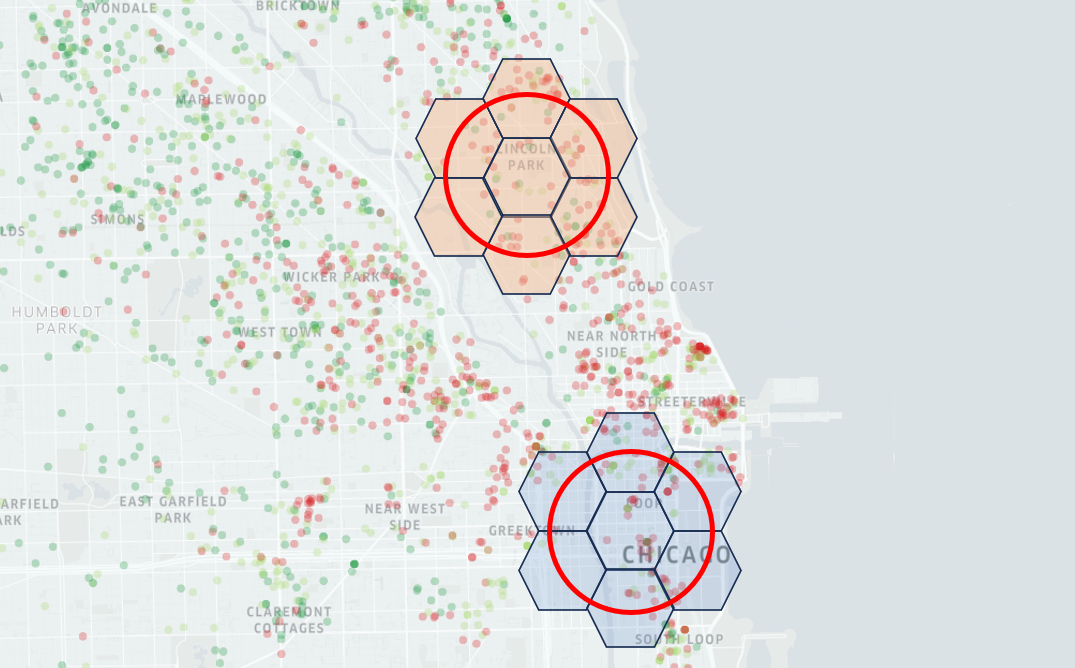
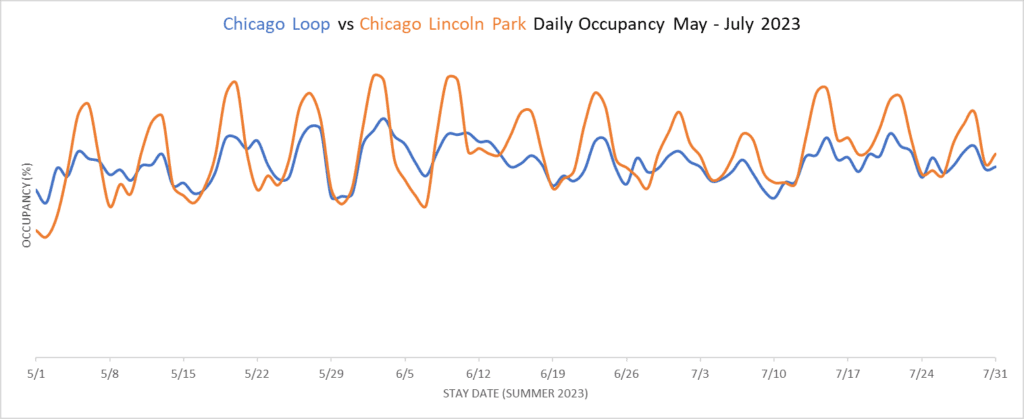
Example: Let’s look at an example of two Chicago neighborhoods: Loop and Lincoln Park. They are only 4 KM (2.5 miles) apart from each other. But when we look at the data, day-of-week patterns for the two neighborhoods are very different. This primarily comes down to Chicago Loop being the business district with stronger mid-week demand from business travelers, while Lincoln Park attracts more tourist demand as there aren’t many offices there.
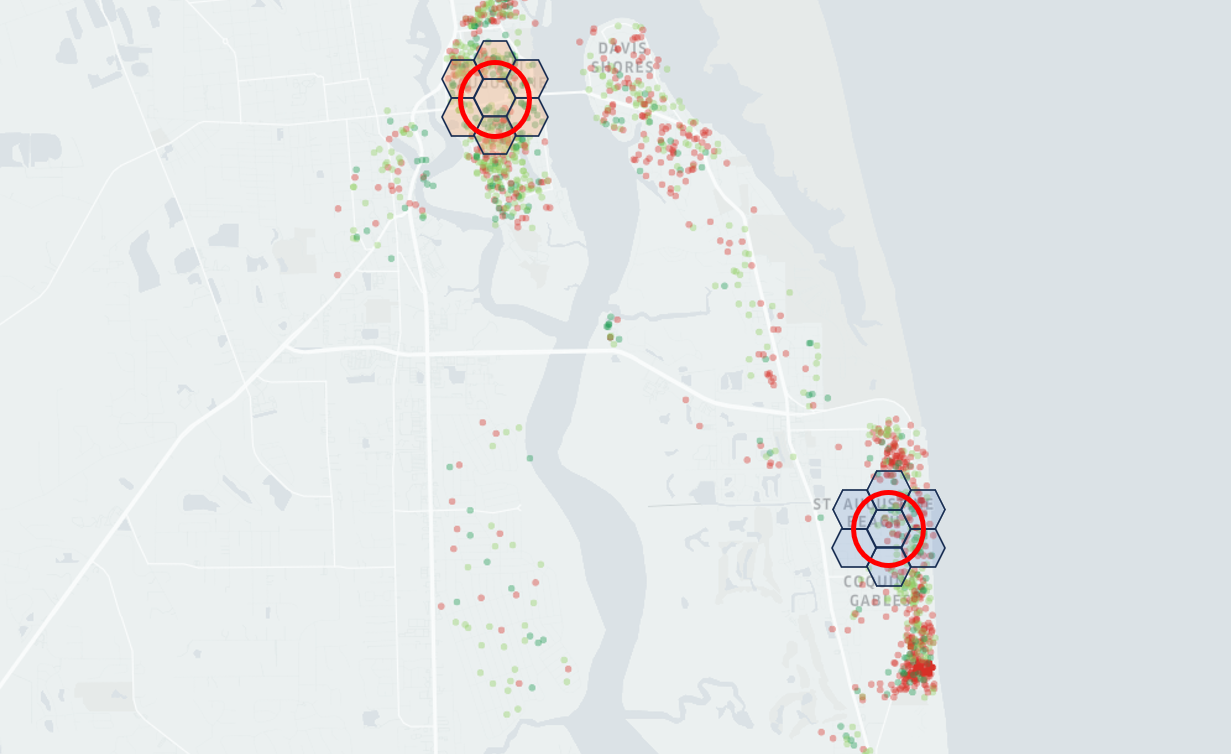
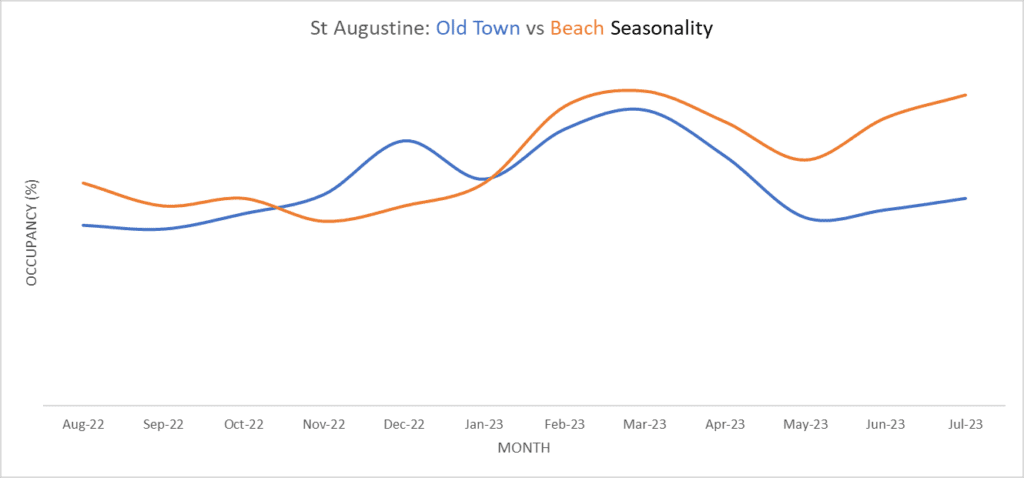
Example: Let’s now look at St. Augustine, FL. This time we are looking at Beach and Old Town. Even though they are only 8 km (5 miles) apart, the seasonality is quite different.
As seen in the chart below, the Old Town area has a Christmas peak while the Beach area has a Summer peak.
The above examples and many others led us down the path of building our new pricing algorithm, Hyper Local Pulse (HLP).
We now look at a hyper-local market on Airbnb or Vrbo to price a specific property. This is defined by 350 similar-sized nearby listings in a maximum radius of 15km – The actual radius is determined dynamically.
From Pedro, Sr. Data Scientist: “At the heart of everything we do at PriceLabs is high-quality data. But having data isn’t useful if you can’t query and find trends in it at lightning speed. Our most challenging data engineering requirement is that our data needs to be as online as possible to reflect the current state of a property’s hyper-local comp-set because updated data means that our algorithm can react quickly to market changes. Using H3, we’re almost instantly incorporating new listings to our dataset.”
We initially solved for creating hyper-local compsets by hosting a Ball Tree index with low latency but batch-processed, which introduced some lag in our data. We eventually replaced this setup by using H3 indexes instead. H3 is a discrete global grid system that Uber developed, allowing us to efficiently narrow down our search space before solving the K-Nearest Neighbors (KNN) problem. and using this strategy, we can guarantee that our search is constantly being done on the best available data.
In our quest for more accurate pricing insights, we’ve learned that different neighborhoods within the same city can exhibit unique property market trends. To address this, we’ve introduced our innovative pricing algorithm, Hyper Local Pulse (HLP). HLP focuses on hyper-local data, enabling us to capture distinct trends within small pockets of listings. We define a hyper-local market as 350 similar-sized nearby listings within a dynamically determined radius of up to 15km, using H3 hexagons to ensure real-time data updates. This approach has replaced our previous method, providing more precise and up-to-date property pricing insights.
Unlock 3: Demand Forecasting
Beyond Guesswork: Embrace the power of data science.
Forecasting is a fascinating problem and is at the core of our dynamic pricing recommendations. When it comes to forecasting, we take a scientific approach to “What Would A Revenue Manager Do.”
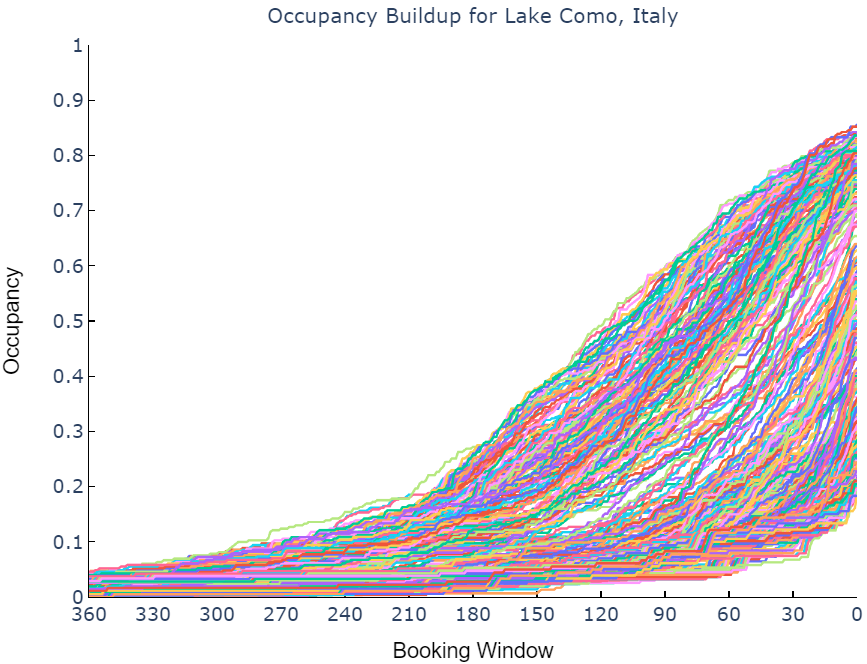
Let’s look at the image below that shows booking curves for Lake Como (Italy) – each line here represents the occupancy evolution for a date in the past. As you’d imagine, each date has a different booking curve.
The final occupancy of each date can be seen at the far right, where the occupancy ranges from 15% to 85%. Some dates show no occupancy 150 days out, while others start showing occupancy even as far as 300 days out. While each date has a different booking curve, some are “bunched” together, exhibiting similar booking patterns.
When forecasting demand for a date in the future “future date” (df), the first puzzle to solve is to find past “reference dates” (dr1,..,drk ) whose booking trends the future date is expected to follow. There are many options for selecting reference dates, such as:
- Same season
- Same day as week
- Holiday dates, or event dates,
- and even similarity scores calculated using the shape of the booking curve as of today.
This is a massive data science lift, especially at PriceLabs’ scale. This experimentation took us several months to find the right mix and the reference date. This is the science part of crystal ball forecasting!
We use the reference dates to understand how a future date is expected to book.
Many revenue managers get this part, though it is incredibly time-consuming. The exercise becomes easier, especially if you have prior year data for a listing or a market.
The next step is where continuous refinement of the forecast happens – the reactive part of what’s happening in the market. As the future date gets closer to the stay date, we use two fundamental revenue management metrics to adjust our forecast: Pacing and Pickup.
- Pacing represents the current occupancy of the future date compared to our reference dates at the same booking window. Think of this as “speed” – am I booking faster or slower than in the past?
- Pickup represents how fast (or slow) bookings are currently coming in. Think of this as “acceleration” – we might be pacing behind compared to the past, but recently, we are getting a lot of bookings, and we can surpass the past reference date occupancy soon.
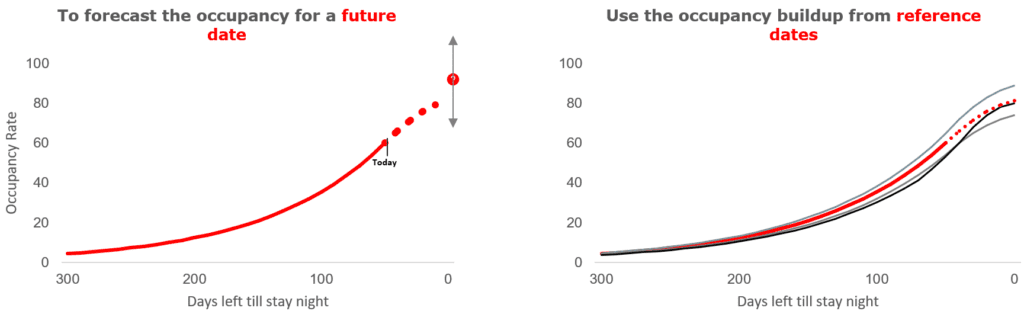
Mathematically, the forecast for a date is a function of our reference dates’ final booking curve and the future date’s booking curve till today. Many revenue managers look at the charts above manually daily to make an educated guess about the future.
Our algorithms do this at scale – daily, infallibly, and automatically. Instead of guessing, we measure what the function might look like for the forecast error to be low.

We process approximately 1 million data points every time we update rates a listing. We take immense pride in this as it involves extensive data engineering to do this in real time.
Unlock 4: Demand Elasticity
You likely know about elasticity from WSJ, Freakonomics podcast, or economics class.
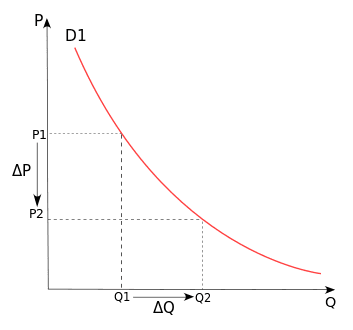
Economists use demand elasticity to measure the change in demand you can expect when you adjust the price up or down. It’s instrumental in production processes, for example – how many cars to produce. Cars, commodities, flight seats, etc., are generally available in large quantities, and demand generally means how many individual units can be sold.
But how do we understand how demand changes for vacation rentals with price? There is only one unique vacation rental – you can sell a night or not (100 % occupancy or 0% occupancy).
9 years ago, when we built our first algorithm, a literature survey led us to our first aha moment: instead of using “number of units expected to sell at a specific price” as demand, this problem required thinking of demand as “probability of getting booked” (PB) at different prices.
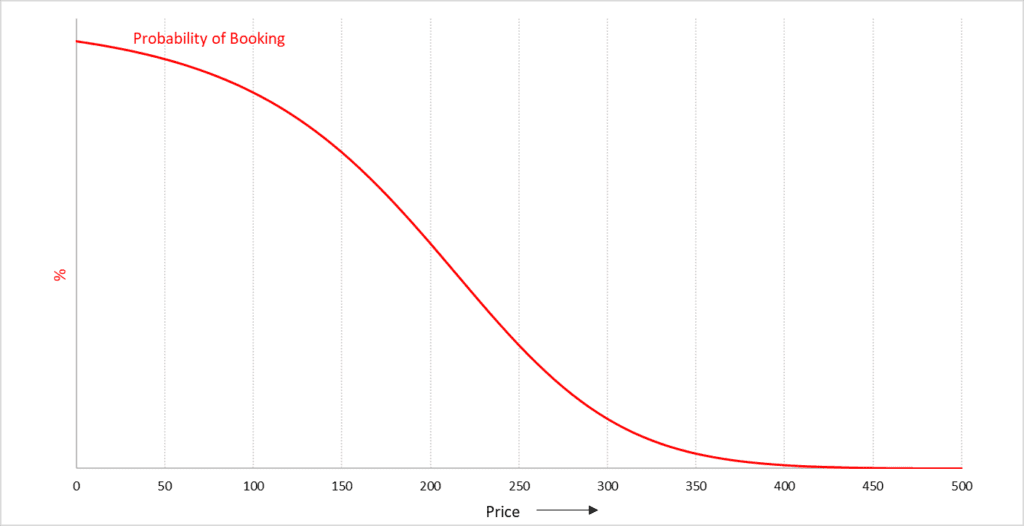
The probability of getting booked differs for each date for various price points; even for a given date, it changes over time. As the demand forecast changes, the probability of booking at a specific price changes.
We estimate market elasticity for each date in the future, as the underlying market factors like demand forecast, market prices, and demand sensitivity differ for each date. The market’s elasticity must be translated into your listing’s unique elasticity curve, determining your probability of booking at different prices.

The charts below show how elasticity can vary depending on the market sensitivity and demand forecast, both of which depend on how the market is evolving for a future date. The impact of market prices is absorbed in the scale on the x-axis.
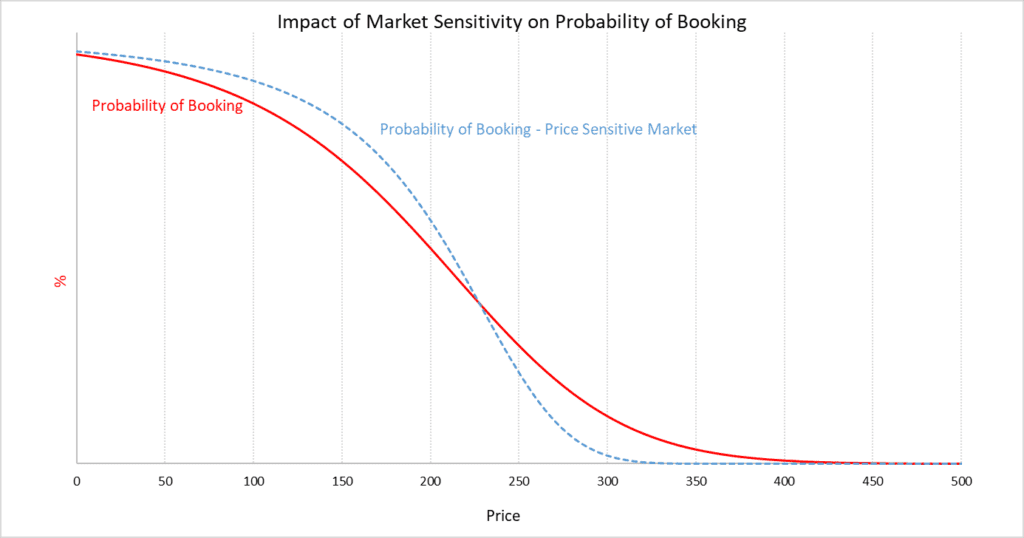
Probability of Booking as a Function of Market Sensitivity: The chart above shows two estimates of the probability of booking – the red one is identical to the first elasticity curve we showed above. In comparison, the blue curve represents a market that’s more sensitive to prices and, therefore, has a steeper slope at “normal” prices. Decreasing the price a little bit from the base price results in a much higher chance of booking, and increasing it a little bit greatly reduces it. We estimate the right price sensitivity for every hyper-local comp-set and future date. This is very evident in mountain markets, where the market is a lot less price sensitive in the Ski season than in the Summer season. However, the overall demand forecast is similar.
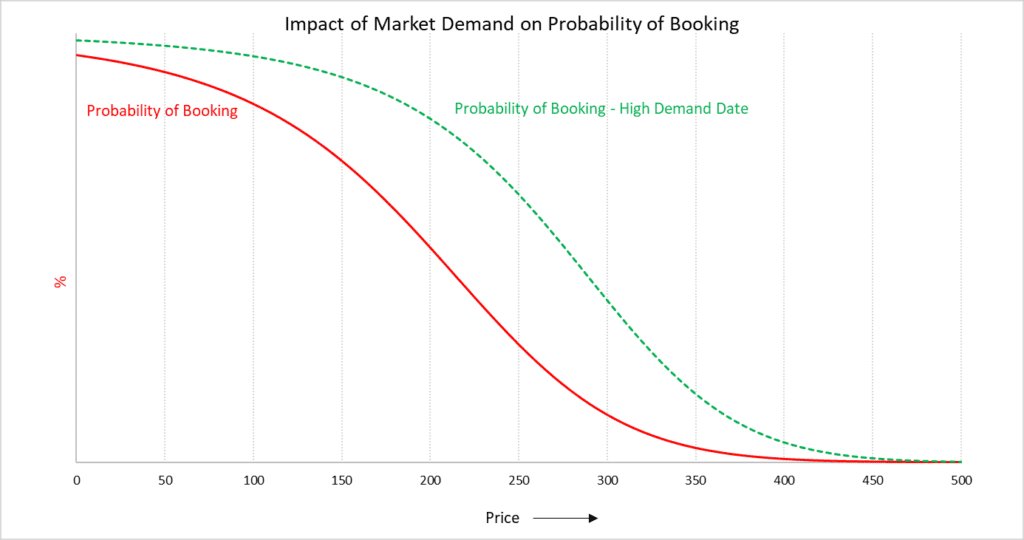
Probability of Booking as a Function of Demand Forecast: In this chart, the red line shows the probability of booking on a normal day, while the green curve shows the probability of booking on a high-demand date. Notice that the overall slope around the “normal” price is similar, but the entire curve is shifted to the right. This means that if you just hold your price steady on a high-demand date, the probability of getting significantly booked increases.
You’ll notice that at very low prices, the probability of booking doesn’t keep climbing up. In other words, even if the price is reduced to close to 0, it doesn’t guarantee a booking! This is because of multiple factors, but an important one is “perceived value.” Commodities (like oil) have globally acknowledged quality standards. Thus, very low prices result in very high demand.
But vacation homes don’t have a standard measure of quality. Guests book homes based on perceived quality and physical quality (photos and amenities). In such scenarios, price acts as a signal quality.
So, if you sell for very cheap, you may not sell every night (and would make a lot less – something we’ll see next!). These elasticity curves help us estimate how the market will react to price changes within your comp-set for every future date.
Unlock 5: Revenue Maximization
Once you understand the probability of a future date booking at a given price, the optimal price P’ is the price that maximizes the “expected revenue” (ER).

You can use the good old calculus book to differentiate the expected revenue function above or work through each possible price point and see which ones maximize your “expected revenue.”
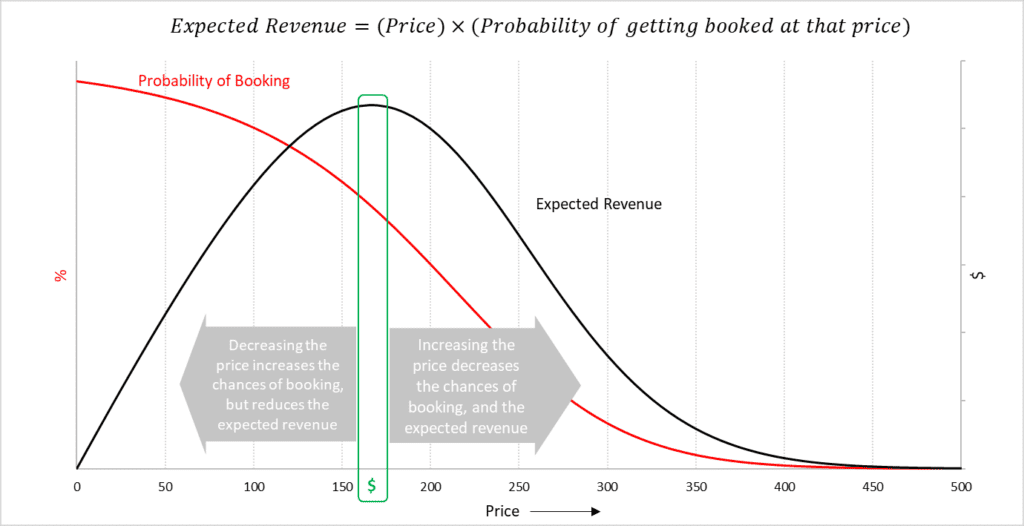
The chart above shows that at low price points, booking probability is high, but little to no money is made. On the other hand, at very high price points, booking probability is so low that we’ll not make any money again. The sweet spot is highlighted by the box where the expected revenue peaks.
In this first part of Dynamic Pricing Overview, we explored how PriceLabs calculates prices for any given day, one day at a time. The next challenge is how booking opportunities and, thus, rates will evolve. Say we are looking to price a date that is 365 days out, To optimize revenue, prices need to be updated daily for each of the 365 days in the future. This means that instead of finding a single optimal price, you need to determine a series of optimal prices over time, resulting in a sequence of price decisions.
This is a complex problem to solve. We use Dynamic Programming techniques to tackle the challenge of setting optimal prices over time, considering changing booking opportunities, frequent price adjustments, and the vast number of possible price combinations. We cover this in part 2 of this blog series.
If you’re ready to experience the benefits of dynamic pricing, we invite you to give PriceLabs a try – Start your Free Trial. Whether you’re a seasoned property manager or just starting out, our algorithm is designed to empower you.
If you have any questions about the above or PriceLabs in general please do reach out to our support team and they will loop us in!
Back to building,
PriceLabs Data Science Team
The post Overview of PriceLabs’ Dynamic Pricing Algorithm (Part 1) appeared first on PriceLabs .
]]>The post PriceLabs’ Minimum Stay Recommendation Engine Algorithm appeared first on PriceLabs .
]]>You can now fully automate your minimum stay rules with Dynamic Min Stay, a powerful new feature that applies our data-driven recommendations directly to your listings. These recommendations adjust automatically based on seasonality, market trends, and listing performance—no more guesswork required.
This article dives into how our model behind Dynamic Min Stay has evolved, what’s powering the latest recommendations, and how they help you drive more revenue with less effort.
Improved Min-Stay Recommendations
Minimum stay rules are powerful levers for maximizing both revenue and occupancy. That’s why we developed our Minimum Stay Recommendations to help you set the right rules for your listings. With the launch of our new Dynamic Min Stay feature, you can now automatically apply and update these recommendations in real time.
In this post, we highlight how we have continually improved our model over time. While the rest of this post will end up being a peek under the hood of the model and a bit more on the technical side, the TL;DR summary is:
- Improved data and algorithms make the model stronger and the generated recommendations better
- Dynamic Min Stay led to an increase in revenue and decreased operational costs when compared to using flat Min Stay rules
Background
In 2017, we introduced our dynamic minimum stay settings, which quickly gained popularity. The ability to adjust minimum stay requirements based on lead time and automatically open up availability for shorter stays was a novel revenue optimization feature. It was a natural progression for revenue management systems, and we took the lead in introducing it.
In February 2022, we expanded these settings, offering even more flexibility with additional layers, adjacent night settings, and the option to set them differently for various seasons.
However, a common concern voiced by our customers was the challenge of determining the optimal settings. Questions like “What should the minimum stay be for bookings far in advance?” and “How should these settings change based on lead time?” often perplexed users. Suppose you want to prioritize mid-term rentals—how should you adjust your settings accordingly?
Our data science team has been diligently addressing these questions since last year, and we’re thrilled to share PriceLabs’ Minimum Stay Recommendation Engine – the World’s first and only intelligent minstay engine.
Why use dynamic minimum stay restrictions
There are two primary reasons to use dynamic Minimum stay restrictions:
- Operational: Check-ins and Check-Outs come with additional operational costs and overhead, which cut into profit. Another case is that one-night weekend stays usually signal a party, which most short-term rentals want to avoid.
- Revenue maximization: Taking a booking negatively affects the probability of neighboring dates getting booked. Set your Min Stay too low and you can find your calendar full of unbooked gaps, set it too high and those dates might not get booked at all!
Coming up with the right Minimum Stay rules is a balancing act between the value of Guaranteed Revenue now and Opportunity Costs associated with neighboring dates being less bookable. Here’s a deep dive on how it works:
The methodology: “opportunity cost” vs “guaranteed revenue”
At the core of our minimum stay recommendation engine is “opportunity cost.” In simple terms, selling a couple of nights 11 months out brings some “guaranteed revenue” (the revenue from those two nights). This feels great, and barring a cancellation, you are now guaranteed certain income for that month. However, for the dates surrounding the two nights booked, the chances of getting booked reduced pretty drastically. That drop in potential revenue from nights around the booked dates is the “opportunity cost.”
To illustrate this, consider the example below showing a calendar with 10 days and 2 nights (15th and 16th of the month) booked with a 2-night stay.

Let’s focus on the previous night (the 14th) and, for example, overlay the possible 4-night reservations that could book the 14th night.
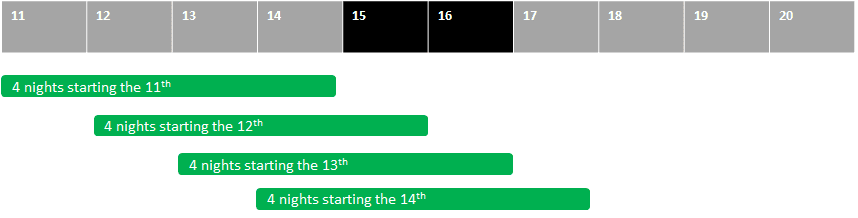
Because the 15th isn’t available, the last 3 of those potential bookings aren’t really possible anymore.
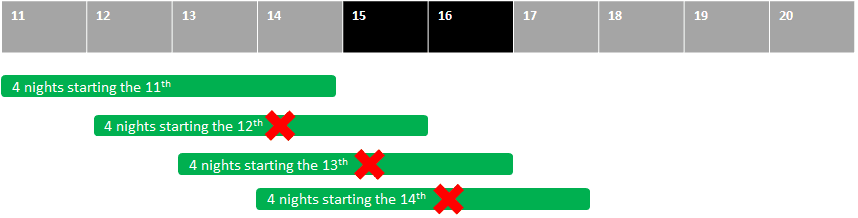
Once the 2 nights (15th & 16th) are booked, it’s not just the 14th that experiences a drop in potential demand, but also other nights around it. For example, many week-long stays that would have previously been booked on the 11th will now be unable to.
The question remains – how many of these longer bookings could potentially bring larger revenue (by also booking the 14th and other adjacent nights) do we forecast in the market?
- If not many longer bookings are expected, the opportunity cost is low, and we should take the guaranteed revenue from that short booking.
- If any longer bookings are expected, the opportunity cost might be high enough to where there’s a benefit to holding out with a longer minimum stay requirement and not taking that guaranteed revenue!
The example above illustrates that one part of calculating the “guaranteed revenue” vs “opportunity cost” tradeoff is easy:
- Everyone knows the guaranteed revenue if you were to get that short booking.
- Estimating opportunity cost is trickier. Our data science team has been working on this since last year, and we’ve come up with a nifty way to incorporate local demand patterns and booking probabilities into an optimization framework to find that tipping point where taking a shorter booking will be worse for the overall listing revenue. That tipping point becomes your minimum stay recommendation.
With the above examples and context, you’ll notice a few things about our minimum stay recommendations:
- They tend to suggest having longer minimum stay requirements far out. Generally speaking, a lot of demand is yet to book, and you’ll still have a good chance of booking those nights later, even if you turn down demand for shorter stays.
- As a date gets closer (e.g., last minute), we’ll generally recommend reducing the minimum stay restrictions to take those shorter bookings. When there’s relatively little demand left to book, it’s better to take that “assured revenue” from that short booking instead of holding out for “potential revenue” from longer bookings that might not materialize.
- In markets where many longer bookings do happen last minute, you will see that the last-minute recommendations might not drop as much. This is because the recommendations look at the localized booking patterns of similar properties in the area (more on that below)!
- In markets with low overall demand, the recommendations would tend towards lower minimum stay restrictions (take whatever bookings you can get).
- High-demand months might be recommended in the seasonal suggestions for increasing the minimum stay.
What Powers Our Min Stay Recommendations Today
When attempting to calculate these values, there are 3 main categories of factors we need to consider. These factors are continuously being tuned and improved on here at PriceLabs
- Market Trends
- Historic bookings to get typical occupancy levels, distributions of Booking Window, and corresponding Length of Stays (LOS) for bookings.
- From this, we can calculate the probability of getting booked on a given date for a given LOS during a given Booking Window for a typical market listing
- We can also do a first estimate of the negative change in booking probability for neighboring dates from removing those other market bookings that are no longer possible
- Listing Performance
- The values we get from Market Trends do a good job of estimating values for a typical listing; however, your listing is unique, and we need to make adjustments due to how your listing performed for past and future dates
- We will look at the overall occupancy level compared to the market; if we see you are falling behind, we want to encourage more bookings by being less restrictive with Minimum Stay Rules
- We will also use your prices to tweak the value functions. If you have a more weekend-heavy strategy than the market and have more variation in your DOW prices, that will be picked up here. The model will want to prioritize longer min stays on weekdays to make sure a booking that may split up the weekend dates is worth it.
- Risk Factor – Dealing with Uncertainty
- Especially at low Length of Stay, increasing the Minimum Stay rule by a single night can greatly increase the possible revenue, but greatly decrease the chance of getting booked at all.
- Consider a 2-night minimum changing to a 3-night minimum, potential revenue has increased by +50% from the extra night. That would be worth the risk as long as the probability of booking those nights hasn’t decreased more than -33% from being more restrictive.
- But -33% is a large drop in the probability of getting a booking, and our calculation of that change in probability is only an estimate and comes with inherent uncertainty in the value. Our model may come back with the booking probability decreasing by -30% but the true value might lie in the range of -35% (not worth increasing the minimum stay) to -25% (definitely worth increasing the minimum stay). Due to this uncertainty, we want our final recommendation to err on the side of taking a slightly less optimal booking than taking no booking at all
- While overall our model is looking to maximize revenue, for close calls and edge cases like the example above, we do add a factor that will choose the less restrictive Minimum Stay Rule
 Length of stay
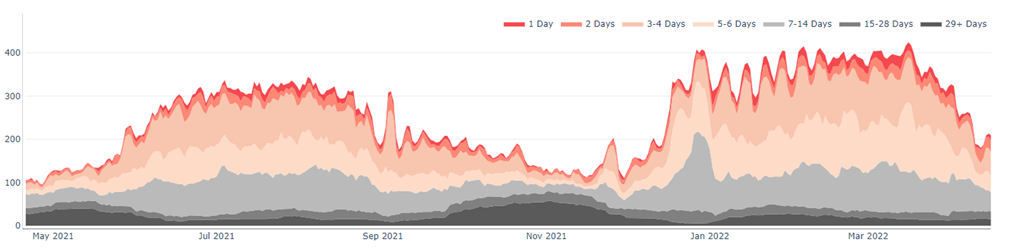
Two modes: short-term vs mid-term rentals
Many of our customers (especially in urban locations) see a significantly higher proportion of mid-term bookings on their properties. The image below shows data for 2-bedroom properties in Chicago (our HQ!) – you’ll see that compared to the ski market above, Chicago sees a lot darker gray (15+ night stays).
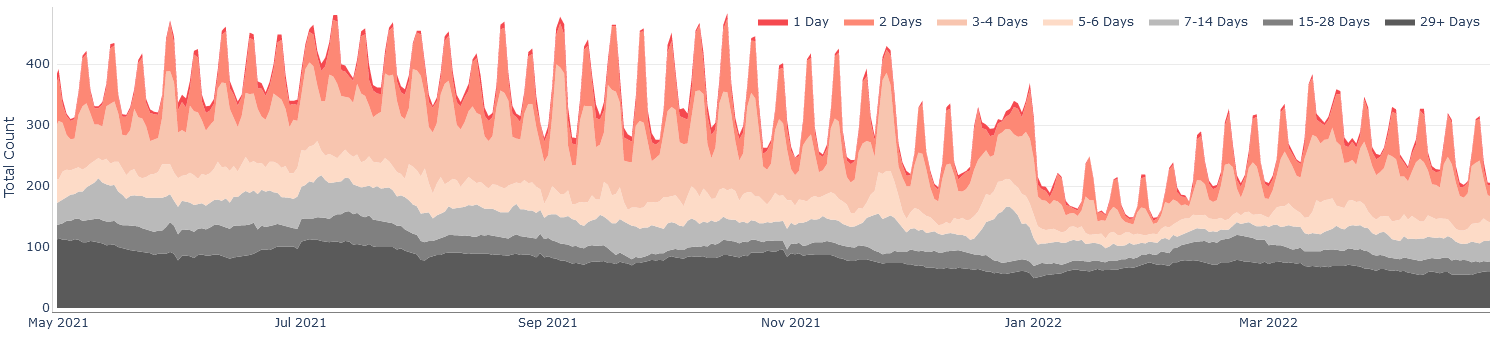 Length of stay patterns in Chicago, IL, USA (an example urban market) show weekend-heavy short-term demand, but also a large portion of mid-term stays
We created these two modes based on observations that many customers prefer one over the other for operational reasons.
- If you select “Prefer short-term,” we’ll remove the 15+ night bookings from the market demand (and related supply) and show recommendations.
- If you select “Prefer mid-term,” we’ll consider all the demand in the market. Note that even with all the demand included, the recommendations might still allow short stays if there’s not enough mid-term demand. Mid-term suggestions incorporate the demand for stays longer than 14 nights, but the recommendations might still be lower if such demand isn’t enough.
Stay restrictions in seasonal markets
For very seasonal markets (e.g. ski or beach markets), annual minimum stay settings do not work. Using our Minimum Stay Profiles in combination with Custom seasonal profiles.
However, the challenge of finding optimal and revenue-maximizing minimum stay restrictions for each season becomes even more complicated.
To help, we also run the opportunity cost optimization for each month’s demand in isolation to see if, for a given month, the recommendations deviate from the overall recommendations. These “exception” months are called out with our recommendations, and you can create special requirements for these using Minimum Stay Profiles.
Why this matters for your business
PriceLabs’ enhanced Min Stay Recommendations leverage deeper insights into Market Trends, your unique Listing Performance, and a sophisticated approach to Risk Factor uncertainty.
By continuously refining our data and algorithms, we’ve built a model that intelligently balances guaranteed revenue against opportunity costs, even in complex edge cases. This results in stronger recommendations proven to boost your revenue while reducing operational overhead, moving you beyond the limitations of static rules.
With Dynamic Min Stay, harnessing this powerful optimization is now effortless, letting our smarter model work automatically to maximize your bookings and profitability.
Back to building,
PriceLabs Data Science Team
The post PriceLabs’ Minimum Stay Recommendation Engine Algorithm appeared first on PriceLabs .
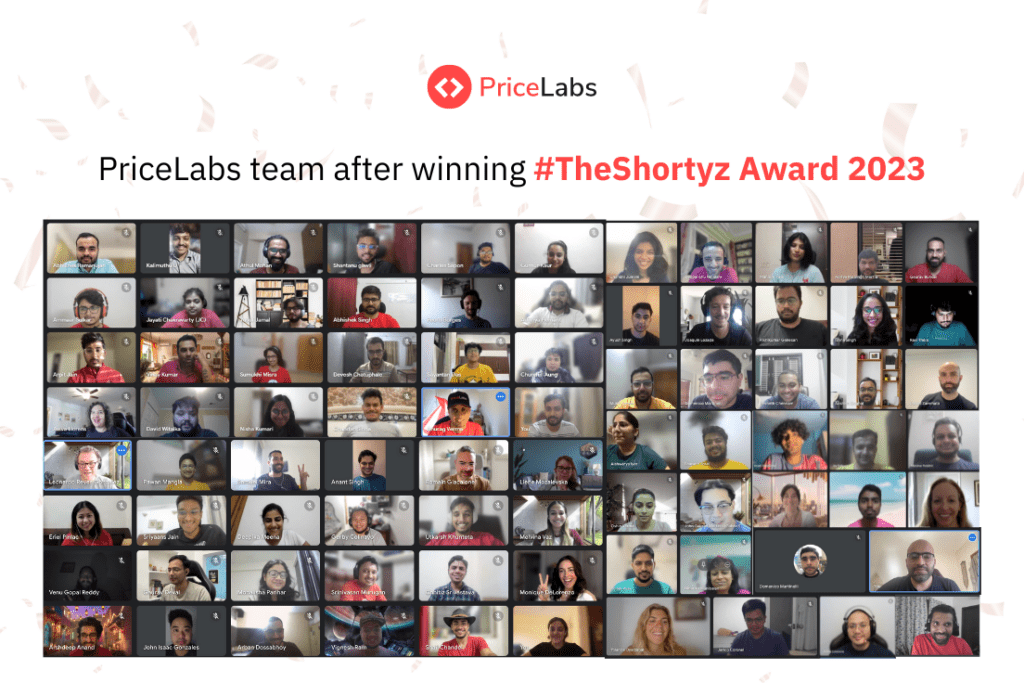
]]>The post 2023 Shortyz Award for Best Ancillary Services Provider: PriceLabs appeared first on PriceLabs .
]]>This past year, we had two key product launches that made PriceLabs’ Dynamic Pricing product multi-fold better and easy to use!
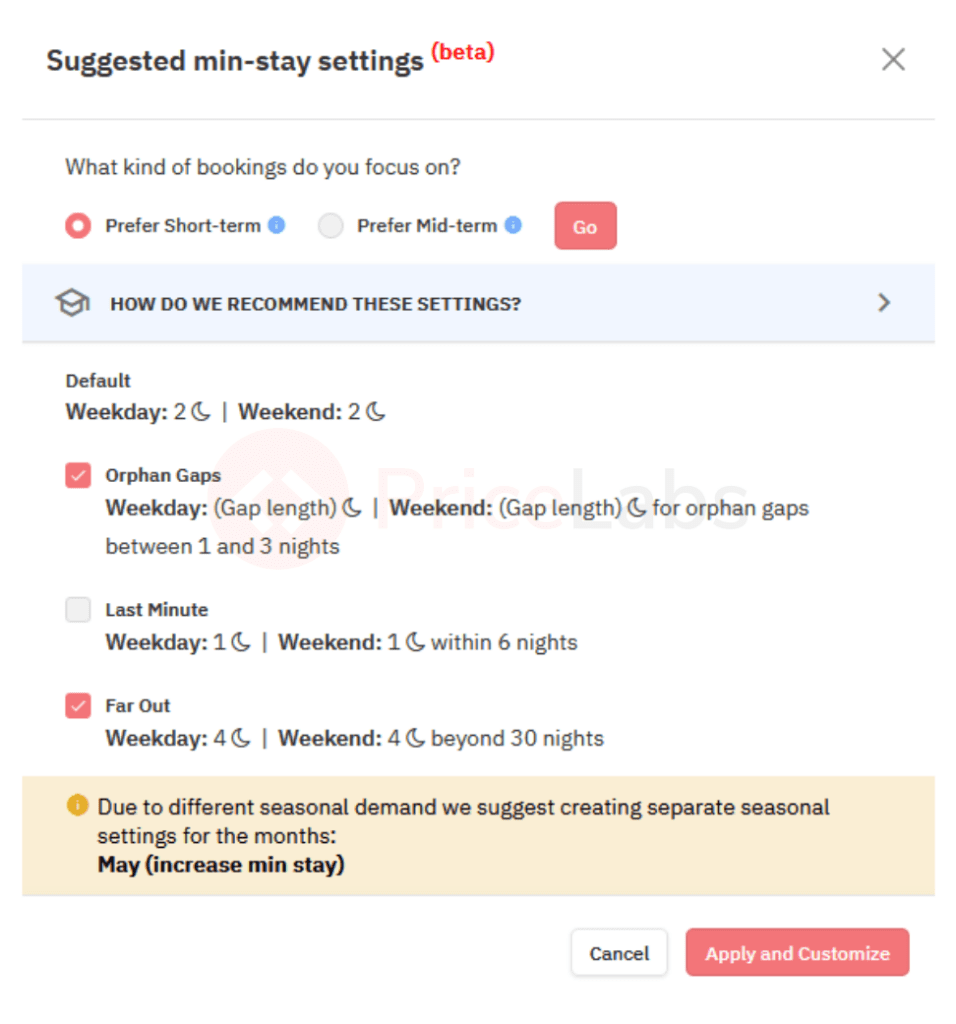
We introduced intelligent and analytics-based tools, namely – Base Price Help and Min Stay Recommendation tool. These tools make adopting PriceLabs technology for new owners and property managers a breeze! Before introducing these tools, setting base prices or minimum stay restrictions before releasing these tools was difficult and time-consuming.

Base Price Help: To help set the right base price
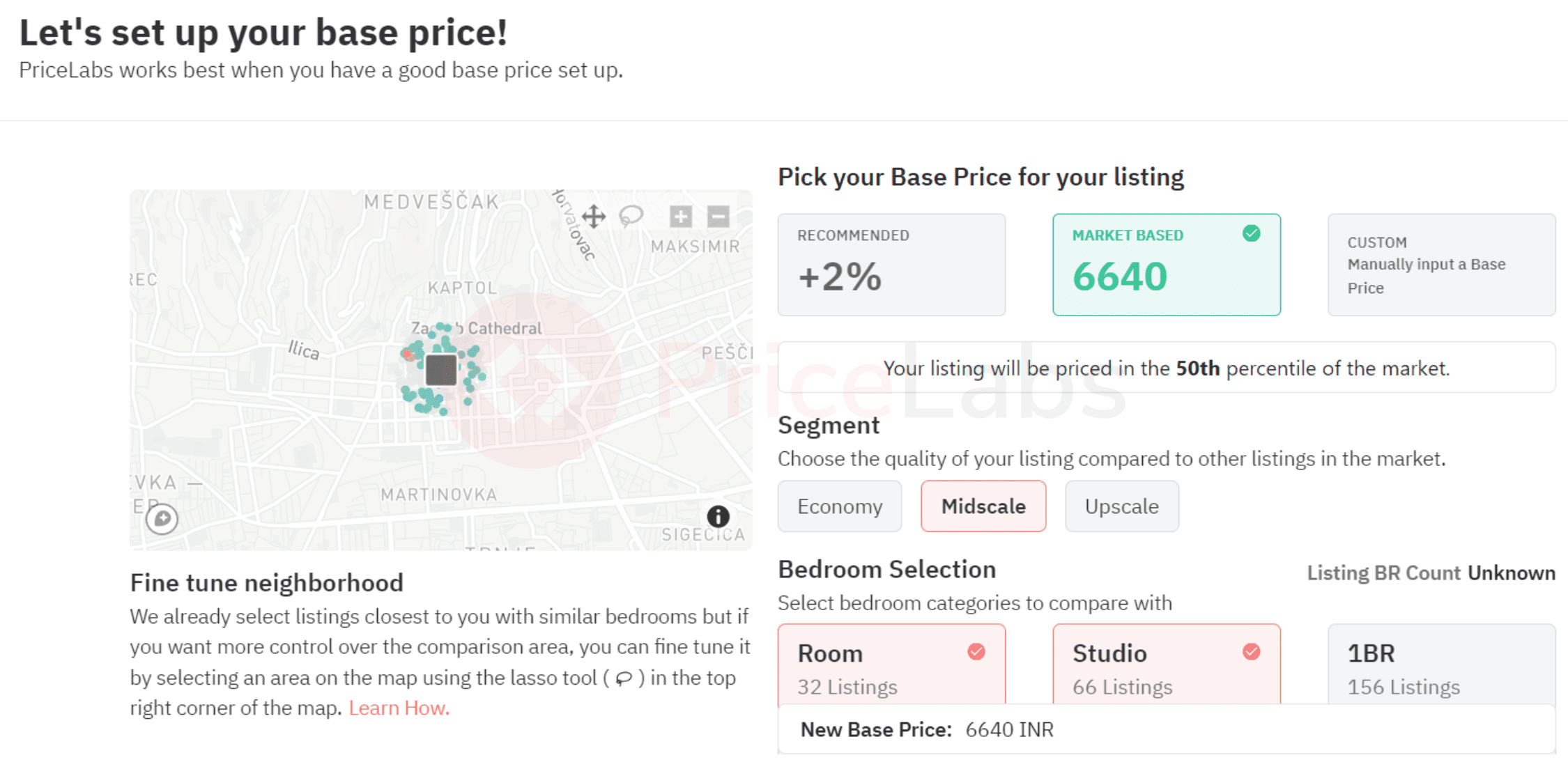
Our Base Price Help tool uses market data and machine learning algorithms to analyze thousands of market data points specific to each property. This helps us provide intelligent recommendations for a listing’s base price starting point. The tool considers hundreds of similar listings in the area and market data for comparable properties. The users can refine these recommendations according to their strategy or indicate if the property is high-end.
MinStay Recommendation Engine: World’s first intelligent minstay engine
After setting the base price, determining minimum stay restrictions is crucial for effective revenue management. Our Min Stay Recommendation Engine considers the seasonality, lead time, gap length, adjacent days, and more factors to recommend dynamic min-stay settings that maximize revenue. With this tool, we suggest what those settings might be for each listing. As a result, it makes it easier for property managers to manage their listings effectively.
Focus on innovation and ease of use
Our innovative tools are unique to PriceLabs. We design them to make pricing and revenue management tasks as easy and accessible as possible. For example, Base Price Help and Min Stay Recommendation Engine offer intuitive interfaces. These allow users to refine and adjust recommendations according to their strategy easily.
At PriceLabs, we’re proud to have won the Shortyz award for the Best Ancillary Service for our innovative tools, Base Price Help and Min Stay Recommendation Engine. These tools solve the challenges of determining a property’s base price and minimum stay restrictions, streamline revenue management tasks, and increase profitability for property managers. This recognition highlights our commitment to innovation and dedication to helping property managers succeed in the short-term rental industry.
This milestone is only possible and is complete with our customers, partners, and team. Thank you for all the support and love!
– Anurag, Richie, Sana
About the Shorty Awards and Best Ancillary Service Provider Award
The Shorty Awards is a globally recognized award for the short-term rental industry. It celebrates the best companies and products in the travel and hospitality industry. Winning the Best Ancillary Service Provider award acknowledges the significant impact of PriceLabs in the industry with our innovations.
The Best Ancillary Service Provider Award is open to businesses that have introduced a new service or product in the last two years. The said service delivered significant benefits to the short-term rental sector in general. These benefits include improving the guest experience, enhancing competitive advantage, or increasing efficiency in administrative tasks. This award recognizes companies significantly impacting the short-term rental industry through innovative products and services.
The post 2023 Shortyz Award for Best Ancillary Services Provider: PriceLabs appeared first on PriceLabs .
]]>The post Welcoming Rental Scale-Up and Thibault Masson into the PriceLabs family! appeared first on PriceLabs .
]]>In 2014, as we were launching the first version of PriceLabs, I wrote to Thibault Masson, the founder of Rental Scale-Up. I wanted to connect with him to spread the word about revenue management and our just-released software. Over the years, our respective teams have kept in touch, meeting at conferences worldwide, creating articles and videos to educate the industry about dynamic pricing, or just catching up.
Today, I’m excited to announce that the team behind RentalScaleUp.com, one of the leading short-term rental industry news & analysis website, is joining the PriceLabs family. This partnership will further our commitment to helping short-term rental entrepreneurs and teams get timely insights to make their businesses successful.
At PriceLabs, we started with a simple mission of helping small businesses in our industry. We have focussed on creating content via our blog, webinars, conference presentations, etc., that would help individuals in our industry learn about dynamic pricing and revenue management better. Having recently completed eight years in the industry, we believe our content should go beyond writing whitepapers and functional specs for our users. Instead, we want to help the whole industry grow by providing key insights and in-depth analysis- whether they use PriceLabs or not.
To build on this mission, we’ve acquired Rental Scale-Up, a beloved and respected voice in the short-term rental industry. Through their website, free weekly newsletter, YouTube channel, and monthly online conference, the Rental Scale-Up team, has shared carefully researched articles about vacation rental business practices, market data insights, and technology news. They’ve often broken the news about new features that Airbnb was about to deliver, marketing tactics that large property management used, and actionable tips that vacation rental owners could implement.
By acquiring Rental Scale-Up, we’ll be able to deliver vacation rental business practices and market data insights in multiple content formats. We’ll preserve the independence of their editorial line.
Personally, I’m also happy that Thibault is joining us, as we share personal links with Chicago, where PriceLabs is headquartered, and a shared vision of how great educational content can help the industry grow and our company thrive. In addition, Thibault has years of experience in product marketing, gained at Booking.com and through consulting work for several vacation rental tech companies. His skills will help us better articulate the value of PriceLabs’ solutions and develop educational programs for owners and property managers.
We have several interesting updates lined up in the coming months, and I am excited with Thibault joining – we will be able to do justice to the products and features our team has been working on!
—-
You can also read our recent announcements about
- Industry First Min-Stay Recommendation engine
- Partnership with KeyData Dashboard
- Funding Announcement after bootstrapping for 7+ years.
The post Welcoming Rental Scale-Up and Thibault Masson into the PriceLabs family! appeared first on PriceLabs .
]]>The post PriceLabs announces $30M in funding from Summit Partners appeared first on PriceLabs .
]]>When we founded PriceLabs, we wanted to provide easy-to-use pricing and revenue management tools to small businesses in short-term rental spaces. We had experienced the problem first hand. The idea was simple: adjust rates based on supply and demand. But there was so much more! We are thankful to our customers, partners, and team members.
The product has since evolved into a comprehensive platform for revenue management that powers pricing for over 160,000 properties worldwide. There are over 8 million short-term rental properties, so this is just the beginning!
Over the last 8 years, there have been plenty of things we have disagreed on – internal debates help ensure the best solution wins. But we were always aligned on a few things – we want to build best-in-class products and keep the prices reasonable without compromising on quality. This has necessitated us to focus on being product-led, online sales, great support, and operating lean.
So when the topic of funding came up in the past, we avoided it. We thought it was against what we were trying to do until we met Colin and the Summit team. We are excited to welcome Colin Mistele, Managing Director at Summit Partners, who will join our board of directors. In Colin, we found someone who resonated with our way of working and look forward to leveraging his experience as we plan for the next growth phase.
With this announcement, we resolve to:
- Remain customer-centric and listen to your feedback.
- Build products to ensure that we can help businesses capture value – increase revenues, and reduce costs via automation.
- Grow our team globally to support our customers. Check out our careers page.
- Finally, continue to be product led and operate lean.
Our team has been working on several amazing projects we can’t wait to reveal in the coming months.
This milestone will not be possible and is incomplete without our customers, partners, and team. Thank you for all the support and love! – Anurag, Richie, Sana
The post PriceLabs announces $30M in funding from Summit Partners appeared first on PriceLabs .
]]>The post How a Property Manager Can Talk to Owners About Using Dynamic Pricing appeared first on PriceLabs .
]]>As a property manager, Talking to your owners about implementing PriceLabs’ Dynamic Pricing tool might seem difficult, especially when owners hesitate to stray from old strategies. However, it doesn’t need to be. Remember, you’re the expert (and we are here to help!)
When talking to your owners about PriceLabs, remember that the benefits are “D.Y.N.A.M.I.C.”
D: Data-Driven
PriceLabs uses real-time and historical data specific to your location to recommend prices. Rates are optimized to take advantage of high-demand periods, raising prices and capturing more valuable bookings. In addition, hosts prioritize occupancy during low-demand periods and lower costs to ensure your calendars stay full.
Each listing’s past and present performance is analyzed. Based on the listing’s occupancy and average daily rate (ADR), PriceLabs recommends a base price. Our system then gathers and analyzes data from your market. This includes supply and demand, seasonal and day-of-week trends, special events and holiday predictions, and the number of days left to book. Finally, we apply all of these factors to the base price as a percentage change.
In the past, property managers may have manually gathered data from limited sample sets. However, this task is arduous, and the information collected is quickly outdated. Furthermore, analyzing trends and applying them to pricing is time-consuming and challenging. Because this is such a task, it’s typical for property managers to set pricing just once a year and discount to fill gaps. With PriceLabs, every 24 hours, new and optimized pricing for every calendar day, backed with accurate data, is synced to every listing. It’s hard to get more individualized attention to your listing than that!
Talking points
- How are your rates currently set?
- Are you presently using market data?
- How often are you making adjustments to your rates?
Y: You’re in Control
Hesitancy to give up control and trust your bottom line to an algorithm is entirely understandable. However, we’re not asking you or your owners to do that. With PriceLabs, the property manager is still entirely in control of the pricing strategy.
Numerous customizations ultimately give you complete control, but to keep it simple, we recommend discussing some of our basic customizations with your owners to help them feel more comfortable with the system.
- Base Price: Owners must understand where our pricing recommendations come from. PriceLabs does not price match; instead, the property manager chooses a base price, and we adjust the base price using the data we’ve collected/analyzed. We provide a suggested base rate for every listing, but you have the final say. Adjusting your base price up or down by 10% will effectively raise or lower our pricing recommendations for all dates by the same percentage. You can review your pricing throughout the year and adjust as you see fit before syncing.
- Minimum Price: The second step after setting a base price is your minimum price. Ask your owners what they’d be comfortable with. Our pricing recommendations will never drop below the floor you set. In highly seasonal markets, you may want to set a different minimum price for high-demand months than in your slow season. You can accomplish this task with our seasonal profile customization.
- Date-Specific Overrides: Some owners may pay close attention to certain high-demand holidays or seasons. Property managers can ensure that the minimum night requirement and pricing are precisely what their owners want through date-specific overrides.
Involving your owners when setting up these basic parameters can help them understand that their trusted property manager is still in control. They will be happy to find that the same limits they are used to setting are still available. Then, after you have talked to your owner about their goals and ensured your pricing strategy, you align your settings with their requirements. Most probably, the owners will be at ease with PriceLabs and impressed by the variety of options available to them and their property managers, which wasn’t the case earlier.
Talking Points:
- How do the owners currently exercise control?
- Which controls are most important to them?
- What is your owner’s primary concern?
N: No Guessing
Your success equals our success. Period. This is why we aren’t keeping any secrets from you! Ultimately, you’re in control of your revenue management strategy; we just give you the tools- so it’s important that you understand how to use them. Our commitment is twofold: we designed the software with you in mind and prioritized our customer support regardless if you’re just getting started or have been a long-time customer.
First, we’ve established a clear and intuitive order of operations within the software, a hierarchy for which different settings apply. This practice allows you to adjust your entire account and confidently customize groups or individual listings. When you change your settings, nothing is left to chance. For example, we recommend a price for every day, and we show you why we recommend the price– just hover your mouse over any calendar day!
Second, our customer success team is unmatched! We are here to help you quickly become an expert so that you (and your owners) aren’t confused about your pricing. During your onboarding, we have a team dedicated to helping you. We host weekly live webinars covering everything from the basics to advanced account settings and have youtube playlists and in-depth help articles. Our commitment to you doesn’t end with your free trial. We are constantly updating our knowledge base for easy access, and you can reach our support by email to set up screen shares and help answer any questions.
As one of the market’s most customizable dynamic pricing options, we prioritized ensuring that you aren’t left with questions. Feeling confident using PriceLabs will allow you to make smarter decisions for your pricing strategy and explore new techniques that wouldn’t have been feasible.
Talking points:
- The PriceLabs team is always available to ensure things are running as expected.
A: Automated
You and your owners will love our automated features because they save you time, prevent human error, and help you gain an edge in your market. Once you set up your customizations and turn on sync, PriceLabs applies your strategies to your pricing daily. In addition, because we account for any changes detected in the market with every daily update, your pricing can react faster and more accurately than ever before.
Pricing recommendations and minimum stays are updated and pushed daily. They are fine tuned to your revenue management strategy and the market daily. If an event is nearby, the software will recognize spikes in occupancy and raise your rates automatically. If your calendar has openings, we will apply discounts as the dates get closer and lower the minimum stay. Hate seeing gaps in your calendar? We will automatically adjust your minimum stay to allow bookings of open dates.
No more missed opportunities, you set up your strategy, and we run with it. In an industry where timing is everything, automation allows you to react faster without worrying about manually making updates.
Talking Points:
- PriceLabs identifies events and opportunities in the market for you to charge more.
- Automatically fill gaps with guests instead of dates sitting empty.
M: Minimum Stay Restrictions
Pricing is only one side of dynamic revenue management; if you’re not currently varying your minimum night stay policy, you’re leaving revenue opportunities on the table. Many property management systems allow you to control your minimum night policy manually, but PriceLabs’ automated customizations take the stress out of filling your calendars and keeping your owners happy.
With PriceLabs, you can drive higher occupancy and more valuable bookings by requiring a more extended stay for bookings made far in advance. Nothing is worse than having a short booking block for a weekend or holiday week. We recommend using cascading minimum stay restrictions that keep min-stays higher further out and lower them as a date approaches. However, it’s entirely up to you and your owners. If an owner does not care about the minimum stay but focuses more on booking value, you can set the minimum stay to be value-based. If certain holidays or demand periods have different minimum stay settings than the rest of the year, you can set date-specific overrides. Fill gaps in your calendar by employing our Orphan Day settings to reduce minimum stays and make gaps bookable automatically.
Setting up your dynamic minimum stays in PriceLabs will help drive higher occupancy and more valuable bookings. Your owners will be pleased with this extra level of control and the increased revenue!
I: Insights
PriceLabs gives you access to approachable data allowing you to gain an accurate and deep intuitive understanding of your own listings’ performance and the surrounding markets. If an owner has questions about their performance or your revenue management strategy, you can easily pull up their data and compare it to what’s happening in the market.
Our products, Dynamic Pricing, Portfolio Analytics, and Market Dashboards give different insight levels. For example, in our Dynamic Pricing tool, we display neighborhood data that shows the average daily rate and occupancy for the listings in your area. As a result, you can ensure that your prices are competitive and keep track of at-market (or better) occupancy rates.
Market Dashboards take neighborhood data a step further. A property manager can use Market Dashboards to create specific comp sets to compare their listings’ performance and visualize the future trends in their area. You can set their pricing and stay restriction strategies based on actionable data with information on the length of stay and lead time. Keep tabs on the competition: see what amenities are most popular in the area, and understand how policies and additional fees are set in your market.
Portfolio Analytics is a real-time reporting system that shows important vacation rental KPIs and listing-level performance data. You now have a real-time reporting system that surfaces high-level metrics about the business. These include monthly revenue or length of stay information. Executives will find the reporting helpful to get a quick snapshot of their business!
Portfolio Analytics dives in even more profound and exposes listing level performance and metrics, which property managers can use to make informed decisions about individual listings when setting up personalized rate strategies.
A fine tuned and informed strategy opens more opportunities to increase both occupancy & revenue. In addition, you’ll be able to go over your pricing strategy confidently, as you’ll have easy-to-present data on your listings’ performance and your competitors.
C: Customizations
PriceLabs’ customizations set us apart from our competitors. While many of our customers opt to use our basic options, we allow every aspect of your pricing to be customized and automated through our advanced options.
Our algorithm analyzes historical demand trends and real-time market data to adjust the base price using recommended default settings. However, any default settings can be turned off or modified to your (or your owners’) liking. Employ your last-minute discounts for close-in dates. Discount orphan days to encourage bookings during gaps or charge a premium to discourage short stays. Adjust our recommended occupancy-based settings to match your portfolio’s booking trends. Set different minimum prices for weekends or far-out dates or by seasons. Fine-tune your strategy like never before!
Essentially, we allow PMs to adjust our algorithm so it’s right for them! Owners will be happy to learn that their trusted PMs can tweak our “secret sauce.”
The post How a Property Manager Can Talk to Owners About Using Dynamic Pricing appeared first on PriceLabs .
]]>The post New Dashboard and Usability Settings appeared first on PriceLabs .
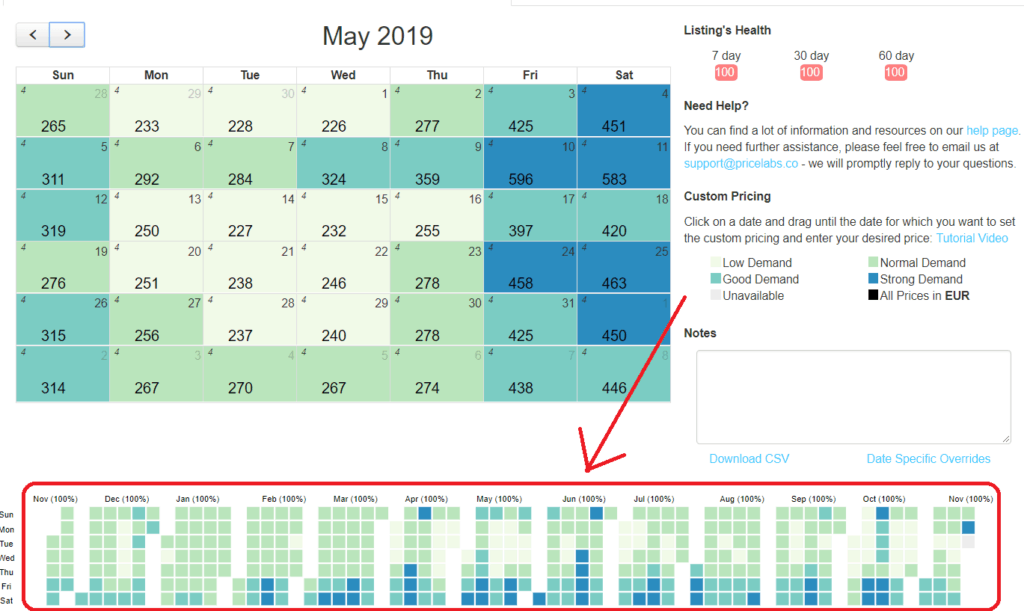
]]>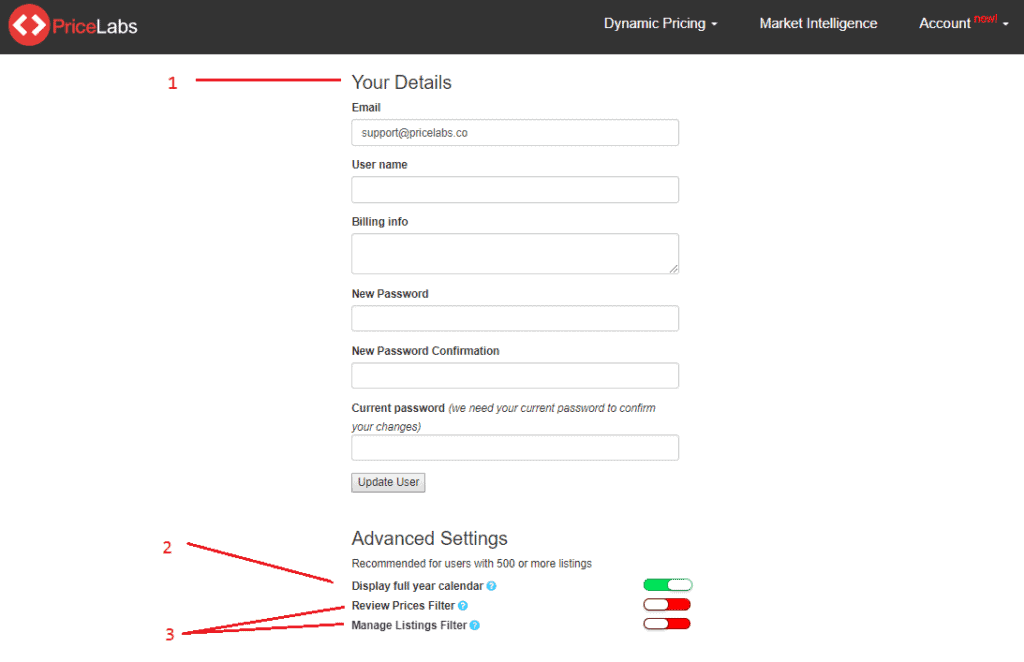 1. Updating account information: These settings can be used to change the user name, email, password, or the name the invoices will be generated to. 2. Display full year calendar: When this toggle is on (green), the full year navigation calendar is displayed at the bottom of usual “monthly” pricing calendar, and the calendar is hidden when the toggle is off(red). Displaying the full year calendar (screenshot below) can add 3-4 seconds when you review prices for a listing, so we recommend keeping it off to speed things up unless you use it frequently.
  3. Filters for Review Prices and Manage Listings pages: These settings are especially useful if you have 500+ listings in your account (we don’t recommend turning them on if you have fewer, as they won’t be as useful). When these toggles are on (green), a series of filter options are displayed at the top of the Review Prices/Manage Listings page, allowing you to only load listings you choose using filters on the PMS, Group, Listing, Sync status, and Availability.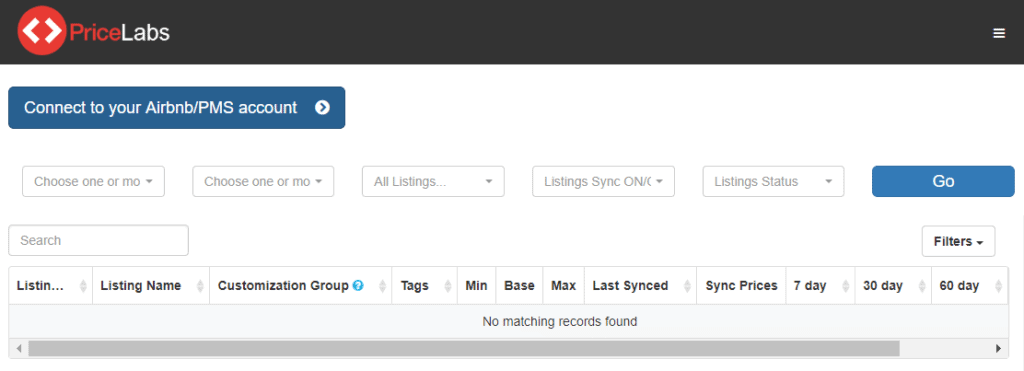
- To view all of your listings, simply click ‘Go’ without selecting any filter criteria.
- To view a subset of listings, choose the right filters and click ‘Go’.
- When this toggle is off (red), all of your listings are displayed as usual.
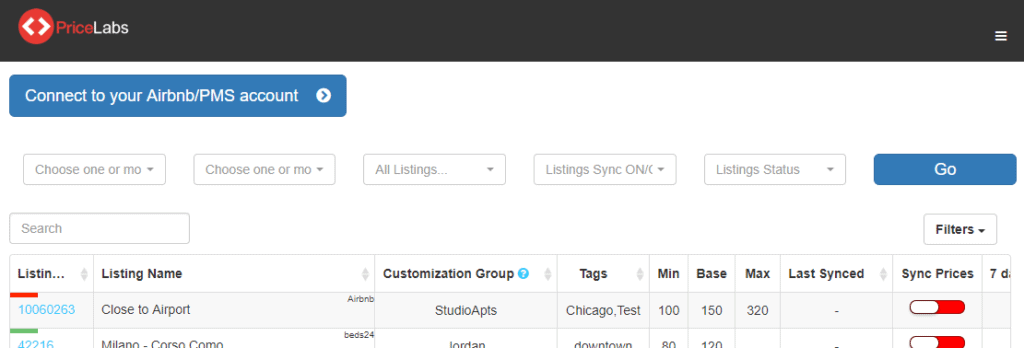
4. Performance Metrics – Vacancy Rate: Our default dashboard settings show you vacancy rates for the next 7, 30, and 60 days, but now you can choose from more options! 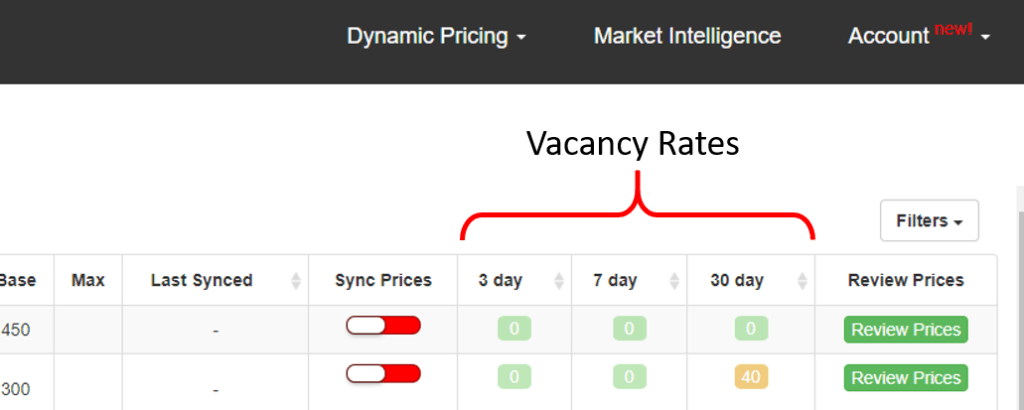 Head over to Account >> Settings and you’ll find more options in the Advanced Settings menu.
 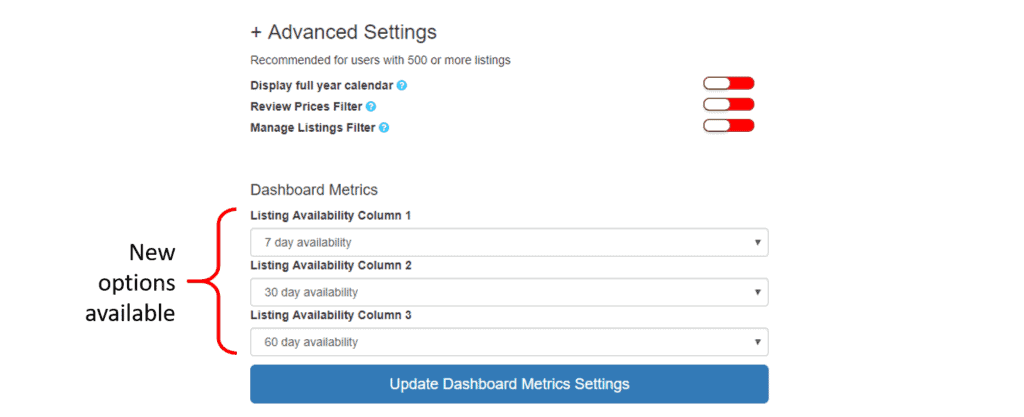 We will be adding a few new options to customize the dashboard next. Please reach out to support@pricelabs.co for any questions!
The post New Dashboard and Usability Settings appeared first on PriceLabs .
]]>