The post Navigating the 2025 Greek Vacation Rental Market appeared first on PriceLabs .
]]>At the same time, property managers face new challenges, including increased competition from rising listing supply, shorter booking windows, and softer occupancy compared to the highs of last year. On the upside, average daily rates (ADR) are growing, helping maintain revenue performance.
This report explores the latest 2025 trends in occupancy, ADR, RevPAR, booking behavior, and supply across Greece’s top vacation rental markets, while highlighting how dynamic pricing strategies are proving essential for maximizing returns.
Greek Vacation Rental Market Trends 2025
Tools like the World STR Index and PriceLabs Market Dashboard provide property managers with a clear view of evolving demand and performance. Here are the key vacation rental trends shaping Greece’s short-term rental market in 2025.
1. Occupancy trends in Greece
Summer Peaks Still Lead
As expected, the Greek islands remain heavily summer-driven markets, with occupancy peaking in July and August.
- Santorini & Crete: August 2024 closed at 81% occupancy, up from 78% in 2023, while July 2025 is already pacing at 74%. September is also showing year-over-year improvement, climbing from 53% to 60%.
- Paros & Naxos: The trend is similar, with August 2024 also at 81% (vs. 78% in 2023) and September improving from 65% to 71%.
This shows that core summer demand remains resilient, with steady growth across both major and boutique island markets.

Winter Weakness
Outside the high season, however, occupancy remains soft.
- Santorini & Crete: The winter months (November–February) experience a range of occupancy from 16–21%, with December and January reaching their lowest points.
- Paros & Naxos: Occupancy stabilizes slightly higher, averaging 24–31% over the same period, but still far below summer levels.
This highlights the significant reliance on the summer window, with winter seeing a sharp drop-off in demand.
Insights:
Occupancy is holding steady, with modest year-over-year growth, but the seasonality gap remains extreme. Property managers will need to:
- Explore long-term stay strategies for the winter months to help fill otherwise low-demand periods. The demand is intensifying. To close gaps, operators will need to attract last-minute bookings and expand strategies for shoulder months.
- Lean on seasonal pricing strategies to maximize summer peaks.
- Incentivize shoulder-season stays (Apr–Jun, Sep–Oct) through discounts and flexible policies.
Unlock Hidden Market Opportunities with PriceLabs Market Dashboards
Stay ahead of the competition by tracking real-time demand, pricing trends, and occupancy shifts in your market. With Market Dashboards, property managers like you can make smarter decisions, identify revenue opportunities, and confidently navigate changing regulations.
Start Your Free Trial2. ADR (Average Daily Rate) Trends
While occupancy is showing signs of plateauing, ADR continues to trend upward across the Greek islands, particularly in premium markets.
- Santorini & Crete: Rates are gradually climbing, with August 2025 pacing at €195 (+4% YoY) and September at €172 (+3% YoY). The annual ADR range now sits between €150 and €195, reflecting steady but controlled growth on the larger islands.
- Paros & Naxos: Boutique destinations are seeing much sharper increases. August 2025 is pacing at €273 (+16% YoY), while June 2026 is already pacing at €339 (+78% YoY). Annual ADRs here are averaging between €250 and €300, and forward-looking data suggest even higher peaks for summer 2026.
This widening gap between the central and more minor islands underscores a clear trend: travelers are willing to pay significantly more per night in boutique, supply-constrained markets. Paros and Naxos, in particular, benefit from limited inventory and strong international appeal, allowing property managers to sustain premium pricing well above the levels seen in Santorini and Crete.

Insight:
With occupancy flattening, rate strategy is becoming the key lever for revenue growth. Managers in larger markets should focus on incremental ADR gains, while those in boutique destinations can capitalize on scarcity-driven pricing power.
Read More: Portugal Vacation Rental Market 2025: A Complete Guide
3. RevPAR Trends
RevPAR continues to highlight the balance between occupancy and rate strategy, showing diverging performances across the islands.
- Santorini & Crete: Summer remains the anchor, with August 2025 pacing at €130 (-1% YoY). September provides a stronger picture, improving to €70 (+4% YoY). On an annual basis, RevPAR is effectively flat at +1% YoY, suggesting that higher ADRs are offsetting softer occupancy in several months.
- Paros & Naxos: The smaller islands continue to outperform. In 2024, RevPAR rose +10% YoY, driven primarily by aggressive ADR growth. Annual averages now sit in the €70–€111 range, with summer peaks above €150 and shoulder seasons outperforming the larger islands. Even with some occupancy softness, Paros and Naxos are delivering double-digit revenue gains year over year.

Insights:
Revenue is being preserved — and in some cases expanded — through higher nightly rates. But this reliance on ADR as the primary lever introduces vulnerability: if demand softens suddenly, RevPAR could decline sharply. For managers, the challenge will be balancing revenue optimization with occupancy stimulation, especially in the shoulder and off-season months.
Read More: Vacation Rental Trends in Croatia: Insights from 2025
4. Booking Window Trends in Greece
One of the most significant shifts in the Greek vacation rental market is the shortening booking window—a trend we’re also seeing across Southern Europe, including Portugal and Italy.
The median booking window for August 2024 is 51 days, a slight decrease from 54 days in 2023. While peak summer travelers continue to plan, shoulder-season and winter guests are booking closer to their travel dates—sometimes just weeks or even days before arrival.

Looking at the broader trend:
- Summer (June–August): Bookings are made well in advance (70–82 days), giving managers a longer runway to optimize pricing.
- Shoulder months (September–November): Booking windows are closing quickly, with stays often reserved just 15–37 days in advance.
- Winter (December–February): The window is at its shortest, ranging from 6 to 13 days, making demand unpredictable.
- Spring (March–May): Booking patterns are more stable, with travelers planning approximately 30–53 days.
Insight:
Shorter booking windows lead to revenue volatility, particularly outside peak seasons. Property managers can’t rely on static pricing strategies—they need dynamic pricing tools that respond in real time to capture last-minute bookings without undervaluing early reservations.
Tools like PriceLabs help managers adjust automatically based on demand signals, seasonality, and pacing, ensuring rates remain competitive whether a guest books three months ahead or three days before arrival.
5. Length of Stay Trends
Length of stay (LOS) is gradually increasing across the Greek islands, signaling a shift in traveler behavior toward longer, more immersive trips.

- Median LOS: Across both Santorini/Crete and Paros/Naxos, the median length of stay has risen from 6 nights in 2023 to 7 nights in 2024.
- Crete: Continues to lead the market in extended stays, averaging 7–10 nights. This reflects its appeal to families, digital nomads, and travelers seeking a slower, more destination-focused experience.
- Santorini & Paros: Trips remain shorter, typically 3–5 nights, catering to leisure travelers on tighter itineraries. However, luxury demand is pushing ADRs higher, meaning shorter stays still deliver substantial revenue per booking.
Insight:
Length-of-stay discounts are an effective lever in Crete, where families and remote workers are driving longer bookings. In Santorini and Paros, bundling premium experiences—such as wine tours, sailing trips, or spa packages—helps maximize value from shorter leisure stays.
6. Listing Growth in Greece
Supply continues to climb across the Greek vacation rental market, adding pressure to occupancy rates and intensifying competition among operators.
- National Growth: Active listings in Greece reached 30,991 in May 2025, up from 28,029 in May 2023, marking a +7% increase in the past year.
- Seasonality Impact: Inventory typically peaks in August–September, with over 32,000 active listings recorded in late summer 2024 before easing back during the winter months.
- Smaller Markets Growing Faster: Paros and Naxos have seen above-average expansion, with listings growing from 6,206 in May 2023 to 7,033 in May 2025 (+13% growth). This is nearly double the national pace, creating sharper competition in these destinations.

Insights:
More listings mean greater competition, particularly in smaller island markets where demand is not growing at the same pace as supply. Operators who thrive will be those who:
- Adapt pricing dynamically to shifting demand.
- Ensure regulatory compliance, especially in markets facing stricter short-term rental oversight.
- Differentiate through guest experience, offering curated stays, local partnerships, and premium services.
As Greece heads into another high-demand summer, property managers face a crowded playing field where pricing agility and strong branding will determine who captures the most bookings.
The Role of Dynamic Pricing in Greece
Dynamic pricing is no longer optional—it is the defining driver of performance across Greek short-term rentals. By aligning rates with real-time demand, operators in markets such as Paros, Naxos, Santorini, and Crete are seeing clear and consistent uplifts in occupancy, ADR, and RevPAR.
Occupancy Impact: Filling Nights That Would Have Stayed Empty
Dynamic pricing not only maximizes peak demand in July and August but also cushions the shoulder and off-season periods when demand is weaker.

Insight: Operators using dynamic pricing consistently capture an additional 20–22% occupancy compared with static pricing. The benefit is most visible in shoulder months, such as March and November, where dynamic strategies deliver 62–75% occupancy compared to just 38–46% without pricing tools.
ADR Impact: Pricing Power, Especially in Peaks
Average Daily Rate (ADR) also benefits from dynamic tools, particularly in high-demand months.

Insight: Moderate strategies often outperform “high” dynamic approaches on ADR because they balance competitiveness with price optimization. For example, in December and January, moderate dynamic pricing delivered ADRs above €530, while static listings averaged just €283–€392.
RevPAR Impact: Where Dynamic Pricing Truly Pays Off
Revenue per Available Rental (RevPAR) captures both occupancy and rate—making it the clearest indicator of dynamic pricing’s impact.

Insight: The RevPAR uplift is staggering. Even “low” adoption of dynamic tools generates 82% higher RevPAR than static pricing. For operators using moderate strategies, the uplift reaches +133%, meaning more than double the revenue potential compared with those who leave pricing untouched.
Why This Matters
The Greek vacation rental market is increasingly competitive, with supply growth outpacing demand in many island destinations. Static pricing strategies leave significant revenue on the table, especially as booking windows shorten and travelers book more last-minute.
Dynamic pricing offers a dual benefit:
- Protects yield in the high season by ensuring rates reflect the market’s willingness to pay.
- Captures incremental demand in off-season by flexing rates downward just enough to win bookings that would otherwise go elsewhere.
Bottom line: In markets like Santorini, Crete, Paros, and Naxos, dynamic pricing isn’t just an optimization tool—it’s a survival strategy.
Maximize Your Revenue with PriceLabs Dynamic Pricing
Stop leaving money on the table. PriceLabs Dynamic Pricing adjusts your nightly rates automatically based on demand, seasonality, and market trends—so you can boost occupancy, increase revenue, and save hours of manual work.
Start Your Free TrialShort-Term Rental Regulations in Greece — 2025 Update
Starting October 1, 2025, Greece will roll out some of the most comprehensive short-term rental (STR) regulations in Europe. The reforms, passed by the Greek parliament, reflect the government’s attempt to balance the rapid growth of STR supply with housing affordability, neighborhood sustainability, and tourist safety.
For operators, these rules introduce new compliance costs but also bring market-wide standardization—potentially favoring professional managers over casual hosts.
Key Regulatory Changes
Greece has introduced several updates to its short-term rental (STR) framework that property managers and hosts need to be aware of:
- Mandatory Registration – All STRs must now be registered with the Greek Tax Authority’s STR Registry (AMA number), and this registration number must be displayed on every listing.
- Safety & Quality Standards – Properties must meet minimum safety requirements, including liability insurance, certification by a licensed electrician, fire extinguishers and smoke detectors, emergency escape signage, pest control certificates, and a stocked first aid kit with emergency contacts.
- Property Type Restrictions – Only “primary use” spaces are allowed as STRs. Industrial or warehouse conversions are permitted if compliant; however, basements and semi-basements are prohibited unless they meet strict lighting and ventilation requirements.
- Taxation Changes – The daily tourist tax has increased significantly, ranging from €1.50 to €8 in peak season (April–October) and €0.50 to €2 in the off-season.
- Rental Limits & Neighborhood Freezes – Rentals are capped at 90 days per year, reduced to 60 days on small islands. In high-density areas like central Athens, where STRs exceed 5% of the housing stock, new permits will be frozen.
- Incentives for Long-Term Rentals – Owners converting STRs to long-term leases can benefit from a three-year income tax exemption if they commit to a minimum of three years.
- Multi-Property Licensing & Taxation – Hosts with more than two properties must register as legal entities and will be taxed at higher rates, similar to hotels.
- Enforcement & Penalties – Non-compliance is subject to fines of up to €5,000, which double for repeat violations.
Market Impact: What the Data Shows
The reforms come at a critical moment: Greece’s STR supply has been surging, outpacing demand in several destinations.
- Nationwide listings grew +7% year-over-year (2024–2025), reaching more than 31,000 active rentals by August 2024 before softening slightly in early 2025.
- Smaller markets like Paros and Naxos are experiencing faster supply growth than demand, with active listings up 12%+ YoY—putting pressure on occupancy and pricing.
This means the regulation is likely to have two immediate effects:
- Consolidation: Casual and non-compliant hosts may exit the market due to compliance costs, while professional operators benefit from reduced competition.
- Shift to Longer Stays & Higher ADRs: With stricter limits and higher taxes, managers will lean on dynamic pricing and bundled services (e.g., tours, premium amenities) to protect margins.
Why This Matters
The new framework pushes Greece closer to hotel-style regulation, raising the bar for compliance while attempting to curb overtourism and housing displacement. For professional operators, the changes are not only survivable but potentially advantageous:
- Fewer casual competitors means more room for structured, compliant businesses.
- Data-driven pricing tools will become essential to offset tax hikes and caps.
- Differentiation through guest experience will separate thriving operators from those squeezed out.
Bottom line: regulation in Greece is no longer a distant concern—it’s here. The property managers who adapt fastest will not only stay compliant but also turn regulation into a competitive edge.
How Property Managers Can Maximize Revenue in the Greek Vacation Rental Market in 2025
With demand in Greece remaining steady but competition intensifying, property managers must operate with greater sophistication than ever before. Between rising supply, shorter booking windows, and stricter regulations, success will depend on how well operators balance compliance, pricing, guest experience, and marketing.
Here are five strategies for maximizing revenue in Greece’s 2025 short-term rental market:
1. Leverage Dynamic Pricing to Capture Demand Shifts
Static pricing leaves revenue on the table. As seen in both Santorini and Paros, operators using moderate dynamic pricing strategies achieve up to a 133% RevPAR uplift compared to static pricing.
- Peaks: Protect yield by setting rate floors during July and August.
- Shoulders: Flex rates downward in September–October and March–May to win price-sensitive bookings.
- Winter: Utilize automated last-minute discounting to convert guests who book 6–13 days before their stay.

2. Adapt to New Regulations Proactively
With new STR rules rolling out in October 2025, compliance will separate thriving managers from those exiting the market.
- Register properties early and clearly display AMA numbers to build trust with guests.
- Use regulatory caps (90/60 days) strategically—front-load availability into high-yield periods, while pushing long stays in off-season months.
- Consider converting underperforming units into long-term rentals to benefit from 3-year tax exemptions.
3. Differentiate with Guest Experience & Bundles
In markets like Santorini, where stays are short (3–5 nights), bundling experiences and offering short-term rental upsells can lift ADR and RevPAR without relying solely on occupancy.
- Offer premium packages, including sailing tours, vineyard tastings, and wellness/spa add-ons.
- Partner with local businesses to create curated itineraries that stand out on OTAs.
- For Crete and Naxos, promote extended-stay discounts (7–10 nights) to attract families and remote workers.
4. Optimize Marketing & Distribution
Visibility drives bookings—especially with supply up +7% nationally and +13% in Paros/Naxos.
- Invest in direct booking channels to reduce OTA dependency and increase margins.
- Use professional photography, drone shots, and translated listing descriptions to capture international travelers.
- Tailor vacation rental marketing by season: highlight beaches and nightlife in summer, but emphasize “slower, immersive stays” for winter and shoulder months.
5. Manage Operations Like a Hospitality Business
As regulations push STRs closer to hotel standards, property managers must elevate their service and operations.
- Standardize safety features (such as insurance, detectors, and first-aid kits) not just for compliance, but also as a marketing differentiator.
- Implement guest communication tools to manage late check-ins, upsells, and repeat stays.
- Track performance with dashboards (e.g., PriceLabs, STR Index) to benchmark against competitors and adjust strategy in real time.
Conclusion
The Greek vacation rental market in 2025 is characterized by slowing occupancy but accelerating ADR growth. Santorini and Crete remain the largest and most stable markets, while Paros and Naxos are increasingly premium destinations commanding higher nightly rates.
For property managers, the lesson is clear: revenue growth will not come solely from occupancy. Success will depend on adopting dynamic pricing, aligning strategies with evolving booking behaviors, and tailoring offerings to both extended-stay and short-break travelers.
With competition rising and seasonality remaining sharp, property managers who adopt data-driven strategies will be best positioned to capitalize on Greece’s strong demand from travelers year after year.
Frequently Asked Questions
1. What are the main vacation rental market trends in Greece for 2025?
In 2025, Greece’s vacation rental market is characterized by steady summer demand, rising ADR (Average Daily Rate), softer winter occupancy, shorter booking windows, and increasing competition from new listings. Santorini and Crete remain stable, while Paros and Naxos are seeing sharper ADR growth due to limited supply.
2. How is occupancy trending for Greek vacation rentals in 2025?
Occupancy is steady but highly seasonal. Peak summer months (July–August) still reach 80% or higher, while winter months drop as low as 16–31%. Paros and Naxos show slightly stronger winter resilience than Santorini and Crete.
3. What is happening with ADR (Average Daily Rate) in Greece’s short-term rental market?
ADR is climbing across all islands. Larger destinations, such as Santorini and Crete, average €150–€195 per night, while boutique islands like Paros and Naxos command €250–€300+, with forward-looking data indicating even higher peaks into 2026.
4. How do RevPAR trends compare between Santorini/Crete and Paros/Naxos?
Santorini and Crete are flat on RevPAR growth (+1% YoY), relying mostly on ADR to offset soft occupancy. In contrast, Paros and Naxos are seeing double-digit RevPAR growth, driven by aggressive rate increases and sustained summer demand.
5. How are booking windows changing in Greece?
The booking window is shrinking. Summer trips are typically booked 70–80 days in advance, whereas winter stays are often reserved just 6–13 days before arrival. This trend increases volatility, making dynamic pricing crucial.
6. What is the average length of stay in Greek vacation rentals?
The median length of stay has increased from 6 to 7 nights. Crete sees the longest stays (7–10 nights), while Santorini and Paros typically attract shorter trips (3–5 nights) with higher ADRs.
7. How much is vacation rental supply growing in Greece?
Active listings have grown by +7% year-over-year, reaching over 30,000 in 2025. Smaller islands, such as Paros and Naxos, are growing even faster (+13%), creating sharper competition in boutique markets.
8. What new regulations affect short-term rentals in Greece from October 2025?
Key rules include mandatory STR registration (with an AMA number), stricter safety standards, rental caps (90 days or 60 days on small islands), higher tourist taxes, freezes on new permits in high-density neighborhoods, and heavier taxation for hosts with multiple properties.
9. How will these regulations impact the Greek vacation rental market?
STR regulations in Greece are affecting the vacation rental market. Casual hosts may exit due to compliance costs, while professional operators stand to benefit from less competition. The market is likely to see more consolidation, stronger ADRs, and a push toward longer stays and bundled guest experiences.
10. Why is dynamic pricing essential for Greek property managers in 2025?
Dynamic pricing helps managers maximize ADR during peak months while filling occupancy gaps in the off-season. Data shows that operators using moderate dynamic strategies achieve up to a 133% higher RevPAR compared to static pricing.
The post Navigating the 2025 Greek Vacation Rental Market appeared first on PriceLabs .
]]>The post How Travel and Damage Protection Strengthen Your Vacation Rental Business appeared first on PriceLabs .
]]>In this post, we’ll show you how vacation rental damage protection for your rentals can fortify your rental business.
Insurance, Waivers & Deposits: Know the Difference
It’s easy to get confused with so many terms flying around, including travel protection, damage waiver, security deposit, and vacation rental damage insurance.
Here’s a quick rundown of each type of protection and what it means for you and your guests:
Travel Insurance
You can give your guests the option to buy trip insurance at checkout. This add-on reimburses them, not property managers.
This protects guests during unexpected circumstances, such as a sudden illness, a family emergency, severe weather, flight delays, or lost baggage. For property managers, this means fewer refund disputes, happier guests, and a stable income, as you can enforce your cancellation policy for vacation rentals.
Security Deposit
The traditional route is to hold a refundable deposit from your guests. If everything is fine at checkout, you release the funds. If there’s damage, you keep what it costs to fix.
Guests hate big holds, and many will book elsewhere to avoid them. That’s why vacation rental managers choose damage insurance or waivers over security deposits.
Damage Waiver
A damage waiver is a small, non-refundable fee that a guest pays in lieu of a hefty security deposit. That fee releases them from liability for most accidental damage up to the limit you choose.
If someone cracks a window or knocks over a lamp, you file a quick claim with the waiver provider and get reimbursed.

No chasing guests and no refund arguments.
Vacation Rental Damage Insurance
This is real insurance underwritten by an insurer and not just a fee. You’ve got two ways to use it for your short-term rental property management business:
Per-Booking Damage Insurance:
Every reservation is automatically covered through providers like Safely, InsureStays/RentalGuardian, or Truvi (formerly SUPERHOG). This policy can protect your property for up to $1 million or more during that single stay.
Annual Short-Term Rental Policy:
Services like Proper Insurance replace your standard homeowner’s policy with one built for STRs. You pay once a year and get $1-2 million in property and liability coverage. This type of insurance policy can also include extras, like pet damage or bed bug remediation.
PriceLabs Dynamic Pricing
A robust protection strategy is only as strong as its pricing. With PriceLabs Dynamic Pricing, you can automatically adjust your rates to seamlessly cover protection fees while remaining competitive.
Start Your Free TrialWhat is Covered by the Vacation Rental Insurance Program?
Not all damage protection plans are the same, but most vacation rental damage protection programs cover these core areas.

Accidental Property Damage
Multi-property managers should look for per-booking accidental coverage that can scale. Safely’s base policy covers up to $10,000 in content damage per booking. If you manage luxury short-term rentals, you can opt for higher limits.
Replacement or Repair Costs
Ensure the vacation rental damage protection plan reimburses you for the full replacement or repair cost, not a depreciated amount.
Guest Liability
For managers with multiple properties, having built-in liability insurance across all reservations is a huge relief.
Always confirm:
- Is liability included, and to what limit?
- Does it cover claims by guests as well as third parties, like neighbors?
Theft and Vandalism:
Some programs, like Safely and Truvi, cover theft or intentional damage caused by guests. But some plans exclude intentional acts. Confirm explicitly to provide extra protection for your listings.
Add-on Benefits
Here’s where some programs stand out. Depending on the provider, you might get extra protections for your listings, like:
- Pet Damage
- Bed Bug Coverage
- Owner’s Personal Items
- Loss of Income/Use
- Guest Relocation Assistance
- Identity Screening
Also Read: Airbnb Safety Issues
Why Does Vacation Rental Damage Protection Matter For Your Business?
Offering travel and damage protection is about strengthening your entire operation. Let’s check out the key benefits of a vacation rental damage protection plan.
Mitigates Financial Risks
When you manage multiple properties, major damage is inevitable. Maybe a kitchen fire, a flooded bathroom, or a $50K party cleanup. Security deposits won’t cut it.
Rather than bearing that cost or risking your owner relations, you can file a claim with a property damage protection vacation rentals provider and get reimbursed.
Vacation rental damage protection, like Safely, directly addresses these financial risks. Per-stay insurance covers these recurring costs, often at full replacement value.
Streamlined Claims and Incident Resolution
No one wants to spend their week wrangling over a broken coffee table with a guest or waiting months for a payout. STR damage protection programs streamline the claims process.
Providers, like Safely and Waivo, let you file in under 5 minutes with just photos and receipts while they handle the entire claim workflow for you.
Cancellation Cover to Protect Revenue
When mishaps and cancellations happen, you lose income unless the guest has travel insurance. That’s why offering trip protection through partners like InsureStays or RentalGuardian is a smart move.
If a guest cancels for a covered reason, they file a claim and get reimbursed. Meanwhile, you still get paid and your reputation stays intact.
Enhanced Owner Trust & Business Growth
| “Over 70% of clients we’ve onboarded into our management portfolio were not holding the correct insurance.” Kylee & Steven – Short Term Rental Experts |
That’s why damage protection can be a powerful selling point to attract and retain homeowners for your vacation rental management business.
You’re telling owners, “Your asset is safe with me.”
This level of assurance sets you apart as a proactive property manager. When owners know they’re protected against damages and accidents, their trust deepens.
You immediately stand out as a proactive, responsible manager. Happy clients even spread the word, fueling your portfolio growth.
Competitive Advantage
Guests prefer listings that don’t lock up hundreds of dollars. Dropping mandatory security deposits and replacing them with property damage protection for vacation rentals boosts bookings.
Clearly stating “Travel Insurance Available” or “Accidental Damage Protection Included” in your Vrbo and Airbnb listing description also signals your professionalism.
When your Airbnb competition is vying for the same guests, adding this to your listing will improve sales for you.
Improves Guest Satisfaction and Confidence
How you handle potential problems plays a big role in guest and client satisfaction. When you have the right protections in place, it directly boosts the Airbnb experience for your guests.
There’s a psychological benefit when they know you’ve provided a safety net. Knowing that accidents are covered encourages guests to feel at home rather than worrying they’ll lose a deposit.
A relaxed guest is a happy guest who leaves good reviews on Airbnb and books again. This builds hosts’ trust in your business.
How to Choose and Implement a Vacation Rental Damage Protection Program?
Implementing the right vacation rental damage protection program takes some upfront planning. For property managers with multiple properties, look for enterprise-level programs or integrations:
- Does the provider integrate with your PMS or channel manager to automatically apply to all bookings?
- Is there volume pricing or a master policy that covers all your units?
- Are claims handled centrally and efficiently?
Here’s a guide to help you get it right.
Check for Exclusions & Deductibles
Before you commit to a damage protection provider, carefully review what isn’t covered and whether you’ll owe any deductible when filing a claim.

Clarify these key points:
- Damage exclusions: Most programs exclude normal wear, maintenance issues, pests, floods, earthquakes, and sometimes high-value items (jewelry, collectibles).
- Intentional damage: Some providers (like Safely) include intentional or negligent guest damage, but others don’t.
- Item or incident caps: Check for sub-limits per item (like $1,000 for electronics). Ensure they’re sufficient for your property’s contents.
- Deductibles: Many damage waivers have no deductible, but insurance policies often do. Aim for zero or minimal deductibles.
- Primary coverage: Confirm how your new policy interacts with existing homeowner’s policies.
Easy Claim Process
When damage occurs, you want reimbursement to be fast and hassle-free. Prioritize providers with:
- Simple filing process: A website or a mobile app where you can submit a claim in minutes.
- Quick turnaround times: How fast do they decide on and pay claims? Avoid providers with reputations for delays.
- High approval rate: You want a provider that is known for quick payouts rather than claim denials.
- Direct payment to you: Ensure reimbursements go directly to you, not the guest or host.
- Support availability: Priority support lines and a responsive team will help you through urgent issues or complicated claims.
Integrate with Booking Channels and PMS
Property management automation saves you time on each reservation. A protection program that seamlessly integrates into your booking workflow ensures fees/coverage sync across platforms.
Here’s what you need to consider:
- PMS integration: Opt for providers that easily sync with your PMS. For instance, Safely integrates with PMS like Lodgify and Hostfully.
- Centralized management: A unified dashboard to track coverage, file claims, and monitor statuses across properties.
- Know OTA-specific rules: Airbnb requires bundling fees into nightly rates, while Vrbo allows explicit damage waiver add-ons at booking.
Smart Pricing Adjustments
Risk management and revenue management strategy go hand-in-hand. Smart pricing adjustments ensure you can offer these protections without scaring off price-sensitive guests or reducing your margins.
Dynamic pricing software, like PriceLabs, can help balance this. You can reduce your nightly or cleaning rates to ensure you’re charging optimal rates, including premium travel & damage protection fees.
Another smart move is to scale the protection cost with the length of stay using PricecLabs. For example, $25 for 1-3 nights, $50 for 4-7 nights, $75 for 8+ nights. This keeps overall pricing competitive and improves Airbnb revenue even after adding the protection fee.
After adding fees, monitor your booking conversion and guest feedback. Adjust pricing if needed to maintain competitiveness. This ensures your properties remain attractive to guests and profitable for your clients.
Also Read: Revenue Management Tips
What is the Best Vacation Rental Damage Insurance?
Here’s a quick comparison table with a clear breakdown of the five leading providers trusted by vacation rental managers.
| Provider | Coverage | Add-ons | Claim Speed | Integration | Ideal For |
| Safely | Up to $1M in damage/liability, $10K for theft or intentional damage per reservation. | Guest background checks and flagging | 98% claims paid in 5 days | Integration with Hostfully, Guesty, Lodgify | Managers seeking a comprehensive, turnkey solution with proactive guest screening. |
| Truvi | Up to $5M damage and $1M liability per booking. | D verification and fraud/party risk checks | Varies, handed post-incident with evidence | Easy API integration with Guesty, Rentals United | Luxury portfolios or managers prioritizing high limits and thorough guest vetting. |
| Waivo | Typically up to $3,000 per stay for accidental damage; no deductible | Damage waiver | Reviewed in 48 hours; payouts usually next-day. | Integrates smoothly into PMS | Managers who prefer hassle-free, cost-effective damage waivers. |
| Proper Insurance | $1-2M in liability plus extensive property coverage | Loss-of-income coverage; full replacement value for contents. | Standard claim process; deductibles apply | Annual policy, not per-booking integration | Managers who want robust, year-round protection, especially for higher-value properties. |
| InsureStays | Damage waiver plans between $1,500-$5,000 per stay; easy claims, paid directly to you. | Offers guest trip insurance | Easy, automated claims; fast payouts; paid directly to you | 98% claims are paid in 5 days | Managers who want flexibility, automation, and revenue opportunities from damage/travel coverage. |
Frequently Asked Questions
Q1: Is a damage waiver worth it?
Yes, managers see 6–10% higher bookings after replacing deposits with damage waivers for their STR portfolio.
Q2: What does Vrbo’s accidental damage protection cover?
Vrbo’s optional damage protection covers accidental guest damage up to limits chosen by the guest, i.e., $1,500, $3,000, or $5,000. If something breaks, Vrbo reimburses you directly, preventing disputes.
Q3: Does Airbnb’s insurance cover property damage?
Airbnb’s AirCover offers up to $3M property damage protection and $1M in liability, but it doesn’t cover everything. Claims can also be slow or denied, so many STR property managers also carry external insurance.
Q4: What is a partial damage waiver?
A partial waiver covers guests for only a limited amount, such as the first $500 of damage. Beyond that, guests pay out of pocket.
More Revenue, Stronger Guest & Owner Relationships
Implementing travel and damage protection is about operational excellence in your vacation rental management business.
A right vacation rental damage protection plan for your STR portfolio paves the way for scalable growth and builds market reputation for your property management company.
The post How Travel and Damage Protection Strengthen Your Vacation Rental Business appeared first on PriceLabs .
]]>The post Top 10 Questions Property Managers Ask About PriceLabs Customizations (And Their Answers) appeared first on PriceLabs .
]]>1. How Do I Know My Prices Are Set Correctly?
Property managers often worry if their pricing is truly optimal. PriceLabs addresses this with transparency and data-driven tools. The platform helps you establish these rules:
- The base price is based on market data and provides a “REC/Base Price Ratio” to indicate if it needs adjustment. A ratio of 1.0 indicates no change is recommended, while a number like 0.98 suggests you might need to lower your base price slightly. You can also use

- Using Neighborhood Data to compare your property’s rates with competitors, see how your pricing stacks up, and make data-backed decisions. We recommend using the neighborhood data tab to visualize market rates and the property’s position within them.

2. How Can I Handle Last-Minute and Off-Season Bookings?
Dealing with last-minute vacancies and periods of low demand is a constant challenge. One of the most essential PriceLabs customizations is the automated solution to fill gaps, eliminating the need for manual price slashing at the last minute.
- Last-Minute Pricing: The platform automatically adjusts rates or applies last-minute booking discounts closer to the booking date, which is crucial for markets with short booking windows. This automation helps you secure bookings in competitive markets, such as Miami.

- Occupancy-Based Adjustments: The occupancy-based adjustment customization feature automatically adjusts rates according to your property’s occupancy level, lowering them when occupancy is low and increasing them when occupancy’s high, ensuring you stay competitive and maximize revenue. For example, if occupancy is low 15 days out, the rate can be lowered by 15%.

- Orphan Day Pricing: You can create custom pricing for orphan gaps. This tool is designed to fill small gaps between bookings by automatically adjusting pricing and minimum stay restrictions.

Unlock Your Property's Earning Potential
Tired of manual pricing and missed opportunities? Our dynamic pricing engine uses real-time market data to automatically adjust your rates, helping you maximize revenue and occupancy. See the difference for yourself.
Start Your Free Trial3. My Properties Have Different Strategies. Can PriceLabs Customizations Handle This?
Managing a diverse portfolio requires a flexible system. PriceLabs customizations enable you to apply various pricing strategies at different levels to suit your needs.
- Account, Group, and Listing Levels: You can set general rules for your entire portfolio at the account level, and then create groups for properties with similar characteristics, such as mid-term rentals or high-end units. This approach saves time by letting you make bulk changes to specific segments of your portfolio.

- Custom Seasonal Profiles: You can create custom seasonal profiles with customizations for specific seasons. For markets with specific seasonal events, you can create non-repeating seasonal profiles for a particular year, which will override your standard pricing settings. This is perfect for adapting to holidays like Thanksgiving or local festivals, which change dates each year.

4. How Does PriceLabs Help With Portfolio Management?
For large portfolios, identifying which properties need attention can feel overwhelming. The
PriceLabs Report Builder simplify this process by allowing you to create, customize, and save reports tailored to your business needs.
- Leaderboard Report: This report gives you a quick overview of all your listings sorted by metrics like occupancy or revenue, so you can easily spot your top performers and those that are underperforming.
- Opportunities Report: This report helps you find potential revenue by highlighting unbooked, unavailable, or blocked dates. This is useful for identifying dates that are open due to minimum stay restrictions or owner blocks, which can then be addressed.
- Customizable Metrics: You can add various metrics, such as “last booked date,” to your calendar view to quickly identify properties that haven’t received a booking in a while, allowing you to take action immediately.

5. Can I See How My Pricing Compares to the Market?
PriceLabs provides robust data analysis tools to help you analyze market trends and stay competitive.
- Competitive Sets: You can build particular custom comp-sets to benchmark your properties against others with similar characteristics, such as the number of bedrooms, amenities, or star ratings. This allows you to go beyond a broad market view and see how properties with similar features (e.g., three bedrooms with a pool and a 4.5-star rating) are performing.
- Market Dashboards: PriceLabs Market Dashboard offers detailed insights into local market trends, including pricing, occupancy rates, and booking windows. You can use filters to narrow down your view to only compare against properties that match your specific criteria, such as “full house” or “at least 10 reviews”.
- Pickup Metrics: These metrics display recent booking activity, enabling you to understand how far in advance guests are booking in your market.

6. How Does PriceLabs Handle My PMS and Other Channels?
PriceLabs integrates with numerous Property Management Systems (PMS), including Guesty, Track, and Streamline.
- Seamless Syncing: Once integrated, PriceLabs sends rates, minimum stays, and other restrictions directly to your PMS, which then pushes the information to your booking channels.
- Discount Hierarchy: PriceLabs’ rates are considered the standard or “hierarchy” of pricing. Any weekly or monthly discounts you set directly on a channel like Airbnb will override the rates sent by PriceLabs, as Airbnb’s algorithm will use an average of the last 30 days. We recommend setting discounts directly on the channel to leverage the platform’s algorithms.
- Data Consistency: PriceLabs standardizes revenue allocation by spreading the booking amount across each day of the stay, which may differ from how some PMSs report revenue, but provides a more accurate view of performance.
7. My Rates are Too High/Low. How Can I Adjust Them?
PriceLabs offers several options to adjust your pricing to better align with your goals and market conditions. You can also use Smart Presets, which simplify the customization process by providing tailored recommendations based on property type and dynamic pricing experience.
- Maximum/Minimum Prices: You can set price caps or floors to prevent rates from exceeding a certain level or falling too low, especially on special dates. This is particularly useful for new or luxury properties.
- PriceLabs’ Smart Presets: This feature simplifies the customization process by providing tailored recommendations based on your property type and dynamic pricing experience. When setting up, you can indicate if you’ve used dynamic pricing before and choose your property type (e.g., short-term, mid-term, multi-unit). This enables the tool to recommend a set of core PriceLabs customizations without requiring manual configuration of each setting. You can then access these presets at the account, group, or listing level to apply them and preview how they affect your rates before committing to the changes.
- Manual Overrides: For specific dates or properties, you can manually override the algorithm’s recommendations. While the goal is automation, having the ability to make manual adjustments is key to maintaining control.

8. How Can I Find New Leads for My Property Management Business?
Property management lead generation can be a challenging task for property managers. The Market Dashboards tool can be a powerful resource for business development.
- Filtering by Host: You can filter the dashboard to find listings that aren’t using dynamic pricing or are professionally managed but have low ratings or bad reviews.
- Identifying Opportunities: By sorting by metrics such as estimated revenue and host ID, you can locate individual property owners or small-scale managers who may be struggling and would benefit from your services.
Get More Leads For Your Property Management Business
Stop guessing where your next client will come from. Use our Market Dashboard to identify underperforming listings and pinpoint owners who need your help—backed by real-time data on occupancy, pricing, and more.
Start Your Free Trial9. How Do I Deal with Minimum Stay Restrictions?
Minimum stay restrictions can be a significant factor in securing bookings, and PriceLabs provides you with fine-grained control over them.
- Dynamic Minimum Stay: PriceLabs can automatically adjust the minimum stay for a property as the booking date approaches. For example, you can set a rule with a five-night minimum far in advance and then gradually reduce it to a two-night minimum to fill in gaps closer to the date.
- Adjacent Day Factor: This customization offers a discount on days adjacent to an existing booking, helping to fill in “orphan” days that would otherwise go unbooked.

10. What About My Owners Who Don’t Want to Discount?
For owners who are hesitant about aggressive pricing, PriceLabs offers a solution to protect their rates while still improving conversion.
- Safety Minimum Price: This new PriceLabs customization enables you to set a minimum price that will be enforced for a specified time period, such as 180 days. If an owner has a strict price floor, this tool ensures the rate doesn’t drop below that threshold, giving them peace of mind while still allowing PriceLabs to optimize rates closer to the booking date.

- Using Flat Rates for High-Value Days: For high-value events or dates, a property manager might set a high, flat rate and then manually adjust it down if it doesn’t book. This allows them to test the market’s willingness to pay a premium without the risk of the price dropping too low.
Conclusion
Ultimately, success with dynamic pricing hinges on a mix of robust technology and strategic human oversight. PriceLabs provides the tools to automate complex tasks, from adjusting rates based on market demand to setting dynamic minimum stay requirements. This automation frees up property managers to focus on higher-level strategies, such as creating targeted marketing campaigns for low-demand periods or utilizing market data to identify new leads. By leveraging PriceLabs customizations and features such as the customizable Report Builder and detailed Market Dashboards, property managers can move beyond simply reacting to the market and instead proactively shape their business for increased revenue and efficiency. The key is to see the software not just as a pricing engine, but as a comprehensive partner in revenue management.
The post Top 10 Questions Property Managers Ask About PriceLabs Customizations (And Their Answers) appeared first on PriceLabs .
]]>The post Portugal Vacation Rental Market 2025: A Complete Guide appeared first on PriceLabs .
]]>At the same time, dynamic pricing (DP) has emerged as a decisive factor in maximizing both occupancy and revenue. This article explores the latest trends in occupancy, ADR (average daily rate), RevPAR (revenue per available room), booking behavior, and regulations—while showing how dynamic pricing continues to give STR operators a measurable competitive advantage.
Portugal Vacation Rental Market Trends 2025
Tools like the World STR Index and PriceLabs Market Dashboard enable property managers in Portugal and beyond to analyze market trends, monitor demand, and optimize revenue strategies. Using these insights, we’ve outlined the key vacation rental trends shaping Portugal’s short-term rental market in 2025.
1. Occupancy Trends

Summer Peaks Dominate the Market
Portugal vacation rental market trends in 2025 continue to be highly seasonal, with the summer months carrying most of the weight. August stands out as the busiest month, reaching an impressive 85% occupancy, followed closely by July (76%) and June (69%). The shoulder months also show solid performance—May (66%) and September (74%)—thanks to cultural tourism and the growing presence of digital nomads.
Winter Remains the Weak Spot
On the flip side, winter still represents the quietest period. January (42%) and February (48%) record the lowest occupancy levels of the year. That said, Lisbon and Porto manage to keep demand relatively steady compared to coastal regions that rely heavily on summer tourism.
Annual Performance Snapshot
Looking at the year as a whole, Portugal’s vacation rentals average around 61% occupancy. Year-on-year, the market remains stable, with a small boost in spring occupancy largely driven by longer-term stays from digital nomads.
The Big Takeaway for Property Managers
Portugal is still heavily reliant on peak summer months, but the steady demand in urban centers and the rise of digital nomads are helping soften those winter dips. For property managers, this creates a clear opportunity: target mid- to long-term bookings in the off-season to smooth out revenue and reduce reliance on just the summer rush.
Read More: Seasonality in DACH Vacation Rentals: How to Maximize Revenue Year-Round
2. ADR (Average Daily Rate) Trends

ADR levels in Portugal show strong seasonality, with peaks in summer and softer performance in the winter months. July records the highest ADR at €246, followed by June (€216) and August (€161). On the other hand, February (€104) and January (€113) represent the weakest months for pricing resilience.
- Annual Average ADR: €125
- High Season ADRs: €161–€246
- Low Season ADRs: €80–€113
Insight: Portugal’s coastal and leisure markets continue to draw high-paying travelers during peak summer months, with July and June commanding the strongest ADRs. However, in winter, ADRs drop to nearly one-third of summer highs, underlining the importance of using flexible, market-based pricing strategies to sustain revenue performance during low-demand periods.
Read More: Italy Vacation Rentals: Prepare Your Rental For the Summer Surge
3. RevPAR Trends

RevPAR (Revenue per Available Rental) reflects the sharp seasonality of Portugal’s short-term rental market. August dominates at €138, while January and February dip to just €41–€43, showing the steep winter slowdown.
- Annual Average RevPAR: €75
- Peak RevPAR: €138
- Low RevPAR: €69
Insight: RevPAR fluctuations reveal the risks of relying on static pricing. While ADRs stay relatively stable in peak months, off-season occupancy collapses, dragging performance down. Property managers leveraging dynamic pricing strategies can smooth revenue swings, often achieving significantly higher RevPAR compared to those sticking with flat seasonal rates.
Unlock Market Insights with PriceLabs Market Dashboards
Want to stay ahead of the competition? With PriceLabs Market Dashboards, you can track local demand patterns, benchmark against competitors, and spot booking trends before anyone else. From occupancy rates to ADR shifts, get the data you need to set the right pricing strategy and maximize revenue.
Explore PriceLabs Market Dashboards4. Booking Window Trends

Travelers in Portugal are booking closer to their trips, showing a clear shift toward flexibility and last-minute planning.
- Summer Peak: August remains the longest booking window, with reservations made 82 days in advance on average, followed by July at 58 days and June at 43 days. This reflects the high demand and competition for summer stays.
- Shoulder Months: May (42 days) and April (36 days) also show relatively longer booking windows as travelers secure spring trips earlier.
- Winter Lows: The shortest booking windows are in January and February (just 19 days), highlighting the dominance of last-minute trips in the off-season. November (19 days) and December (25 days) also follow this trend.
- Annual Trend: The average booking window is 36.7 days, down from 38 days last year, a modest 3% decline year-over-year.
Insight: This steady shortening of booking windows shows how much more spontaneous and flexible travel has become. For property managers, it means that real-time pricing adjustments and dynamic availability settings are now essential to capture demand—especially in the off-season, where bookings often happen just weeks (or even days) before arrival.
Read More: Vacation Rental Trends in Croatia: Insights from 2025
5. Length of Stay Trends

Portugal’s length of stay (LOS) trends remain steady in 2025, showing only a slight uptick compared to last year (5.13 nights vs. 5). The market continues to be shaped by digital nomads, leisure travelers, and seasonal holiday patterns.
- Summer holidays lead the way – In July and August, guests stay the longest, averaging 6 nights, driven by family trips and extended vacations.
- Shoulder months stay balanced – From September to November, as well as in spring (March–June), the average LOS holds steady at 5 nights, often tied to cultural city breaks or remote workers mixing leisure and work.
- Winter shows variety – January and February average 5–5.5 nights, slightly longer than typical short breaks, while December sits at 5 nights—likely boosted by festive travel.
Insight: Portugal’s annual average LOS is holding firm at just over 5 nights, confirming its pull as a leisure-heavy destination. For property managers, this means:
- Setting longer minimum stays in peak summer to maximize revenue.
- Offering shorter stays in the shoulder and winter months to capture weekend city travelers and last-minute domestic bookings.
This flexible approach can help smooth occupancy across the year while catering to different traveler types.
6. Listing Growth in Portugal

Portugal’s short-term rental market has seen consistent growth over the past five years, despite regulatory headwinds in urban hubs like Lisbon and Porto.
- Back in April 2020, there were just under 80,000 active listings.
- By mid-2023, supply had passed the 100,000 mark, reaching over 100,900 in September 2023.
- Growth continued steadily into 2024, peaking at around 107,000 listings in August.
- As of July 2025, Portugal counts more than 111,000 active rentals—the highest on record.
While expansion slowed in early 2025 due to seasonal churn and tighter licensing rules in Lisbon and Porto, the coastal and leisure-heavy regions continued to drive supply growth.
Key Insight: With supply now exceeding 111,000 listings, competition in popular markets—especially coastal destinations—is intensifying. Property managers who differentiate through dynamic pricing, compliance readiness, and tailored guest experiences will be best positioned to stand out in this crowded market.
The Impact of Regulation
Portugal’s vacation rental market is shaped not only by traveler demand but also by evolving regulations that directly impact how property managers operate and plan for the future.
The Mais Habitação Package (2023–2024)
The government temporarily suspended new short-term rental (STR) licenses in high-demand areas such as Lisbon, Porto, and the Algarve. Existing licenses, however, remained valid and transferable during property sales. The primary goal was to protect affordable housing for locals while balancing tourism activity.
Market Effects of the Suspension
The suspension led to a decline in property prices, particularly for small apartments in restricted areas, as STR investments became less attractive. The policy also created uncertainty among property owners and investors, slowing down sector growth.
Decree-Law 76/2024: Adjustments and Flexibility
In late 2024, Decree-Law 76/2024 revised the earlier restrictions. It lifted the blanket ban on new STR registrations in some areas and returned licensing authority to local municipalities, allowing for more tailored decision-making. It also limited automatic license cancellations and reduced the ability of condominium associations to block STR operations—bringing greater stability and flexibility for owners and investors.
EU Regulation (EU) 2024/1028: Single Rental Registry
From mid-2025, EU-wide rules require property owners to obtain a unique registration number for all listings and contracts under the new Single Rental Registry. A digital one-stop shop has also been introduced to streamline compliance. These measures aim to increase transparency, ensure tax and safety compliance, reduce fraud, and ease housing pressures in tourist-heavy areas.
Overall Market Impact
Portugal’s combination of national reforms and EU-wide regulations reflects a clear shift toward balancing tourism growth with housing protection. With decentralized licensing and an EU-backed registration framework, the STR market is moving toward greater sustainability, transparency, and long-term stability.
The Role of Dynamic Pricing
The most striking insights from the Portugal market lie in the comparison between properties using dynamic pricing and those that do not.

The data highlights three clear advantages:
- Occupancy improves dramatically for vacation rentals that heavily utilize dynamic pricing, with 30 percent more filled nights than static-priced listings.
- ADR is stronger for dynamic pricing users, averaging 19 percent higher than non-dynamic pricing users.
- RevPAR nearly doubles with dynamic pricing, growing by 93 percent compared to static-priced properties.
Dynamic pricing not only boosts revenue during peak periods but also cushions operators during off-season troughs by helping them capture last-minute demand at competitive rates.
Boost Your Bookings with Dynamic Pricing
Portugal’s vacation rental trends show just how much occupancy, rates, and booking behavior can improve with Dynamic Pricing. With PriceLabs Dynamic Pricing, you’ll always stay one step ahead—automatically adjusting your prices to capture demand, boost RevPAR, and keep your calendar full, no matter the season.
Sign Up For Free trialHow Property Managers Can Maximize Revenue in Portugal’s 2025 Market
Portugal’s short-term rental market in 2025 is more competitive and regulated than ever before. To thrive, property managers need to go beyond standard pricing tactics and actively position their rentals to capture demand across seasons. Here are the strategies that can make the most significant impact:
1. Embrace Dynamic Pricing for Every Season
Static pricing leaves money on the table. With ADR swings from €104 in winter to €246 in summer, dynamic pricing ensures rates are optimized daily based on demand, competition, and events. Adjusting your pricing strategy according to seasons protects occupancy during slow months while maximizing revenue in peak season.

Action: Utilize automated pricing tools, such as PriceLabs’ Dynamic Pricing tool, to adjust nightly rates in real-time and apply last-minute discounts when demand softens.
2. Target Long-Stay Guests in the Off-Season
Digital nomads and remote workers are filling the seasonal gaps. With an average LOS of 5+ nights, offering attractive weekly and monthly discounts can lock in consistent income during low-demand months. You also need to dynamically adjust your minimum stay restrictions according to changing seasonal trends.
Action: Develop “work-from-anywhere” packages that include Wi-Fi upgrades, ergonomic desks, and flexible check-in options to attract longer bookings in January–March.
3. Optimize Minimum Stay Policies by Season
Summer demand justifies more extended minimum stays (5–7 nights), but strict rules in winter may block shorter weekend bookings. Adapting stay policies seasonally improves occupancy and turnover.
Action: Set more extended minimum stays in July–August to maximize revenue per booking, and shorter stays in winter to capture spontaneous city breaks.
4. Differentiate Listings with Experience-Led Positioning
With over 111,000 active listings in Portugal, standing out is critical. Properties with strong vacation rental marketing and optimized listings with professional photos, curated descriptions, and unique amenities (pools, workspace setups, eco-friendly features) consistently outperform generic listings.
Action: Invest in professional photography and highlight experiences (beach holidays, wine tours, cultural city stays) instead of just the property features.
5. Leverage Early-Bird and Last-Minute Promotions
Booking windows are shortening (36 days on average), but summer trips are still reserved months ahead. Capturing both early planners and last-minute bookers ensures year-round demand.
Action: Offer early-bird discounts for summer 2026 while using last-minute deals (up to 20% off) to fill winter gaps.
6. Stay Ahead of Regulatory Compliance
With new EU registration rules and Portugal’s evolving STR licensing framework, compliance is not optional. Short-term rentals that are licensed, transparent, and professionally managed are more appealing to both guests and platforms. Keeping a close eye on regulatory changes and staying compliant will also safeguard your business from crises.
Action: Promote your compliance status in listings to build trust and avoid costly penalties.
Conclusion
The Portugal vacation rental market in 2025 presents both opportunities and challenges. Demand remains strong, particularly in summer, but heavy seasonality requires careful management to avoid revenue gaps in the winter months. Regulations are adding pressure, especially with the introduction of the EU’s Single Rental Registry, making compliance more critical than ever.
Above all, the data underscores the critical role of dynamic pricing. Properties using dynamic pricing consistently outperform static-priced listings across every key performance metric—occupancy, ADR, and RevPAR. For property managers looking to stay competitive and profitable in Portugal’s evolving STR landscape, adopting dynamic pricing is no longer optional but essential.
Frequently Asked Questions
1. What are the peak vacation rental seasons in Portugal?
Portugal’s peak season is in July and August, when international tourists and domestic travelers flock to the beaches and coastal towns. Demand is also high during Easter and spring holidays.
2. How does seasonality affect vacation rental pricing in Portugal?
Pricing in Portugal is heavily influenced by seasonality—rates are highest in summer, moderate in shoulder months like September and October, and drop in winter when city breaks dominate.
3. What is the average length of stay (LOS) in Portugal vacation rentals?
The annual average LOS is 5.1 nights, with 6 nights in summer, 5 nights in spring and fall, and 3–4 nights in winter. Longer summer stays are often linked to holidays, while shorter ones are tied to city breaks.
4. Who are the main travelers driving Portugal’s rental market?
Portugal attracts a mix of international tourists, digital nomads, leisure travelers, and domestic visitors. Summer stays are led by families and beachgoers, while winter months see weekend city breaks.
5. How can property managers maximize occupancy in Portugal?
Property managers can optimize performance by:
- Using dynamic pricing to adjust rates to seasonality.
- Setting longer minimum stays in summer and shorter stays in winter.
- Catering to digital nomads with discounts for monthly stays.
6. Is Portugal’s vacation rental market still growing in 2025?
Yes. Despite new regulations and competition, Portugal continues to see strong demand. The average LOS increased by 1% YoY, and international interest in coastal and urban rentals remains high.
The post Portugal Vacation Rental Market 2025: A Complete Guide appeared first on PriceLabs .
]]>The post Vacation Rental Trends in Croatia: Insights from 2025 appeared first on PriceLabs .
]]>In 2025, the Croatian short-term rental (STR) market faces both growth opportunities and new challenges, shaped by evolving traveler behavior, increased supply of listings, and regulatory shifts.
Vacation Rental Trends in Croatia 2025
Tools like World STR Index and PriceLabs Market Dashboard help property managers in Croatia and across the world to draw market insights to inform their revenue management strategies. Using these tools, we have drawn data for the Croatian short-term rental market to identify vacation rental trends in 2025.
1. Occupancy Trends

Croatia’s occupancy levels in 2025 show clear seasonality. Peak months such as August (79%), July (73%), and June (55%) continue to dominate, reflecting strong international demand for summer holidays. In contrast, the winter months—January (17%), February (18%), and December (21%)—show significantly weaker occupancy.
- Average occupancy across 2025 is 33%, higher than 2024’s 13% but still pacing lower at 9% for 2025 forward bookings.
- Growth compared to the previous year remains fragile, at -4% overall, with gaps especially pronounced in shoulder and off-season months.
Insight: Croatia’s reliance on the summer season is evident, with minimal occupancy outside peak months. This highlights opportunities for destination marketers and property managers to develop off-season tourism offerings (e.g., wellness retreats, conferences, cultural festivals).
Unlock Market Insights with PriceLabs Market Dashboards
Want to stay ahead of the competition? With PriceLabs Market Dashboards, you can track local demand patterns, benchmark against competitors, and spot booking trends before anyone else. From occupancy rates to ADR shifts, get the data you need to set the right pricing strategy and maximize revenue.
Explore PriceLabs Market Dashboards2. ADR (Average Daily Rate) Trends

In 2025, ADRs in euros remain relatively strong across the year, though highly seasonal:
- Peak ADRs: July (€175), August (€160), and June (€141), reaching up to €252 pacing for July 2025.
- Low ADRs: November (€100), January (€105), and February (€95).
- Annual Average ADR: €116, in line with 2024 (€131), showing flat year-over-year growth.
Insight: While occupancy fluctuates heavily, ADR levels remain resilient, especially in the summer. This suggests Croatia continues to attract high-spending travelers during peak months but has limited pricing power in winter.
Read More: Spain Short-Term Rental Market Data 2025: Analyzing Shifting Trends
3. RevPAR Trends

RevPAR (Revenue per Available Rental) provides the clearest picture of seasonality in Croatia’s vacation rental market:
- High points: August (€126), July (€127), and June (€78).
- Lows: January and February at just €18–17, underscoring weak winter demand.
- Average RevPAR: €39 in 2025, down from €53 in 2024, marking a -26% decline year over year.
Insight: RevPAR seasonality is sharper than ADR, driven primarily by occupancy swings. Even with steady ADRs, poor off-season occupancy drags overall performance. Targeted promotions and vacation rental marketing in low-demand months could help reduce volatility.
4. Booking Window Trends

Booking behavior in Croatia shows shorter planning horizons in 2025:
- Peak months: August bookings were made 91 days in advance on average, July 74 days, while June averaged 48 days.
- Short booking windows: Winter months like February (5 days) and January (8 days) reflect last-minute domestic bookings.
- Annual average: 29.8 days in 2025, compared to 34 days in 2024, a 13% decrease.
Insight: The shortening booking window signals greater uncertainty and flexibility in traveler behavior. Hosts need to adopt agile pricing strategies and maintain visibility across OTAs to capture late bookers.
Read More: Italy Booking Behavior: A Post-2020 Guide for Property Managers
5. Length of Stay Trends

Travelers’ length of stay in Croatia has shortened slightly in 2025:
- Peak stays: July and August still average 7 nights, confirming Croatia’s appeal for week-long summer holidays.
- Shoulder and off-season stays: November through March average 4–5 nights, driven by short city breaks and weekend trips.
- Annual average stay: 5.67 nights in 2025, down from 6 nights in 2024 (a 3% decline).
Insight: Shorter stays suggest budget-conscious travelers and the rise of flexible trips. Adjusting minimum stay requirements—longer in summer, shorter in off-season—can help optimize both occupancy and revenue.
Listing Growth in Croatia
The number of active short-term rentals in Croatia has steadily increased, with 150,000 active listings by July 2025, compared to 143,305 a year earlier.
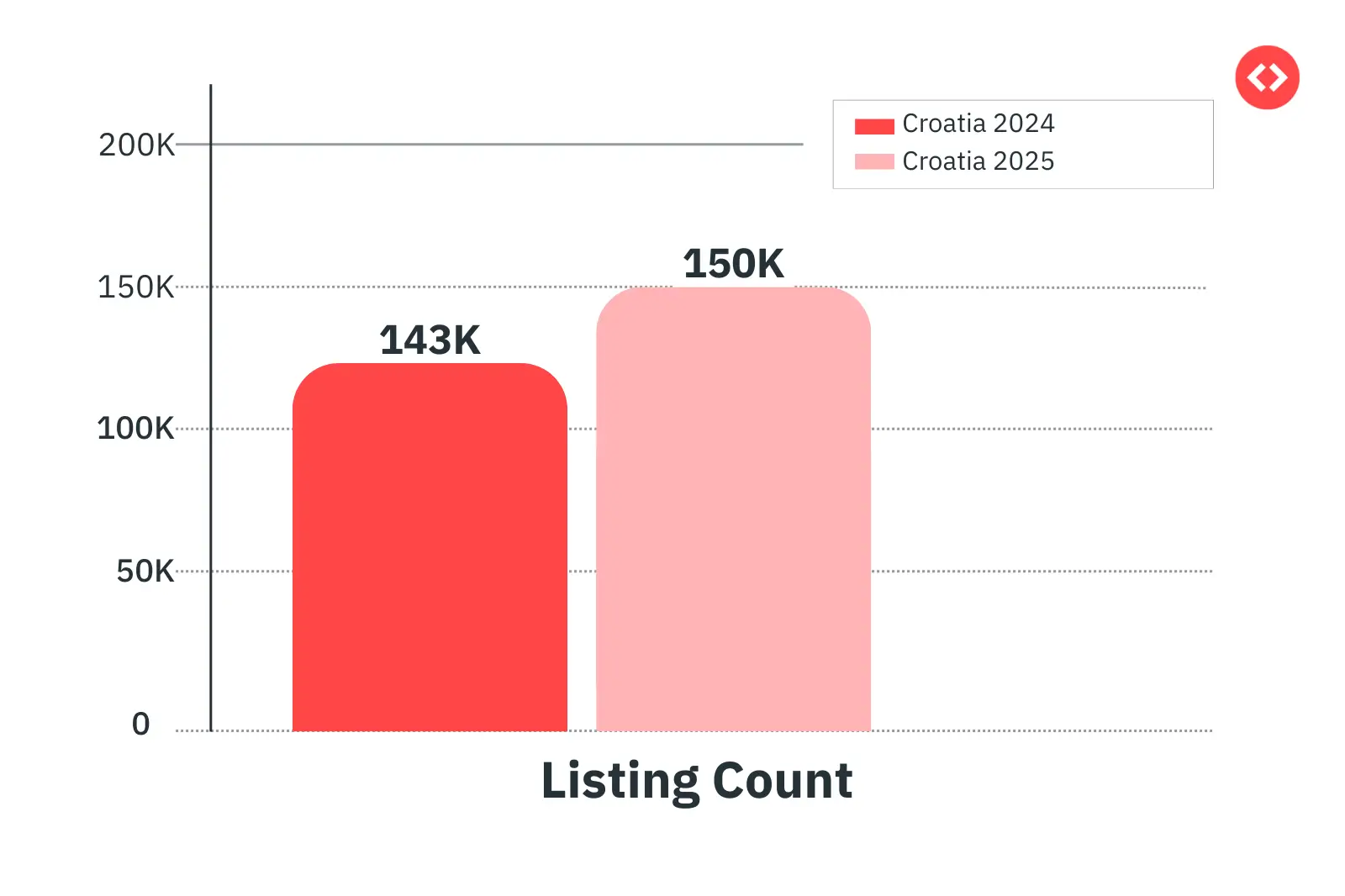
Key Insight: While growth is moderate (4.7% YoY), Croatia is approaching a saturation point. More supply means more competition for occupancy, making revenue management strategies (like dynamic pricing) even more critical.
Read More: Short-Term Rental Laws in Italy in 2025
Dynamic Pricing: Adoption and Impact
Dynamic Pricing (DP) tools such as PriceLabs are increasingly used in Croatia. These tools adjust rates in real-time based on demand, seasonality, and market competition.
Adoption Levels
From July 2025 data:
- 17% of listings don’t use dynamic pricing.
- Among those using it: 29% Low, 30% Moderate, 12% High.
Performance Impact of Dynamic Pricing
Listings using DP show higher occupancy, ADR, and RevPAR, with the difference most pronounced in peak season.
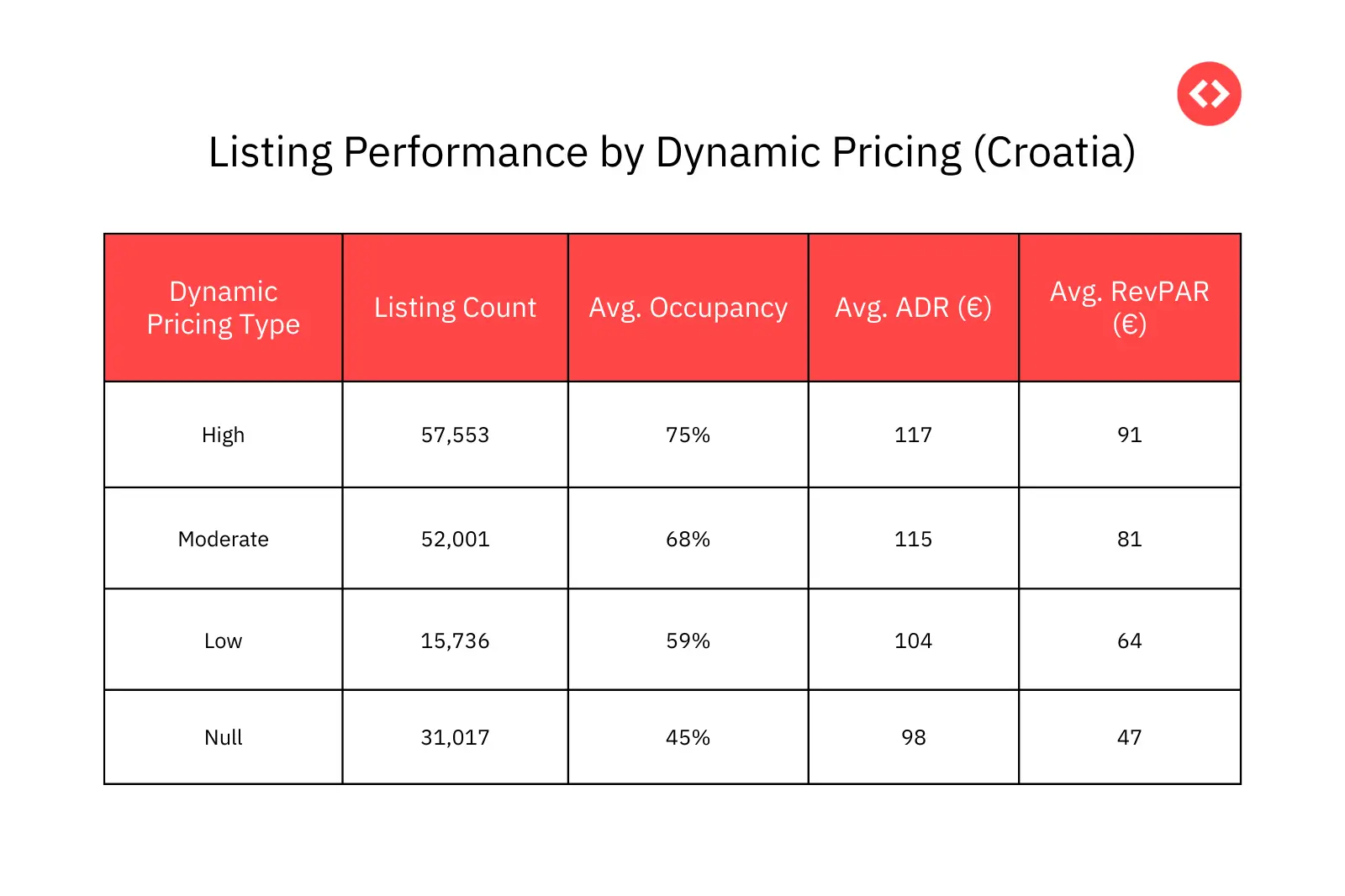
Occupancy Rates Rise with DP Adoption
- Listings with high dynamic pricing adoption enjoy an impressive 75% occupancy, compared to just 45% for listings without DP.
- Even moderate dynamic pricing boosts occupancy to 68%, showing that fine-tuned pricing strategies keep calendars consistently filled.
ADR Increases with Smarter Pricing
- Hosts using high dynamic pricing achieve the highest ADR at $133, compared to $112 without DP.
- Interestingly, even though low dynamic pricing has some effect, it caps ADR at $118, showing that under-utilized dynamic pricing doesn’t maximize rate potential.
RevPAR is Where the Gap Widens Most
- Revenue per available room (RevPAR) is the clearest indicator of DP’s value.
- Properties with high DP earn $103 RevPAR, almost double the $54 RevPAR of listings without DP.
- Moderate DP still delivers strong returns at $92 RevPAR, showing that even partial adoption significantly improves revenue outcomes.
The Takeaway: Full DP Unlocks Competitive Edge
- High dynamic pricing strikes the best balance: higher occupancy + higher ADR = maximum RevPAR.
- Properties not using dynamic pricing leave substantial revenue on the table, both in occupancy gaps and nightly rates.
Boost Your Bookings with Dynamic Pricing
Croatia’s vacation rental trends show just how much occupancy, rates, and booking behavior can improve with Dynamic Pricing. With PriceLabs Dynamic Pricing, you’ll always stay one step ahead—automatically adjusting your prices to capture demand, boost RevPAR, and keep your calendar full, no matter the season.
Sign Up For Free trialHow Property Managers Can Apply These Insights?
To turn these insights into action, property managers must think beyond traditional hosting and embrace a data-driven approach across all aspects of their business.
1. Advanced Revenue Management
- Adopt or Upgrade Your Dynamic Pricing Tool: The data is unambiguous: a high-performing listing in 2025 is a dynamic pricing listing. Choose a tool like PriceLabs Dynamic Pricing tool that offers deep market insights and allows you to customize minimum stay rules and discount strategies.
- Implement a Tiered Pricing Strategy: Don’t just set a price; set a strategy. For example, during summer, set a high base rate with a 7-night minimum stay. In the off-season, lower your base rate and offer last-minute discounts for bookings within a 14-day window to capitalize on the shorter booking trend.
- Optimize Minimum Stay Rules: Utilize a tool to automatically adjust minimum stays. In July and August, a 7-night minimum reduces turnovers and operational costs. In the winter, drop this to 2-3 nights to attract weekend getaways and short breaks.

2. Strategic Marketing
- Create Off-Season Packages: Marketing “sun and sea” in November is a losing game. Instead, pivot your messaging to highlight the local attractions for specific seasons.
- Wellness & Foodie Retreats: Partner with local spas, restaurants, and wineries to create all-inclusive packages. Market your property as a cozy base for a relaxing off-season escape.
- Digital Nomad Stays: With shorter stays and remote work on the rise, position your property as a perfect “work-from-anywhere” hub. Highlight fast Wi-Fi, a dedicated workspace, and local cafes with great coffee.
- Culture & Festival Tourism: Research local events like the Rijeka Carnival in February or the Zagreb Festival of Lights in March. Promote your listing as the ideal base for these cultural experiences, which attract travelers outside of summer.
3. Operational and Compliance Strategies
- Streamline Operations for Faster Turnovers: The drop in average length of stay means more frequent cleanings. Automate property management tasks, such as guest communication (check-in instructions, welcome messages), to save time. Consider an optimized vacation rental cleaning process to handle the increased workload efficiently.
- Stay Ahead of Regulations: Starting in 2025, Croatian short-term rental regulations have become much stricter and now require apartment owners in residential buildings to obtain consent from at least 80% of co-owners before a property can be registered for tourist rental—a change aimed at curbing the rapid conversion of homes to short-term rentals and easing pressure on local housing availability. The government has also introduced a clear legal distinction between “hosts” (those renting out rooms in their primary residence or small-scale family accommodation) and “landlords” (commercial operators or those whose primary income comes from short-term rentals); these categories now face different tax rates and compliance standards, with landlords subject to higher taxes and more rigorous checks. Property owners must now also register officially, keep proper guest records, and adhere to local zoning rules, which can vary by city or region in Croatia. Ignoring these changes is a significant business risk. Actively monitor local regulations, as they can vary by city, and ensure your property is fully compliant. This will help you to future-proof your STR business from crises.
The Future of Croatian Property Management is Professional
The Croatian vacation rental market in 2025 is at a crossroads. While the allure of its coastline and islands remains, the era of passive, “set-it-and-forget-it” pricing strategy is over. The data is precise: competition is intensifying, traveler behaviors are becoming more erratic, and regulatory changes are introducing new complexities.
Success is no longer about strong seasonal demand alone. It’s about a professional approach to property management, revenue, and marketing. Property managers who embrace dynamic pricing will not only outpace their peers in ADR and occupancy but will also build a more resilient business model. Those who strategically market their properties in the shoulder and off-seasons will unlock new revenue streams, turning winter’s traditional weakness into a year-round strength.
Ultimately, the market is rewarding sophistication and technology. The most successful listings will be those managed by operators who treat their property as a business, not a hobby. By leveraging data, adapting to new regulations, and embracing a proactive, agile strategy, property managers in Croatia can secure their place at the forefront of this vibrant and evolving industry for years to come.
Frequently Asked Questions
1. What are the peak and off-peak seasons for vacation rentals in Croatia?
Peak occupancy months in Croatia are June, July, and August, with occupancy rates reaching up to 79% in August. Off-peak months like January, February, and December see much lower occupancy, often below 20%.
2. How has the average daily rate (ADR) for vacation rentals in Croatia changed in 2025?
ADRs remain relatively strong during the summer peak months, with July averaging €175 and August €160. In the winter months, ADRs drop significantly, with November, January, and February staying around €95-€105.
3. What is dynamic pricing, and how does it impact rental revenue in Croatia?
Dynamic pricing tools adjust rental rates in real-time based on demand, seasonality, and competition. Listings that actively use high dynamic pricing see higher occupancy (up to 75%) and increased ADR and RevPAR, significantly boosting revenue.
4. Why are booking windows in Croatia shortening, and what does this mean for hosts?
Travelers are booking closer to their travel dates now, with average booking windows dropping by 13% to about 30 days. Property managers must adopt agile pricing and marketing strategies to capture late bookings and remain competitive.
5. How have regulations in Croatia affected the short-term rental market in 2025?
New laws require consent from a majority of co-owners in residential buildings before listing a property, and distinguish between “hosts” and “landlords” for tax purposes. These regulations have increased compliance requirements and slowed supply growth, affecting profitability.
6. What strategies can property managers use to improve off-season occupancy in Croatia?
Developing off-season tourism offerings such as wellness retreats, cultural festivals, experiential travel, and digital nomad packages can attract guests outside the summer months. Marketing around events like the Rijeka Carnival and Zagreb Festival of Lights is recommended.
7. How is the length of stay changing for vacation rentals in Croatia?
The average length of stay has decreased slightly to around 5.67 nights in 2025, driven by more flexible trips and budget-conscious travelers. Property managers should consider adjusting minimum stay requirements seasonally.
The post Vacation Rental Trends in Croatia: Insights from 2025 appeared first on PriceLabs .
]]>The post Spain Short-Term Rental Market Data 2025: Analyzing Shifting Trends appeared first on PriceLabs .
]]>But in 2025, Spanish short-term rental market data suggest something else. Property managers face a new reality — growing competition, tightening short-term rental regulations, and shifting guest behavior are changing the game.
Armed with the latest Spain short-term rental market data from PriceLabs, plus local context, community insights, and cultural references, this guide shows how to navigate these changes and turn August and September into your most profitable months.
Why August Dominates the Spanish Short-Term Rental Market?
August is Spain’s busiest travel month — and for good reason:
- National Holidays: Mid-August (Asunción de la Virgen) sees most Spaniards take their annual vacation.
- Iconic Festivals: La Tomatina (Buñol), Semana Grande (Bilbao & San Sebastián), and Málaga Feria draw huge domestic and international crowds.
- International Demand: UK, German, French, and Dutch travelers flock to Spanish beaches and cities.
For STR hosts and managers, this means strong demand — but in 2025, it also means fierce competition for every booking.
Spanish Short-term Rental Market Data 2025
Europe’s STR market hit a record 854 million guest nights in 2024, up 19% from 2023. Spain contributed significantly with 171 million guest nights, ranking second in Europe. Andalucía, for instance, emerged as Europe’s leading region for guest nights, recording 44 million in 2024, surpassing even Croatia. Cataluña also remains a strong performer, with 29 million guest nights.
For summer 2025, international tourist arrivals in Spain were forecasted to rise by 2.7%, with spending up 4.2%. Domestic travel was also projected to increase by 1.0%, with spending up 1.1%. Despite this broad tourism growth, STR occupancy is softening.
PriceLabs Data: Spain’s August & September 2025 Pacing & Key Metrics

According to PriceLabs STR data, August 2025 occupancy is pacing 62%, down 5% from last year, while ADR is up 8% (€169). Revenue per available rental (RevPAR) is flat or slightly declining due to weakening occupancy. A stable median length of stay around 6–7 nights indicates consistent traveler behavior in stay duration.

The total number of active STR listings in Spain has surged 8.7% (from 343,049 to 368,893 listings) over the past 12 months, heightening competition among Spanish vacation rentals and putting pressure on occupancy levels.

PriceLabs’ city-level data reveals stark differences between Spain’s two biggest urban STR markets:
Madrid: Occupancy has slipped sharply as an expanded listing base outpaced demand. The tightening regulations of 2024–2025 are only beginning to affect supply, so further drops are possible.
Barcelona: Longstanding restrictions have stabilized supply, but ADR has dropped 13% YoY, hinting at weaker demand or a shift toward lower-priced inventory.
Unlock Market Insights with PriceLabs Market Dashboards
Want to stay ahead of the competition? With PriceLabs Market Dashboards, you can track local demand patterns, benchmark against competitors, and spot booking trends before anyone else. From occupancy rates to ADR shifts, get the data you need to set the right pricing strategy and maximize revenue.
Explore PriceLabs Market DashboardsUnderlying Factors Influencing the Spanish Short-term Rental Market
The performance of Spain’s short-term rental (STR) market is shaped by a complex mix of economic conditions, traveler behavior, seasonal trends, and evolving regulations. Understanding these underlying factors is key for property managers and hosts to anticipate market shifts and adapt their airbnb pricing strategy, vacation rental marketing, and operational strategies accordingly.
1. Tourism Growth vs. STR Supply Pressure
- Data link: Despite 2025 being set for record tourism, occupancy pacing for Aug–Sep 2025 is -5% to -2% below STLY.
- Why: Active listings are up 8% YoY, meaning supply growth is outpacing demand in certain regions (e.g., Madrid).
- Implication: Even though ADR is up 6–8% YoY, RevPAR is flat to down (-1% on average) because fewer nights are being sold. This is a textbook case of revenue pressure from oversupply.
2. Stricter Regulations & Policy Changes
- Data link: Cities like Barcelona already cut STR listings by ~2% YoY, but national registry requirements (Ventanilla Única Digital de Arrendamientos) could lead to more removals, particularly of non-compliant units. The regulations require all landlords offering holiday homes or seasonal lets to register their properties, marking a pivotal shift towards centralized control and data-driven enforcement.
- Why it matters now: The Spanish government’s removal orders for 65,000 unlicensed listings, predominantly in Madrid and Barcelona, align with these challenges, reflecting heightening regulation aimed at easing the housing crisis. In oversupplied markets, regulatory enforcement could help compliant STRs by reducing illegal competition and boosting occupancy. The current dip in occupancy due to slower pacing means any supply reduction could materially improve RevPAR.
One Reddit post noted:
“There’s a glut of Airbnbs… property prices are up and you’re now restricted to owning just 2 STRs unless you open a company. The mood is mixed: great for some regions, but city center rules are getting tighter.”
Read More: Short-term Rental Laws in Italy
To help property managers and hosts navigate Spain’s new Single Rental Registry requirement, AvaiBook by idealista (integrated with PriceLabs) has created a Single Lease Registry Guide. It explains the application process, exceptions, and requirements, and provides direct links to complete your registration. Whether you manage one property or an entire portfolio, this guide makes compliance straightforward and helps you continue operating legally on major rental platforms.
3. STR & Long-Term Rentals: A Connected Market
- Data link: In markets where occupancy dips and RevPAR is stagnant, some owners may shift to long-term rentals, reducing STR supply — but also tightening local housing availability.
- Example: If August’s occupancy stays at 62% (down from 67%) despite record tourism, owners may look for stability elsewhere.
- Market ripple: Such shifts could prompt further regulation, as policy-makers track how STR availability impacts rent prices. Amidst local residents expressing anger over STR’s impact on housing and neighborhood quality, it has become even more important to practice responsible hosting as emphasized by this Reddit user.
“Managing guest expectations and keeping neighbors happy is important—city councils are getting tougher every month about noise and permits.”
Read More: Italy Booking Behavior: A Post-2020 Guide for Property Managers
How can Spanish Short-term Rental Property Managers Thrive?
In this increasingly competitive and regulated environment, Spanish hosts must adopt sophisticated, data-driven strategies to maximize their August profitability.
1. Master Dynamic Pricing
Use PriceLabs and similar dynamic pricing tools to adjust nightly rates in real time based on demand, local events, and competitor moves. Static pricing means a loss of revenue in this shifting market. The market’s willingness to pay higher rates during peak season is evident; for instance, ADR in Andalucía consistently peaks in August, reaching €190 in 2023. This approach means optimizing for the highest possible RevPAR, balancing higher per-night rates with occupancy to maximize overall revenue per available unit.

Boost Your Bookings with Dynamic Pricing in Spain
Spain’s short-term rental market is shifting fast—don’t leave money on the table. With PriceLabs Dynamic Pricing, you can automatically adjust rates to match demand, seasonality, and local events. Stay competitive, fill more nights, and maximize your revenue with ease.
Sign Up For Free trial2. Optimize Early for August Bookings
With booking windows averaging 73 days, property managers must prepare listings well in advance—refresh photos, update listings for SEO and AEO (Answer Engine Optimization), and leverage geo-targeted keywords like “family rentals in Andalucía August” or “beachfront apartment Barcelona.” Analyze your listing data to understand what has worked for you before. In an AI-first digital landscape, original data and first-party insights are golden tickets. Property managers can differentiate by creating unique content, such as curated local guides, which are prioritized by AI search algorithms and appear on Google searches. Proactively engage past guests with newsletters or personalized emails, offering incentives for repeat bookings.
3. Enhance Guest Experience
Exceptional guest services drive 5-star reviews, repeat bookings, and referrals. Stand out by offering:
- Streamlined Check-in & Communication: Use smart locks for self-check-in and send clear, advanced instructions. Be responsive to inquiries throughout the stay.
- Thoughtful Amenities & Personalization: Provide high-quality linens, a stocked kitchen, and small extras like welcome snacks or local toiletries. Tailor touches to guest type.
- Local Recommendations: Offer curated lists of local eateries and attractions for an authentic experience, positioning yourself as a local expert.
- Prioritize Cleanliness & Collect Reviews: A spotless property is essential for every stay. Optimize your vacation rental cleaning process to ensure your guests don’t walk into a dirty property. Additionally, actively request feedback and showcase positive reviews to build credibility.
4. Automate Operations & Manage Costs
Operational automation and cost optimization are fundamental for scalability and protecting profit margins.
- Automation: Use Property Management Systems (PMS) to automate property management tasks like centralizing communications, managing channels, automating cleaning schedules, and preventing double bookings. A well-designed booking engine integrated with a PMS can also significantly increase direct bookings, boosting profit margins by eliminating third-party commissions.
- Energy Efficiency: Invest in smart appliances and thermostats to reduce utility costs. Systematize appliance management routines for diagnostics and preventive maintenance, potentially saving 50% or more on energy costs. These investments allow hosts to maintain competitive pricing without sacrificing profit margins.
Read More: Off-Season Upgrades and Maintenance for Dubai Vacation Rentals
5. Engage Responsibly with Community & Regulations
Stay compliant with new registration laws, such as Spain’s “Ventanilla Única Digital de Arrendamientos”. Actively communicate with neighbors and guests about noise and waste policies to maintain goodwill amid regulatory scrutiny. Responsible property management mitigates risks, reduces complaints, and protects the host’s “social license to operate,” making their business more resilient against future regulatory changes or social backlash.
Your Path to a Successful Autumn in Spain
August and September are prime opportunities for Spanish STR property managers. Success requires smart, data-driven strategies and adapting to evolving conditions. While Spain’s overall tourism is robust, urban centers like Madrid and Barcelona face localized challenges from supply saturation and regulations.
To thrive, property managers must:
- Leverage dynamic pricing to capture August’s peak demand and optimize revenue. Current data indicates a higher ADR, but lagging occupancy, making dynamic adjustments vital for RevPAR.
- Optimize listings for guests and AI with professional visuals, compelling descriptions, and strategic SEO, AEO, and LLM optimization for maximum visibility.
- Prioritize exceptional guest experiences via streamlined check-ins, thoughtful amenities, local recommendations, and impeccable cleanliness. This builds loyalty and differentiates properties.
- Embrace automation and energy efficiency for streamlined operations and cost savings. PMS and smart home tech reduce errors, save time, and protect profit margins.
- Stay informed on regulations and foster positive community relations. Addressing public sentiment on housing and overtourism is crucial for long-term sustainability, especially with increased listings.
Spain’s STR market is vibrant yet complex. By implementing these strategies, adapting to nuances, and committing to responsible property management, Spanish property managers can maximize the August surge and build resilient, profitable businesses.
Frequently Asked Questions
1. What is the high season for short-term rentals in Spain in 2025?
In Spain, the high season for short-term rentals is during July and August, with August being the peak month. These months record the highest occupancy rates and rental prices, especially in popular destinations like Barcelona, Madrid, Valencia, and coastal cities such as Málaga and Alicante.
2. How is the short-term rental market in Spain performing in 2025?
The Spanish short-term rental market in 2025 shows strong demand during summer, with high occupancy in August. However, data also reveal shifting booking patterns, longer lead times, and growing mid-term rental demand, especially in urban centers. Property managers are advised to adapt pricing and marketing strategies to capture revenue across both peak and shoulder seasons.
3. Which cities in Spain have the strongest demand for short-term rentals?
Top-performing cities for short-term rentals in Spain include Barcelona, Madrid, Valencia, Málaga, Alicante, and Seville. Coastal regions and island destinations such as Ibiza and Mallorca also experience strong demand during summer, while major cities maintain steady occupancy throughout the year.
4. What are the average occupancy rates for Spanish short-term rentals?
In 2025, Spanish short-term rentals show average occupancy rates of 60–70% annually, with coastal and tourist-heavy cities peaking at over 80% in August. Seasonal variations are significant, so dynamic pricing is key to maximizing returns.
5. How can property managers in Spain maximize revenue from short-term rentals?
Property managers in Spain can maximize revenue by using dynamic pricing tools like PriceLabs, monitoring local market trends, adjusting minimum stays, and targeting both leisure and mid-term rental guests. Leveraging market dashboards helps identify demand shifts and set competitive pricing.
The post Spain Short-Term Rental Market Data 2025: Analyzing Shifting Trends appeared first on PriceLabs .
]]>The post Vacation Rental Accounting Guide: How Can Property Managers Avoid Common Financial Pitfalls? appeared first on PriceLabs .
]]>A study by TopKey found that short-term rental (STR) managers lose an estimated 10–20% of their monthly spend per property to “expense leakage”—unbilled or unreimbursed costs like seasonal deep cleans, emergency repairs, or recurring supplies. For a U.S. property manager, that’s $800 to $1,600 per unit per month, adding up to nearly $19,200 annually per property in lost revenue.
Property managers across the U.S. are unknowingly losing thousands of dollars every year. This comprehensive vacation rental accounting guide is designed to help you plug those leaks, track expenses accurately, recover every last reimbursement, and keep your profits healthy and scalable.
What Makes Vacation Rental Accounting So Challenging?
Managing finances for STRs is fundamentally different from a traditional long-term rental or real estate portfolio. The high-velocity nature of the business and unique financial layers create several pain points.
- Multiple, Layered Income Streams: Unlike a single monthly rent check, STR revenue is a mix of nightly rates, cleaning fees, pet deposits, early check-in fees, and upsells.
- Complex Fee Structures: You’re dealing with OTA commissions (Airbnb, Vrbo, etc.), credit card processing fees, management fees, and dynamic pricing adjustments.
- State-by-State Compliance: Accounting laws vary significantly by jurisdiction. In some states, it’s a legal requirement to keep owner funds separate. Even where it’s not, failing to do so can expose you to legal liabilities.
- Frequent Transactions: Dozens of monthly bookings automatically generate hundreds of financial entries. Reconciling each one manually is a full-time job in itself.
- Owner Trust Accounting: You’re handling money that isn’t fully yours. Accuracy isn’t optional; it’s the foundation of owner trust and the core of your business reputation.
- Seasonality and Cash Flow: Spiky revenue flows across the year make forecasting and budgeting difficult without a clear, granular view of your finances.
These layers make accuracy and consistency crucial for staying compliant with U.S. regulations, such as 1099 reporting and trust fund segregation.
How Should You Structure Your Chart of Accounts?
Your Chart of Accounts (CoA) is the backbone of your vacation rental bookkeeping. It categorizes every transaction, keeps trust and operational funds properly separated, and serves as the foundation for accurate owner reporting and financial insights.
A well-structured CoA allows you to:
- Track Property-Level Performance: Understand which properties are your top earners and which are underperforming.
- Separate Operational vs. Trust Funds: Legally and ethically keep your money distinct from your owners’ money.
- Understand Cost Drivers: Pinpoint where your money is going (e.g., cleaning, repairs, marketing).
- Report Transparently to Owners: Provide clear, professional statements that justify your management fees.
Here’s a simple table structure for your CoA:

Pro Tip: Look for a vacation rental accounting software that can auto-generate a CoA template in QuickBooks or Xero. This can save you countless hours and reduce the risk of miscategorization, ensuring your books are set up correctly from day one.
How Can You Simplify Monthly Reconciliation?
A typical month-end without automation is a nightmare. It often involves:
- Exporting transactions from your PMS and bank.
- Manually sorting through 100+ digital and physical receipts.
- Tagging each expense to the correct property.
- Splitting shared expenses (e.g., internet, pest control) across multiple units.
- Generating individual owner statements.
- Manually processing payouts.
This can take 2–3 full days and still leave significant room for error.
The solution is a three-way integration between your dynamic pricing tool, your property management system (PMS), and your accounting software (like QuickBooks or Xero).
How the Automated Flow Works:
- A guest books (via Airbnb, Vrbo, etc.). The booking data, including all fees, flows into your PMS.
- PriceLabs syncs pricing details nightly, pulling from your PMS. This ensures your rates are always optimized and your PMS has a clear, documented record of the final price.
- The PMS formats reservation data into transactional line items aligned with your CoA categories.
- The PMS automatically syncs that data into QuickBooks or Xero:
- Income → mapped to revenue accounts.
- Cleaning fees, platform fees → mapped to separate income/COGS accounts.
- Deposits and proceeds → mapped to liability and owner trust accounts.
This entire process is done automatically—no more manual exports, no more tagging, and a significant reduction in reconciliation errors.
Bonus Insight: PriceLabs integrates directly with Booking.com and connects with over 150 PMSs and channel managers, making it easy to keep your Airbnb, Vrbo, and other OTA listings updated, regardless of the platform. The pricing data flows cleanly and accurately, providing a single source of truth for your income.
Ready to Automate Your Pricing & Your Books?
Stop leaving money on the table and hours on the calendar. PriceLabs integrates seamlessly with your PMS to standardize rates, streamline your accounting, and boost your bottom line—all on autopilot.
Start Your Free TrialProtect Owner Funds: The Role of Trust Accounting and Owner Statements
What is trust accounting, and why is it important for vacation rentals? In many U.S. states, trust accounting is legally required. Even when it isn’t, it’s a best practice that protects you and your owners by ensuring you:
- Separate Client Funds: Keep money that belongs to your owners (e.g., guest payments) in a separate bank account from your own operational funds.
- Prevent Overdraws: Never accidentally use one property’s funds to cover expenses for another.
- Maintain Accurate Records: Ensure owner statements are accurate, auditable, and compliant with local regulations.
Best Practice: Open a separate bank account specifically for trust funds. Then, automate your owner statements to pull income, expenses, and net distributions per property directly from your accounting software. This ensures complete transparency and builds a foundation of trust with your property owners.
Stop Revenue Drains: How Do You Prevent Expense Leakage?
Expense leakage occurs when reimbursable costs are not billed. This is a silent profit killer that can cost you thousands of dollars annually.
Common culprits of expense leakage include:
- Cleaning charges that aren’t correctly linked to reservations.
- Emergency repairs during a guest’s stay are never reimbursed.
- Utility overages in high season that aren’t passed on to the owner.
- Small, unreimbursed supply runs (e.g., lightbulbs, toiletries).
Here’s a table that illustrates the financial impact:

To combat this, use expense automation tools that tag transactions and match them to the correct property or reservation. For instance, teams at Arrived were able to recover an estimated $250K–$350K per year and automate expense reconciliation, capturing charges they were previously missing.
Track the Right KPIs: How To Track Vacation Rental Performance?
Once your books are clean and automated, you can finally track the financial metrics that actually grow your business.

Tracking these KPIs makes cash flow projections more accurate, helps you provide clear and transparent financial statements to owners, and lets you quickly spot underperforming properties so you can adjust pricing or expenses as needed. This data-driven approach clearly shows owners the value of your management fees and services.
Dynamic Pricing: A Surprising Tool for Accounting Sanity
You might think dynamic pricing is just about increasing occupancy or ADR, but it’s also a financial sanity-saver.
How does dynamic pricing help with accounting? With tools like PriceLabs’ Dynamic Pricing, rate changes are automatically documented in your PMS. This ensures that:
- You can easily map actual earnings to each booking, reducing reporting errors.
- Variable pricing helps you forecast cash flow more accurately during peak and off-peak seasons.
- You can set floor prices based on your actual cost data (cleaning, utilities) to further protect your profit margins.

Ready to Simplify Your Pricing and Your Accounting?
Take the guesswork out of rates and the headache out of bookkeeping. With PriceLabs, you can automate your pricing, sync seamlessly with your PMS, and keep your finances organized—so you earn more while doing less.
Start Your Free TrialSo, Do You Really Need Full Accounting Automation?
This is the key question. Can you manage with a dynamic pricing platform like PriceLabs integrated with your PMS, while continuing to handle accounting manually?
It’s time to automate if you’re:
- Managing more than 10 properties.
- Spending 10+ hours a month reconciling books.
- Getting frequent owner queries about missing or confusing statements.
- Losing money on underreported cleaning or repair costs.
- Using multiple spreadsheets to manage different financial aspects.
A full accounting automation setup, often a combination of a PMS, a dynamic pricing platform, and a dedicated accounting software (like QuickBooks), eliminates manual data entry, automates expense allocation, and generates real-time dashboards.
Stop Letting Poor Accounting Undercut Your Business
Good accounting is your safety net, not just a necessary evil. It’s the springboard for growth, helping you scale with confidence.
With the right processes and tools—a PMS for bookings, PriceLabs for pricing, and a robust accounting tool—you can:
- Reclaim Lost Revenue: Plug expense leaks and recover money you’re unknowingly losing.
- Build Owner Trust: Provide transparent, accurate, and professional financial reporting.
- Scale Confidently: Make data-driven decisions based on a clear, real-time understanding of your business’s financial health.
Review your Chart of Accounts and calculate your potential expense leakage. That’s your baseline for financial clarity. From there, decide whether full automation or a partial setup (PMS + dynamic pricing or PMS + accounting automation) makes the most sense for your business.
Frequently Asked Questions: Common Questions about Vacation Rental Accounting
1. What’s the best vacation rental accounting software for property managers?
For property managers in the U.S., QuickBooks is the most widely used and recommended software. Its power lies in its integrations with property management systems (PMS) and other tools, which significantly reduce manual data entry and ensure clean, auditable books.
2. How do I know if I’m losing money through expense leakage?
A simple way to check is to review your reimbursable expenses (like cleaning, repairs, and supply costs). If you’re not consistently tagging and charging these per property or per reservation, you are very likely leaking 5–10% of your earnings.
3. Can dynamic pricing tools like PriceLabs really help with accounting?
Yes. PriceLabs helps standardize and document rate tracking, which makes it much easier to match booking income with nightly rates during reconciliation. This reduces errors, improves cash flow forecasting, and gives you a clear financial record for every reservation.
The post Vacation Rental Accounting Guide: How Can Property Managers Avoid Common Financial Pitfalls? appeared first on PriceLabs .
]]>The post How to Handle Guest Complaints (2025): 5-Step Property Manager Guide appeared first on PriceLabs .
]]>To handle guest complaints, respond within 30 minutes, show empathy, follow a clear SOP, use technology to triage, compensate where necessary, and follow up after resolution. No property manager wants their listing to be marked as low-quality, especially now. With Airbnb’s revamped hosting quality system in place, over 400,000 low-quality listings have already been removed, many flagged due to consistent patterns in public reviews.
To ensure your property doesn’t join this list, let’s break down how to handle guest complaints effectively by:
- Understanding the most common vacation rental guest complaints
- Following a 5-step complaint resolution strategy
- Using tools and processes to prevent escalation
Common Guest Complaints

Knowing how to handle guest complaints starts with understanding the issues guests most frequently report.
In the U.S., the most common guest complaints include:
- Inconsistent cleaning standards across STRs
- Noise complaints in urban multi-unit buildings
- Unexpected fees or vague checkout instructions
- Delayed responses from remote property managers
For instance, a traveler on Reddit shares,
“We had to pay $300+ fee for visitors stopping by during a $900/night stay, even though they were just visiting for a few hours.
Why do Guests Leave Complaints?
This brings us to the real question: Why do guests escalate issues into public complaints?
When expectations aren’t met or when guests feel ignored, it results in disappointment. And that disappointment often finds its way into reviews.
Take this Airbnb review, for example:
“We were a little disappointed because we were super excited to use the hot tub here. However, once we got there, we found out that the hot tub had been leaking and would not hold water. We were unable to use it. Then, we tried using the tub, which would not hold hot water from the spigot. We were able to get hot water from the shower head. The host is very responsive and answered quickly once we reached out. Unfortunately, due to these issues, we would not stay here again.”
The sentiment analysis of this review reflects a failure to deliver on a core expectation, a breakdown of amenities, and ultimately, a diluted experience. Even though the host responded promptly, the impression of being let down had already done the damage.
Across Airbnb and similar platforms, guest reviews often include either direct criticism or subtle cues about what went wrong, be it faulty appliances, slow responses, or hidden charges.
Guest Complaints Escalate When:
- Mid-stay feedback is ignored – Guests feel their concerns aren’t valued, leading to frustration that builds over the stay.
- Staff lack the authority or clarity to resolve issues – Delays in decision-making make guests feel neglected and prolong dissatisfaction.
- There’s no standard operating procedure (SOP) in place – Without clear guidelines, resolutions become inconsistent and unprofessional.
- Guests feel dismissed or invalidated – A lack of empathy can turn small issues into major grievances.
- Complaint escalations have no communication trail – Missing records cause miscommunication and repeated explanations, adding to the guest’s irritation.
How to Handle Guest Complaints: 5-Step Action Plan
Nowadays, with the surge in tools and data-driven approaches, it’s an unsaid expectation for a property manager to form an action plan to handle guest complaints.
Here’s a breakdown of the plan:
1. Respond Immediately and Empathetically
You don’t always know what triggered a situation and led to guests’ disappointment. Negligent or rude staff can cause distress among the guests.
Why immediate response works: A timely reaction demonstrates professional conduct, making guests feel heard and dissolving the issue while you plan next steps.
Analysis: Try to understand the complaint from the guest’s point of view. For instance, a check-in delay may feel like a disregard for their time, not just a scheduling issue.
Ideating solution: Determine if the issue can be resolved instantly or if it requires escalation. Even asking clarifying questions gives you time to respond with care.
Execution
- Acknowledge within 30 minutes
- Empathize with the guest
- Clarify details
- Act or escalate
Bonus Tip: Platforms like PriceLabs help align guest expectations with pricing. Dynamic pricing ensures guests don’t feel they’ve overpaid during low-service periods, and it reduces complaints tied to perceived value.
Boost Your Revenue Instantly
Let PriceLabs’ dynamic pricing adjust your rates automatically to capture every booking opportunity.
Start Your 30-Day Free Trial Now2. Form a Complaint Resolution SOP
Why it works: Eliminates guesswork — staff always know the next step.
Execution:
- Create SOPs for noise, cleanliness, amenity failures, etc.
- Train staff regularly.
- Update SOPs based on real feedback patterns.
 Quick Win: Make it a habit to regularly update your SOPs based on recurring complaints and how they were resolved to ensure your process evolves with real guest feedback. To get started quickly, you can download free SOP templates and tailor them to your needs.
3. Use Tech to Triage and Track Complaints
Technology can simplify how you manage complaints so nothing slips through the cracks and response times remain fast.
Why technology will work: Property management systems and AI-fueled chatbots will manage complaints, reduce response lag, and improve data capture.
Ideating solution: Set routing rules. Hygiene complaints go directly to the housekeeping team, while maintenance issues are routed to technicians.
Execution: Deploy a chatbot for FAQs and escalate complex ones. Have a setup where guests can report issues directly without involving the staff members.
Use tech analytics to review how well the system handled the complaint. What was the resolution time? Was it escalated? Adjust your strategy accordingly to avoid future dissatisfaction.
Suggested read: Top 7 Guest Service Examples for Vacation Rentals
4. Deliver Compensation When Necessary
Sometimes, small gestures can do the job and rebuild guests’ trust. An assurance of compensation of any kind prevents negative reviews.
Why the compensation strategy works: Guests often seek acknowledgment through compensation when their expectations aren’t met. Even a small token shows you value their experience.
Analysis: Gauge the emotional temperature. A broken AC in a luxury rental can be a deal-breaker, even if fixed quickly.
Ideating solution: Decide between a partial refund, discount vouchers, or even an upgrade. Empower your team with guidelines so they can act without waiting for approvals.
Execution: One of the most effective ways to handle guest complaints is by offering fair, proportional compensation. Here’s a quick guide you can adapt for your property.

5. Close the Complaint With Follow-Up Surveys
The resolution of a complaint doesn’t necessarily guarantee a negative review. Closing the complaint matters.
Why this works: A follow-up survey signals that you care beyond the immediate fix. It also helps reduce the chance of a negative public review.
Analysis: Look for subtle cues in feedback: did the issue feel resolved? Is there lingering dissatisfaction?
Ideating solution: Incorporate learnings into your SOPs and pre-arrival communications to prevent similar issues in the future.
Execution: Send the follow-up survey within 24 hours of checkout, acknowledge their response, and thank them for helping you improve.
Example follow-up survey questions:
- How satisfied are you with the resolution of your issue?
- Would you stay with us again or recommend us to friends and family?
These short, clear questions make it easy for guests to share honest feedback and give you measurable data to improve your services.
Why do Property Managers Need to Avoid Ignoring Guest Complaints?
In hospitality, silence is risky. Ignoring guest complaints can cost you more than just a bad review.
Here’s why addressing them proactively is essential:
- Negative reviews can tank bookings and OTA rankings: When guests feel unheard, they turn to platforms like Airbnb, Booking.com, and Google to voice their frustration, deterring future guests.
- You risk delisting on platforms like Airbnb: Airbnb takes unresolved complaints, especially those related to safety or discrimination, very seriously. Repeated violations may lead to suspension or removal from the platform.
- Unresolved issues can lead to legal consequences: If complaints involve safety hazards or health concerns, legal risks increase, especially if there’s no documented resolution process.
- Your reputation takes a long-term hit: Sites like TripAdvisor and Google Reviews carry lasting influence. One ignored complaint can spiral into a pattern of public distrust.
Closing Thoughts
Here’s a quick recap to strengthen your complaint resolution strategy:
- Respond quickly and empathetically; a timely response is at the core of handling guest complaints.
- Spot recurring patterns of complaints and identify triggers of different situations, making it easy for you to handle guest complaints and prevent escalation.
- Form structured SOPs and ensure clarity on protocols, which helps your team by providing a guide on how to handle guest complaints.
- Follow up with post-resolution contact; guests often remember the treatment after their complaint gets resolved.
- Never ignore a complaint; use feedback to refine your existing guest complaint handling methods.
- How you handle guest complaints defines your reputation and can drive repeated bookings.
Frequently Asked Questions
1. How long does it take to build an effective guest complaint handling procedure?
Depending on the size of the property and the nature of complaints received, building a complaint handling procedure (SOP) may roughly take 2 to 6 weeks. The procedure will include mapping complaint categories, training staff, creating resolution workflows, and testing escalation paths. Multiple properties may demand additional time for automation or standardization of SOPs.
2. Is it possible to apply one guest complaint handling strategy across all rental listings?
A property manager can try, but it’s not feasible. While core procedures such as response time and empathy remain consistent, complaint patterns may vary, i.e., location, listing type, and guest profile. Urban units may need strict regulations to control noise and maintain hygiene, while vacation rentals must prioritize amenities. It’s hard to have a generalized method.
3. Are there any legal risks if guest complaints are ignored or mishandled?
Yes, there are. Ignoring a serious guest complaint, failure in safety, or ADA compliance can expose property managers to legal scrutiny. Airbnb might even remove the listings that violate the policy. Guests might even file claims in courts through consumer protection agencies.
The post How to Handle Guest Complaints (2025): 5-Step Property Manager Guide appeared first on PriceLabs .
]]>The post Vacation Rental Insurance for Property Managers: Complete Guide appeared first on PriceLabs .
]]>What Is Vacation Rental Insurance for Property Managers?
Vacation rental insurance is a specialized insurance policy tailored to properties rented on a short-term basis on platforms such as Airbnb, Vrbo, and Booking.com or via direct bookings. It’s designed to cover what’s left out by homeowners’ insurance and landlord insurance. It works as a combination of real estate insurance and commercial insurance.
Alternatives to Short-Term Rental Insurance for Property Managers
Airbnb managers face two options other than getting this specialist insurance:
- Airbnb AirCover: The vacation rental website offers Airbnb AirCover included with all bookings, free of charge. While it protects against a number of risks, its coverage isn’t all-inclusive. For instance, it doesn’t pay for damage resulting from natural disasters or anything not caused by a guest.
- Self-Insurance: STR managers can collect a small fee from guests that goes towards an insurance fund. This can amount to a significant amount of money, sufficing to cover small damages. However, you cannot save up enough to pay for major destruction with self-insuring.
Vacation Rental Insurance Coverage: What’s Included?
Standard homeowner insurance typically doesn’t cover the unique risks associated with vacation rentals. That’s why vacation rental property managers need specialized insurance policies designed for short-term stays, multiple guests, and commercial operations. These policies offer broader protection to help you stay financially secure when things go wrong.
Here’s a breakdown of what vacation rental insurance usually includes:
- Property Structural Damage: Guest-caused, fire, and vandalism
- Property Contents Replacement: Furniture, electronics, and linen
- Guest-Caused Damages
- Theft
- Commercial General Liability: For guest injuries, Airbnb property management staff injuries, and lawsuits; typically $1 million+
- Loss of Rental Income/Business Disruption Coverage: In case the property becomes temporarily uninhabitable
- Optional Extra Coverages: Pet damage, flood, hurricane, water damage, and off-site liability
- Guest Screening: Specialized vacation rental insurance companies offer complimentary guest screening.

Why Does a Vacation Rental Manager Need Specialist Insurance?
A special short-term rental insurance will typically cover the following circumstances that will help you, as a property manager, to protect your business from unexpected expenses.
1. Protects Against Lawsuits and Liability
Short-term rentals perform business operations. Without commercial liability coverage, you risk having to cover medical expenses and lawsuit costs for injured guests, neighbors, and your team members. Standard homeowners’ policies exclude business use.
2. Covers Guest-Caused Property Damage
Airbnb rentals are prone to issues such as broken windows and appliances, stains on carpets and linen, and various forms of vandalism. If you don’t get property insurance, your property management company will have to pay out of pocket for these extra expenses, thinning your earnings.
3. Offers Income Protection
Sometimes damage is so severe that you have to shut down operations for an extended period. In this case, the loss of income clause will reimburse your bookings.
4. Provides Goodwill and Competitive Edge
Airbnb property owners feel more confident when their vacation rental comes with guest screening and a solid insurance promise. This allows you to generate more property management leads than your competitors.
5. Streamlines Claim Process
Specialized Airbnb insurance providers resolve claims within days, avoiding disputes between you and the owner.
All in all, short-term rental insurance helps you build healthy relationships with property owners, solve issues quickly, and keep your revenue to yourself.
However, getting vacation rental insurance is not enough for the success of your property management business. To maximize earnings and profit, you need to apply dynamic pricing aligned with your market specifications.
Get More Revenue with PriceLabs’ Dynamic Pricing Tool!
Easily launch a smart pricing strategy that optimizes daily rates dynamically to reflect market conditions, seasonality factors, demand shifts & competitors’ prices. Put pricing & revenue management on autopilot for optimal results.
Start Your 30-Day Free Trial NowWhat to Look for in Insurance as a Vacation Rental Property Manager?
When managing a vacation rental, unexpected events—from guest accidents to property damage—can disrupt operations and significantly impact your revenue. That’s why having the right insurance in place is essential. But not all insurance policies are created equal. As a property manager, you need coverage that protects both your business and your homeowners while aligning with your operational needs. Here are the key features to look for when evaluating vacation rental insurance:

3 Best Vacation Rental Insurance Providers for Managers
The top short-term rental insurance companies for professional managers based on coverage, services, and reviews are:
- Structural Damage Coverage: Up to $1 million
- Personal Property Replacement: Up to $10,000
- Liability Insurance Coverage: Up to $1 million
- Built-in guest screening
- Efficient claim process
- Payment of 80% of claims within 4 days
- Coverage for the property manager, owner, and guests
- Flexible price depending on property portfolio size, estimated occupancy, and deductible and coverage limits
- Commercial General Liability: Up to $2 million
- Property Manager Commission Income Protection
- New-for-Old Replacement
- Off-premise liability covering swimming pools, hot tubs, golf carts, and others
- Vrbo’s preferred comprehensive home insurance vendor
- Liability Coverage
- Accidental Damage Protection: Replacement cost value
- Corporate Damage Protection
- Bed Bud Protection
- Protection for the property manager and property owner
- Automated reporting
- Online claims processing
- Electronic invoicing
When choosing the right insurance for your vacation rental management business, consider your portfolio, the specific requirements of each property, your team size, and the most common risks in the area.
Skipping Vacation Rental Home Insurance: Risks & Real-Life Experiences
If you’re feeling tempted to skip the specialist insurance to save on the cost, check out what experienced vacation rental operators say about the risks of not having proper insurance:
High Costs Incurred by Bad Guests
A Reddit user with significant STR experience explains that Airbnb AirCover alone does not provide enough coverage. Based on their experience with a number of claims and lawsuits, without vacation rental insurance, you have to pay exorbitant property damage costs and attorney fees.

Loss of Rental Income
Another Reddit user highlights the risks of not having full coverage, including costly repairs and lack of revenue in case of bed bugs, for example.

Insufficient Coverage
Yet another experienced Airbnb operator shares on Reddit how not having the right policy is as bad as not having any policy. It’s important to opt for new-for-old replacement, as otherwise the money you get in case of burglary, for instance, might not be enough to buy new items.

Protecting Your Business with Vacation Rental Insurance
As a successful property manager, your job is to minimize risk, protect assets, and maintain trust with owners and guests. That’s why vacation rental insurance isn’t just nice-to-have. It is a must for additional protection that fills the gaps left by homeowners’ insurance, platform programs, and security deposits. From guest injuries to major property damages and lost income, specialist insurance covers the most costly risks in the profession.
To protect your business against suboptimal nightly prices, check out PriceLabs’ Dynamic Pricing & Revenue Management tool!
Frequently Asked Questions
1. Is Vacation Rental Insurance Worth It for Property Managers?
Yes, vacation rental insurance is key to running a well-protected property management business. The extra coverage that it provides is more than enough to offset the premium.
2. What Is the Best Insurance for Short-Term Rentals?
Safely, Proper Insurance, and Rental Guardian offer some of the best options for vacation rental property managers. However, to choose the right fit for your business, you need to consider your properties, your market, the typical risks, and your budget.
3. Why Should an Airbnb Manager Not Self-Insure?
While self-insuring can help cover small property damages, it cannot take care of expensive liability claims, costly medical treatments, lawsuit fees, and major property repairs. Without vacation rental insurance, you can easily go bankrupt in case of any of these occurrences.
4. What Coverage Options Are Not Provided by Airbnb and Vrbo?
Airbnb and Vrbo don’t cover loss of rental income, off-site liability, and named insured manager status. Moreover, they don’t protect direct bookings.
The post Vacation Rental Insurance for Property Managers: Complete Guide appeared first on PriceLabs .
]]>The post Short-Term Rental Analytics: Master Pacing & Performance appeared first on PriceLabs .
]]>What Are Short-Term Rental Analytics?
Short-term rental analytics or vacation rental data analysis refer to the collection, measurement, and interpretation of data that help property managers and revenue teams make smarter, more profitable decisions. Instead of relying on gut feeling or guesswork, these analytics provide data-backed insights into how your properties are performing—and how they stack up against the competition or past performance.
At their core, short-term rental analytics answer critical questions like:
- What is my average lead time or booking window?
- How many nights are being booked, and at what rate?
- Are bookings coming in faster or slower than last year?
- How does my pricing compare to similar listings in the market?
- Which channels or listings are driving the most revenue?
By consistently tracking and analyzing these metrics, property managers gain a clearer picture of both current performance and future potential. But one of the most powerful—and often underutilized—components of short-term rental analytics is pacing intelligence.
Let’s dive into what it means and how it can help you stay ahead of the market.
What is Pacing Intelligence in Short-Term Rental Analytics?
“What we really mean when we talk about pacing intelligence is: how are you performing for future dates compared to either a previous period or the market?” — Vincent Breslin, Co-founder of Uplisting.
The PriceLabs RevLabs episode discusses pacing intelligence and how to use it in detail. Pacing intelligence looks at forward-looking data, comparing your current booking curve to a relevant benchmark—such as last year’s performance, your internal goals, or your comp set. It’s not just about how many bookings you have—it’s about whether that number is good or bad for this time of year, in this market.
For example, if you had 20 nights booked for August last year by July 1 and 25 this year, you’re pacing ahead. But if the market is pacing at 35 nights, you’re falling behind.
Pacing vs. Projections: What’s the Difference?
“Pacing is about comparing where you are today versus where you were in the past. Projection is where you think you’ll land.” — Anurag Verma, Co-founder of PriceLabs.
- Pacing = How current bookings compare to historical trends or the market.
- Projection = Where you expect to end up, based on forecasting models.
Pacing grounds your projections in real-time truth. It allows you to intervene early and adjust strategy if you’re trending behind. You can analyze your pacing data using PriceLabs Portfolio Analytics.

Key Metrics in Short-Term Rental Analytics
Property management KPIs and metrics, such as occupancy rate and ADR, are central to STR performance tracking and pacing strategy, helping managers assess and improve their business.

“You want to understand what’s happening right now with your future reservations, not just guess based on gut feeling.” — Anurag Verma, Co-founder of PriceLabs.
Analyzing Internal vs. Market Data with Short-Term Rental Analytics
Relying solely on your own data is risky because market dynamics can change rapidly. Comparing your pacing against the broader market gives you essential context.
Your property’s year-over-year pacing data is your primary “source of truth,” offering an unfiltered view of your portfolio’s performance. Even with new or lost properties, you can compare “like properties” to anticipate performance. Ultimately, your business must meet its own financial goals, regardless of broader market trends.
However, market data provides crucial external context, especially in today’s volatile STR landscape, where supply and other factors constantly change.
“It’s not just about being up or down from last year—it’s about understanding whether that change is market-driven or property-driven,” says Anurag Verma, Co-founder of PriceLabs..
For example, if your property paces 20% ahead year-over-year, but the market paces 40% ahead, you might be missing revenue. This signals that rates are too low or that length-of-stay rules are too strict. Revenue management isn’t just about preventing losses; it’s about seizing opportunities during upturns.
Always understand the “why” behind the numbers. Consider a client whose market faced a hurricane. Their property might show a significant year-over-year decline. But if the market hasn’t recovered and they still outperform it, the story changes. Reacting to internal numbers without market context can lead to misguided decisions, like unnecessary price drops in a depressed market.
Market supply volatility also drastically alters dynamics. A sudden flood of new inventory, like 250 new large homes entering a market that previously had only 10, can overwhelm demand. Property managers in growing markets must constantly monitor new construction and listing trends and proactively adapt their strategies.
How to Use Comp Sets Effectively in Short-term Rental Analytics?
“If you’re managing a high-end treehouse or a 5-bedroom ski chalet, you can’t rely on standard comp sets—you need to define your own.” — Anurag Verma, Co-founder of PriceLabs.
Comp sets, or competitive sets, help you compare how your vacation rental is performing against similar properties in your area. They’re a key tool for making smart pricing decisions.

Default Comp Sets:
Tools like PriceLabs often provide automatic comp sets based on factors such as bedroom count and type. These work well in areas where properties are very similar—like lots of one-bedroom apartments in a busy downtown area (think central Miami). In such cases, the default comp set usually gives a good idea of how your listing is doing.
Custom Comp Sets:
But what if your property is unique? Let’s say you manage a luxury properties or a big ski chalet. In these cases, the default comp sets won’t cut it. For example, suppose you’re renting out an 8-bedroom mansion in the countryside and there aren’t many similar listings nearby. In that case, you’ll need to create a custom comp set by finding truly comparable homes—even if they’re in different but similar markets. These kinds of properties are often valued for their experience and unique features, not just their location, size, or property type.
Use Comp Sets Carefully:
While comp sets are helpful, don’t let them be your only guide. As Rebecca Ballart says, “The business down the street may not have the same goals or fee structures as you.” Just because a nearby property charges less doesn’t mean you should, too. Their pricing strategy might reflect different business priorities or owner expectations. Always focus on what makes your property special—like better service, standout amenities, or strong guest reviews. These can justify higher prices even if competitors are cheaper.
Want instant insights into your local vacation rental market?
Try the PriceLabs Market Dashboard and uncover trends that drive smarter decisions!
Start Your Free trialAdjusting Strategy by Market Type
Different markets require different pacing strategies:

“Urban markets are more last-minute driven. Vacation markets tend to have longer lead times. But overall, booking windows are shrinking across the board.” — Vincent Breslin.
This shift is partly due to widespread last-minute discounts, which trained consumers to wait. Reversing this trend requires early bird pricing strategies.
This proactive approach not only boosts immediate revenue but also results in increased visibility and faster bookings for subsequent high seasons.
Strategic Levers to Influence Pacing
1. Dynamic Pricing
Dynamic pricing involves continuously adjusting nightly rates based on real-time demand, seasonality, and booking trends. This includes raising rates for peak periods, holidays, and events, and strategically lowering them during slower midweek nights or off-peak seasons.
Proactively adjusting rates ahead of time can significantly improve performance. Instead of waiting for last-minute desperation, strategically lowering prices for future slow seasons well in advance can build momentum on Online Travel Agencies (OTAs).
“Airbnb and the OTAs just love it when you’re driving bookings. And when you’re driving bookings, they want to show your properties more,” Jasper Ribbers explains.
This proactive approach not only boosts immediate revenue but also results in increased visibility and faster bookings for subsequent high seasons. PriceLabs Dynamic Pricing solutions help you automatically adjust your nightly rates based on market trends and real-time data.

Take Control of Your Short-Term Rental Analytics
Gain the insights you need to optimize pricing, track performance, and stay ahead of the market with tools like PriceLabs Dynamic Pricing.
Start Your Free trail2. Flexible Minimum Stays
The flexibility of minimum stay requirements is a powerful, often underutilized, lever for increasing occupancy and revenue.
“More flexibility usually leads to more revenue,” Jasper Ribbers states.
Many operators tend to be overly restrictive, missing out on potential bookings.
- Impact on Searchability: Strict minimums (e.g., a rigid 7-night minimum) severely limit a property’s visibility on major OTAs.
- Increased ADR for Shorter Stays: Guests are often willing to pay a premium for the flexibility of shorter stays, allowing you to increase ADR for high-demand short periods.
- Stair-Stepping Minimum Stays: Gradually reduce minimum stays as the booking date approaches (e.g., 7 nights at 90 days out, 3 nights within 30 days) to protect longer stays while capturing last-minute demand.
- Filling Gap Nights: Shorter stays, especially for weekdays, are excellent for filling empty calendar gaps.
- Length-of-Stay Discounts: Encourage longer bookings with attractive discounts for extended stays (e.g., weekly or monthly discounts), offering flexibility without rigid minimums.
- Adjacency Logic: Utilize advanced rules that allow more flexible minimum stays when they “fill a gap” around existing bookings, preventing undesirable odd-length gaps.
However, increasing flexibility and offering shorter stays will inevitably lead to a higher volume of turnovers. This means balancing revenue optimization with operational capacity, potentially requiring investment in additional staff or more efficient processes.

Real-World Pacing Challenges
Learning from real-world scenarios provides invaluable context for applying pacing intelligence. The case studies mentioned below are discussed in the RevLabs episodes.
Case Study: Supply Flood in Branson, Missouri
Rebecca Ballart shared how Branson, a popular drive-to, multi-family vacation destination, experienced an unprecedented and rapid increase in the supply of large homes (6-bedroom and higher). This created an “amenity race” and significantly impacted legacy homeowners’ occupancy.
The response involved strategic pricing in shoulder seasons, meticulously studying booking windows, and crucial collaboration between revenue management and marketing teams. They targeted repeat guests through direct contact and personal phone calls for high-value bookings, fostering loyalty and long-term revenue.
Case Study: Proactive Pricing for OTA Momentum in Australia
Jasper Ribbers shared a case from Australia, where operators traditionally focused on last-minute pricing, hurting low-season bookings and subsequent high-season OTA visibility.
The strategy flipped: they used custom seasonal profiles to significantly reduce prices well in advance for the low season, utilizing OTA-specific early booker deals. This proactive approach led to a remarkable 40% outperformance in RevPAR, even requiring operational adjustments for increased turnover.
Case Study: Natural Disaster Recovery
Monique shared an example where a client’s market experienced a significant year-over-year decline due to a hurricane. By comparing the client’s performance to the overall market, it was clear they were outperforming the severely impacted market. This crucial context provided a realistic understanding, indicating a broader demand problem rather than a property-specific pricing issue.
Actionable Takeaways
“You don’t want to react too quickly, but you also don’t want to wait too long to adjust. The sweet spot is identifying trends early and acting with purpose.” — Vincent Breslin.

- Regularly Review Pacing Reports: Make it a routine to review pacing reports, market dashboards, and internal historical data to inform every strategic decision. Always compare internal performance against both historical data (your “source of truth”) and the broader market context to gain a complete and accurate picture.
- Compare Internal + Market Data: Internal year-over-year performance serves as your baseline, while market data reveals broader trends, helping to distinguish between property-specific issues and market-wide shifts.
- Align Revenue + Marketing: Optimized rates are only effective if potential guests see them and are compelled to book. Revenue and marketing teams must work hand-in-hand to ensure maximum visibility and conversion. Establish regular meetings to share insights on demand shifts and trends for precisely targeted marketing campaigns.
- Embrace Flexible Minimum Stays: Challenge any rigid or outdated minimum stay policies. Greater flexibility often translates directly into more revenue by significantly increasing a property’s visibility and catering to diverse traveler needs. Actively utilize “stair-stepping” minimums and “adjacency logic” to optimize your calendar.
- Invest in the Right Technology: Leveraging specialized vacation rental technology solutions is indispensable. Dynamic pricing tools, robust channel managers, and sophisticated market intelligence platforms (like PriceLabs’ Market Dashboard and Short-Term Rental Index) are essential for automating processes, gaining deep insights, and managing operations with peak efficiency.
From Insight to Impact: Turn Short-Term Rental Analytics into Actionable Strategies
Mastering short-term rental analytics isn’t just about tracking data—it’s about making informed, confident decisions that drive sustained revenue growth. Pacing intelligence is a core strategy for maximizing revenue in short-term rentals. By blending internal benchmarks with market context, property managers and revenue teams can make faster, smarter, and more profitable decisions.
“Revenue management is no longer just about setting prices. It’s about understanding performance, identifying trends, and acting before the market moves past you.” — Anurag Verma, Co-founder of PriceLabs.
In a competitive landscape, that’s not just smart—it’s essential.
Frequently Asked Questions
Q: What are short‑term rental analytics?
A: These analytics are data-driven insights that help property managers track performance trends—like occupancy, ADR, RevPAR, pacing, and booking window—to optimize pricing, stay competitive, and maximize revenue.
Q: How does pacing intelligence help in short‑term rental analytics?
A: Pacing intelligence compares your current booking momentum for future dates against benchmarks like last year or the market, helping you act early if you’re behind or capitalize when trending ahead.
Q: How can short‑term rental analytics improve my pricing strategy?
A: By analyzing market demand, competitor pricing, seasonality, and internal trends, analytics tools guide dynamic pricing adjustments that drive bookings and revenue growth.
Q: What are the best analytics tools for short‑term rental properties?
A: Leading tools include platforms like PriceLabs, which provide dashboards, market benchmarks, pacing reports, and automation for smarter pricing decisions.
Q: Can analytics help understand guest preferences and behavior?
A: Yes! Tools that incorporate guest booking patterns and reviews offer insights into preferences so you can optimize amenities, listing details, and marketing strategies.
The post Short-Term Rental Analytics: Master Pacing & Performance appeared first on PriceLabs .
]]>The post Starting a Property Management Business? Here’s A Complete Vacation Rental Playbook appeared first on PriceLabs .
]]>For starting a property management business, you’ll need to follow 10 non-negotiable steps.
What is a Vacation Rental Property Management Business?
A vacation rental property management business involves managing short-term rental homes on behalf of individual property owners, without owning or leasing the properties yourself.
In this model, you handle all core operations: updating and optimizing listings, managing bookings and guest payments, responding to guest inquiries, adjusting nightly rates based on market trends, and coordinating cleaning and maintenance tasks.
The primary goal is to maximize occupancy, increase the homeowner’s rental income, and ensure a smooth guest experience. This business model is especially effective if you have a background in hospitality, are locally based and responsive.
You earn a short-term rental management fee of around 20% to 30% of bookings, and the owner takes care of property-related costs. Another option is a flat monthly fee model. You charge a fixed fee each month, regardless of how many bookings the property gets.
Let’s outline an entire setup plan for starting a property management business from scratch.
Step-By-Step Guide For Starting a Property Management Business
These steps tell you how to start a property management company from the ground up and prepare it to scale in the future.
Step 1: Frame a Business Plan
A clear Airbnb business plan sets the foundation for every decision you make when starting a property management business. As you’ll manage various properties for other owners, your plan should answer three core questions:
- How will you earn?
You can charge a flat monthly fee, a percentage of bookings, or offer add-on services to charge a premium (like photography, interior upgrade advice, or marketing audits).
- What kinds of properties and guests do you want to focus on?
Define your ideal fit, such as urban condos, family-friendly homes, or remote villas. This helps you attract owners with aligned goals and expectations.
- What will your daily workflow look like?
From onboarding clients and coordinating cleanings to after-hours guest emergencies, define your scope of services and how you’ll systematize operations.
- What will be your monthly break-even point for expenses vs. revenue?
Before starting a property management business, you should figure out the number of properties you must manage to cover all your business expenses, like software subscriptions, contractor payments, and marketing. To calculate it, divide your total monthly expenses by your average management fee. This tells you how much revenue you need to generate across all properties to break even.
Also Read: Airbnb investing for beginners.
Step 2: Market Research and Demand Analysis
The success of a vacation rental property management business relies on how well you understand demand in your target market. It means doing your homework before you commit to a location, niche, or strategy.
To become a property manager, you need to identify the type of properties and homeowners you want to work with to shape your service offerings accordingly.
| “Just get an idea and be open to splintering off into different ideas. That’s how you’re going to find the real, true profitable markets.”Daniel V. Rusteen (Airbnb expert) |
Consider these fundamentals:
- What kinds of properties perform well in your target area?
- Is the market seasonal (beach towns, ski resorts), or steady year-round (urban business hubs)?
- How saturated is the market?
- What do high-performing listings have in common?
- Are homeowners struggling to self-manage or getting booked?
Don’t try to target every type of listing. Instead, specialize in 1 or 2 property profiles you understand deeply and build efficient systems around them.
Tools like PriceLabs’ Market Dashboards make this easier. You can dig into Average daily rates (ADR), occupancy trends, booking windows, supply, and pricing demand over time.

“PriceLabs Market Dashboard was actually how we started gauging what area makes sense and know where to go next.” Lydia Patel |
Step 3: Service Positioning for Your Selected Niche
You don’t want to be a generalist managing everything from beach cabins to city lofts. Instead, you want to stand out to the right homeowners.
Choosing a clear niche will shape nearly every operational and marketing decision you make. It enables you to build repeatable systems, establish a focused pricing model, and identify precisely which types of owners to target with your pitch.
Here are a few examples to help clarify your positioning:
- Premium properties: High-end homes with luxury finishes, pools, or views. Owners expect full-service management and spotless execution.
- Family vacation homes: Suburban or spacious properties catering to parents and kids. Owners focus on safety, cleanliness, flexible check-in/check-out options, and longer stays.
- Business travel-friendly units: Smaller, centrally located homes ideal for midweek bookings. Hosts prioritize fast communication, 24/7 access, and midweek booking optimization.
Step 4: Legal Setup
Now, it’s time to lay the legal groundwork. Short-term rentals operate at the crossroads of hospitality and real estate. You’ll be dealing with business rules, local short-term rental laws, and tax requirements.
Prioritize three aspects at this stage.
1. Right Business Structure
First, choose a business framework, like an LLC (Limited Liability Company), a sole proprietorship, a partnership, or a corporation. Most property managers set up an LLC, and for good reason.
An LLC builds credibility with homeowners, vendors, and platforms. It also helps separate your personal assets from business liabilities, making taxation easier.
Check your city or county’s official site for the latest rules.
For example, the STR market in the US is regulated at the local level. So, rules can vary even within the same state. That’s why it’s essential to consult a legal advisor for the most up-to-date requirements.
Some cities also limit how many STRs can operate in a neighborhood or restrict STRs to only owner-occupied units. So don’t guess. Look it up and document everything.
2. Taxation
As an STR property manager, you need to understand the tax implications of your business, especially if you plan to scale across multiple cities or states.
Here’s what to keep in mind:
Get a tax ID:
Most cities or states may require a separate tax identification number for reporting income. For instance, you need a Sales Tax Certificate in Florida and a Transaction Privilege Tax (TPT) license in Arizona.
Clarify tax roles in your contract:
Be specific about who handles what. You don’t want to be held responsible for tax filings that the owner forgot to complete.
Track your management income separately:
Whether you charge a flat monthly fee or a percentage of revenue, you’re earning taxable income. Maintain accurate records for every property you manage, including the costs incurred during management.
Don’t wait until tax season to get organized:
Some jurisdictions may require you to file quarterly tax reports. Create a simple tracker to stay on top of local filing deadlines, owner tax obligations, and your own business reporting needs.
Also Read: Short-term rental tax loophole.
3. Contract Documentation
A well-structured contract protects both you and the vacation rental owner. It clearly sets expectations, reduces the risk of disputes down the line, and signals that you run a trustworthy operation.
At a minimum, your agreement should cover:
- Your fees: flat fee or x% of revenue
- Your responsibilities: guest communication, cleaning, and maintenance coordination
- What the owner is responsible for: major repairs, upgrades, property taxes, and insurance
- Booking rules and pricing control: who sets rates and how
- Termination terms: how either party can exit the agreement
Also, do not forget to consult a lawyer for contract creation. You don’t need a 20-page legal document, but the contract should be clear and fair to both parties..
Step 5: Scaling Strategies To Acquire More Clients
When you bring a new property owner on board, gather the necessary information upfront and have a clear checklist of setup tasks to ensure a smooth onboarding process. This helps in alignment. Consider these key aspects of an effective onboarding process.
- What Info Do You Need?
- What Services are Included?
- What’s Your Onboarding Checklist?
- How Do You Build Your Local Brand?
- How do you Plan To Use Social Media Marketing?
Also Read: Airbnb promotion guide

Step 6: Build SOPs to Manage Multiple Listings More Efficiently
Your Airbnb property management business model should account for growth in the future. A growing vacation rental business needs a structured approach. This way, you can manage every home without getting overwhelmed and stay profitable too.
1. Build a Team
At a certain point, you’ll want to hire for roles to maintain quality as you grow. The first few hires matter significantly because they’ll help shape your systems and service quality.
- Focus on building a team you trust, even if it’s just a couple of go-to people.
- Start small with reliable cleaners. You can get an assistant to help with emergencies when you’re offline.
Outsourcing tasks that aren’t your forte is a smart move. For example, hire a bookkeeper to track and handle all the income/expenses.
2. Daily Operations and Task Delegation
You can only do so much alone. As you grow beyond a few units, roles start to split. You need to learn how to automate property management tasks. Here are the key tasks to delegate:
- Turnover cleanings
- Maintenance coordination
- Guest messaging (use automated replies + VA backup)
- Owner reporting and updates
- Accounting and bookkeeping
3. Inventory Setup
Focus on building repeatable systems. If every property has different linens, cleaning expectations, or dishwasher instructions, you’ll waste time.
Standardize everything you can:
- Airbnb welcome letters and house manuals – use a templated format for each property
- Cleaning checklists – so nothing gets missed by your team or a new vendor
- Restocking lists – automate what needs to be bought and when
- Regular inspections – to catch wear and tear before your guests do
Standardization means consistent quality. Guests know what to expect, and your team has fewer decisions to make.
4. Financial Planning for Scale
Multiple listings usually mean more revenue. But it also means higher expenses, tighter margins, and bigger risks if you’re not tracking everything closely.
From day one, set up a simple financial system that can grow with you. It must include:
- Monthly P&L per unit: Track revenue, Airbnb cleaning fees, maintenance, platform commissions, etc
- Cash reserves: Set aside funds for repairs, slow seasons, or regulatory changes
- Owner payout tracking: When managing for others, keep transparent records of revenue shares, deductions, and payment timelines
- Tech stack and labor costs: More STR properties mean more supplies, tech tools, and possibly more staff.
Step 7: Focus on Guest Experience
Getting bookings is only the start. The real test of your vacation rental business comes after guests walk through the door.
Remember: Great guest experiences lead to great reviews, which in turn drive sustainable growth.
So, here’s how to make that happen at scale.
1. Smooth Check-in & Check-out Process
Guests shouldn’t need to guess how to get in or what to do before they leave. So start with clear instructions:
- A friendly welcome message as soon as guests book
- Driving directions and parking info
- Access codes for smart locks or keyless entry
- Check-out reminders and expectations (trash, linens, etc.)
Share your pre-planned digital Airbnb welcome book or simple guide PDF, which includes house rules, appliance tips, and favorite local spots.
2. Prompt Communication
As you’re managing a space, it’s your responsibility to help guests feel comfortable, informed, and cared for. You must set the tone early on.
- Confirm their booking with a warm, helpful message
- Ask them to read and acknowledge Airbnb house rules
- Be clear about how they can contact you (or your team) during the stay
If something goes wrong, your “response speed” matters more than the issue itself. Train your team or Airbnb co-host to keep calm as the occasional 2 AM call about a beeping smoke detector is part of the job.

4. Collect Guest Feedback
You can’t improve what you don’t measure. After each guest checks out, send a brief, open-ended thank-you message either manually or through your PMS to show you care.
This creates a feedback loop that helps you identify strengths, fix recurring issues, and improve service consistency over time.
You can also repurpose positive guest feedback into testimonials for your vacation rental website or social pages to attract more leads.
Step 8: Create a Marketing Plan For STR Properties
One of the fastest ways to prove your value as a property manager when you are just starting a property management business is by improving your client’s listing performance. Start by refining your title and description to highlight guest-friendly features (e.g., “Cozy 2BR | Walk to Downtown | Free Parking & Fast Wi-Fi”) and pair them with high-quality photos.
Beyond Airbnb, expand your reach with multi-channel distribution through platforms like Vrbo (great for families), Booking.com (ideal for international guests), and a direct booking site to save on fees. You can even use a channel manager to sync calendars and avoid double bookings.
Also Read: Complete Vacation Rental Guide

Step 9: Choose Your Tools & Tech Stack
Manual workflows simply won’t cut it when you manage a large portfolio. A smart tech stack not only automates routine work but also helps provide guests with a smoother experience.
1. Property Management System (PMS)
A PMS handles reservations, syncs calendars across platforms, and automates routine operational tasks. Without one, managing multiple listings will be time-consuming and error-prone.
2. Channel Manager
Managing various listings manually across platforms like Airbnb, Vrbo, and Booking.com often leads to double bookings or miscommunications with guests. That’s why you need a channel manager to sync your calendars, pricing, and messages across all platforms.
You can invest in a standalone channel manager or look for PMS platforms with a built-in feature, like Hostaway, Guesty, and Lodgify.
3. Dynamic Pricing Tools
A dynamic pricing tool is a must-have for property managers who want to stay competitive and maximize revenue.
Unlike static pricing, which can lead to undercharging during peak demand or overcharging during low seasons, tools like PriceLabs Dynamic Pricing help keep your rates optimized on a daily basis.
The vacation rental software adjusts nightly rates automatically based on:
- Local demand and market trends
- Seasonality and holidays
- Competitor pricing
- Historical data
PriceLabs also integrates with popular PMS platforms like Guesty, Hospitable, Hostaway, Avantio, and Lodgify.

Step 10: Track Costs and Income for Revenue Optimization
When you are starting a property management business, you have to make financial reviews a regular habit: monthly for routine checks and quarterly for deeper insights. Track more than just occupancy; utilize key property management metrics to identify underperforming areas, spot seasonal trends, and refine your revenue management strategy.
When managing for others, send clear performance reports showing monthly income, net payouts, major guest or maintenance issues, and a breakdown of fixed and variable costs.
Custom templates or spreadsheets work well. Transparent, consistent reporting not only builds owner relations but also helps you justify decisions and retain long-term clients.
Frequently Asked Questions
1. Do you need any qualifications or licenses to be a vacation rental manager?
No, you don’t need any formal qualifications to manage a vacation rental business. But many cities and states require business licenses or STR permits.
2. What are the key responsibilities of a vacation rental manager?
A vacation rental business manager handles bookings, guest communication, cleaning, maintenance, pricing optimization, and owner reporting.
3. How long does it take to start a vacation rental business?
You can usually launch a vacation rental business within 4 to 8 weeks, depending on your chosen setup and licensing.
4. How much do vacation rental managers earn?
Most STR property managers charge 20% to 30% of the gross revenue per listing. But overall income varies by location, scale, and portfolio size.
5. What is Section 179 short-term rental?
Section 179 allows you to deduct the full cost of qualifying property in the first year, like furniture.
6. What cities are best for STR?
Areas with high travel demand and STR-friendly laws are the best. You can also use tools like PriceLabs Market Dashboards to find the most in-demand locations.
Conclusion: Build Systems First & Scale with Confidence
When starting a property management business, you need to shape your business plan, build a team, and track performance to prepare yourself to scale.
The most successful property managers set up systems early, stay compliant with changing regulations, use tech to automate tasks, and prioritize client satisfaction. A structured, repeatable process lets you manage multiple listings efficiently and grow with confidence.
The post Starting a Property Management Business? Here’s A Complete Vacation Rental Playbook appeared first on PriceLabs .
]]>The post Italy Booking Behavior: A Post-2020 Guide for Property Managers appeared first on PriceLabs .
]]>Understanding key metrics, such as booking windows (the time between booking and arrival) and median length of stay (LoS), is vital for effective revenue management and marketing in Italy’s hospitality industry. These insights offer foresight into demand patterns, enabling the optimization of inventory, pricing, and promotions for Italian vacation rentals. This report analyzes these metrics from April 2020 to June 2025, offering a comprehensive view of Italy’s evolving travel landscape and Italy’s booking behavior.
Understanding the Data: Italy’s Booking Behavior 2020-2025
To gain a comprehensive understanding of Italy’s booking behavior, let’s examine the data for both the median booking window and the median length of stay from April 2020 to June 2025. This allows us to observe three distinct phases in Italian travel trends:
1. Crisis & Uncertainty (2020 – Early 2021)

In the early stages of the COVID-19 pandemic, traveler behavior was driven by uncertainty. The booking window was often very short—just a few days—due to travel restrictions and last-minute decision-making. However, those who did travel often stayed longer, especially during summer months. This reflects a trend toward slow travel and maximizing fewer travel opportunities.
Read More: Maximize Bookings During Slow Season In Italian Urban Cities
2. Recovery & Confidence (Mid 2021 – 2022)

As COVID-19 restrictions lifted, traveler confidence grew. We observe a notable increase in booking windows, particularly during the peak summer months. Guests were booking vacations up to 2 months in advance, signaling the return of planning and anticipation in travel behavior. The length of stay remained consistently high (6–7 nights), especially in July and August.
3. Stabilization & Hybrid Habits (2023 – 2025)

In recent years, we have observed a slight decrease in the average length of stay, particularly during off-peak months, while the booking window remains relatively long. Travelers are still planning ahead, but opting for shorter, more frequent trips. This points to the rise of “bleisure” travel and remote work flexibility, allowing guests to blend work and leisure across multiple shorter stays throughout the year.
PriceLabs Market Dashboard
Ready to unlock the power of data? Try PriceLabs Market Dashboards today and turn insights into action for your vacation rental success!
Try Now!Why Have Italian Travel Trends Changed So Significantly?
Four key reasons explain these shifts in Italy’s booking behavior:
- Revenge Travel & Renewed Confidence: After years of restrictions, travelers flocked back to Italy with urgency, eager to make up for lost time. This surge in “revenge travel” led to a boom in early bookings, especially during peak seasons. As travel rules stabilized and vaccination rates improved, guests resumed planning their trips with greater confidence.
- Remote Work & the Rise of Bleisure: With flexible work now a norm, travelers aren’t tied to rigid schedules. Off-season travel increased as guests combined business with leisure, extending their stays or returning more frequently for shorter visits. This blurred the line between vacation and work, fueling the popularity of “bleisure” stays in Italian cities and countryside alike.
- Price Sensitivity & Strategic Planning: Inflation and rising travel costs have made travelers more budget-conscious. Many are booking further in advance to snag deals, but shortening their stays to control costs, impacting both the length of stay and last-minute booking behavior.
- A New Type of Guest: The modern traveler isn’t just a summer tourist. Italy now attracts digital nomads, solo adventurers, hybrid workers, and weekenders—each with different habits and expectations. This diversification has created complex booking patterns that property managers must now monitor and respond to in a dynamic manner.
How to Leverage Shifting Italy’s Booking Behavior: Strategic Actions for Property Managers
Staying competitive in the vacation rental market means staying in tune with changing Italy booking behavior. Here’s how property managers can act on current travel trends to improve occupancy and revenue throughout the year.
1. Set Minimum Stay Rules Based on Seasonality
Adjust your minimum stay restrictions to reflect seasonal travel patterns:
- During peak months, such as July and August, when travelers typically stay 6–7 nights, consider enforcing longer minimum stay requirements.
- During shoulder seasons, such as March and October, consider reducing the minimum stay to 2–3 nights to attract short-stay guests, including last-minute bookers and bleisure travelers to accommodate shorter trips and the growing bleisure travel trend..
By aligning your policies with Italian travel behavior, you improve occupancy and attract a wider range of guests.
Read More: Short-Term Rental Laws in Italy in 2025
2. Use Dynamic Pricing to Respond to Booking Window Trends
Don’t rely on static pricing. Use dynamic pricing tools to:
- Raise rates for bookings made well in advance during high-demand periods.
- Offer discounts for last-minute reservations (typically 7–14 days before check-in) to fill gaps.
Tools like PriceLabs automate these pricing shifts based on live demand data, helping you stay competitive in the Italian short-term rental market.

3. Offer Mid-Term and Workcation Rate Plans
Create rate plans specifically for weekly or mid-term stays (7–30 nights) to attract digital nomads and remote workers.
- These guests prefer flexible, home-like accommodations and tend to book outside of traditional peak seasons.
- Mid-term stays reduce turnover costs and help maintain occupancy during slower travel periods.
This strategy taps into emerging Italy booking behavior while building more predictable income.
4. Track Monthly Booking Trends
Instead of relying on annual averages, analyze your own booking window and length-of-stay data every month.
- Compare this to broader Italian vacation rental trends to identify patterns early.
- Use these insights to adjust pricing, promotions, and stay requirements accordingly.
When you monitor changes in real-time, you respond faster and outperform your competitors.
5. Drive Early Bookings with Targeted Incentives
Encourage early planning by offering clear benefits for advance reservations:
Time your promotions around the 27–40 day window before check-in, when travelers are most likely to book.
Use early-bird discounts, value-added packages, or flexible cancellation policies.
Frequently Asked Questions
Has Italian tourism fully recovered to pre-pandemic levels?
While Italy’s tourism sector has shown remarkable recovery with increasing arrivals and longer booking windows, certain segments and overall visitor numbers are still on a trajectory to fully match or exceed pre-2020 peaks. The data from 2024 and 2025 projections show a strong rebound, but behavior has shifted.
What is “bleisure travel” and how does it affect Italian vacation rentals?
“Bleisure travel” is the combination of business and leisure, where travelers extend work trips for personal enjoyment or combine remote work with a vacation. This trend contributes to shorter, more frequent stays in off-peak seasons, creating new opportunities for property managers to offer mid-term rates and attract digital nomads.
How far in advance should guests book a vacation rental in Italy now?
For the peak summer months (July/August), guests are booking significantly in advance, often 1.5 to 2 months (e.g., 50-60+ days) prior to their stay. For shoulder seasons, it’s typically 3-5 weeks out (21-35 days), while last-minute bookings can still occur, especially for shorter stays.
What impact has inflation had on the behavior of Italian travelers?
Rising travel costs due to inflation have made travelers more mindful of their budgets. This often leads them to book further in advance to secure better deals, while also reducing their length of stay to manage overall expenses, which in turn influences both booking windows and stay durations.
Final Thoughts On Italy’s Short-term Rental Booking Behavior
The post-2020 travel era in Italy has ushered in a more structured, yet flexible guest behavior. Property managers who adapt to these changing patterns—using dynamic pricing, flexible policies, and market data—will be better positioned to attract the right guests at the right time.
Staying ahead of the curve means more than just filling your calendar—it means understanding when and how your guests want to book, and meeting them there.
The post Italy Booking Behavior: A Post-2020 Guide for Property Managers appeared first on PriceLabs .
]]>